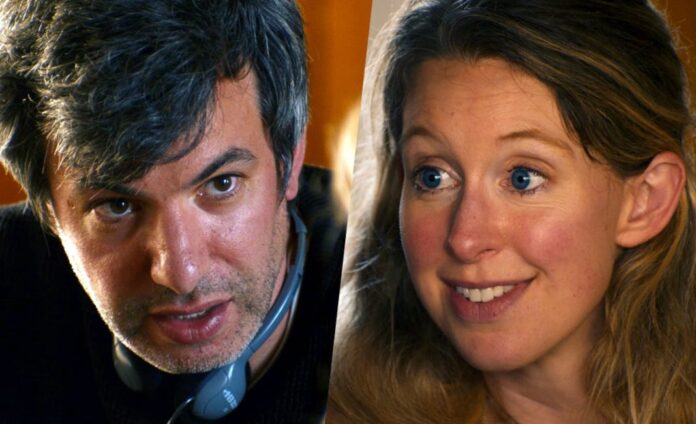
You Can See Everything is so surprising you should probably watch it yourself before reading this review.
It set my theatre abuzz. As soon as the lights turned on everyone was discussing and dissecting. This was past midnight, on a Monday, and yet the packed audience was completely engaged.
On a superficial level, You Can See Everything is a documentary about disgraced Theranos CEO and convicted fraudster Elizabeth Holmes. And on that level alone it’s outrageous enough.
Thirty-four days before her incarceration, Holmes and her partner, Billy Evans, invited an A24 documentary crew into their home, to “see everything.” The movie isn’t a re-litigation of Holmes’ crimes, which co-directors Lance Oppenheim and Nathan Fielder (who also plays a major role in front of the camera) assume the audience is already familiar with. Rather, it is a mind-bending experience of being immersed in the world of two people who live by deception. And it’s not a meaningless detail that these manipulators happen to be from the ruling class.
Both Holmes—who once graced the covers of Forbes and Fortune as the next tech-world wunderkind—and Evans—an independently wealthy hotel heir—are fascinatingly unhinged representatives of their class. It’s easy to pathologize them as narcissistic, controlling, and delusional, as many commentators have. But most importantly, they are bourgeois. Of course Holmes is entitled to sympathy, of course she “thinks differently,” of course she did nothing wrong. She is Special. And if you don’t believe her, all the resources at her disposal, including her ability to court documentarians, will be deployed to convince you.
The immediate success of this three-hour documentary can be attributed at least in part to the simmering anti-billionaire sentiments it tapped into. In the much-memed trailer, Holmes appears uncannily wide-eyed and alien. Anyone familiar with Nathan Fielder’s deadpan cringe comedy and elaborate high-concept bits came to the theatre expecting him to make a fool of her.
However, after weeks of living with Holmes, Fielder finds his better judgement faltering. His perception is bent; he knows Holmes is a proven liar, and yet he feels sympathy. It is suggested that perhaps Holmes is a genuine naïf, a victim of the men around her, or so literal-minded she doesn’t understand what she says.
This is when You Can See Everything morphs into a surprising exploration of narrative, manipulation, and truth. Holmes is not the subject after all, or not the only subject. This is a documentary about documentaries, and about a man struggling to nail down the truth. Layers of narrative fold over on themselves, illustrating and obfuscating at the same time.
Finally, in the end, it is revealed that Fielder himself withheld information, and who knows what else. He can’t be trusted. We didn’t see everything.
However, this is not a postmodern denial of truth. Fielder and Oppenheim never suggest that truth is relative. They deceive the audience, but then the mass of us are being deceived all the time, by the media, by the government, by the ruling class at large, the class Elizabeth Holmes represents.
The truth exists. It’s just difficult to see. We have to piece it together ourselves despite those who would deceive us.
Fielder’s admission at the end is not a clever twist for the sake of it. Rather, it demands we reexamine everything and think.
And if my theatre was any indication, that’s exactly what people are excited about.

