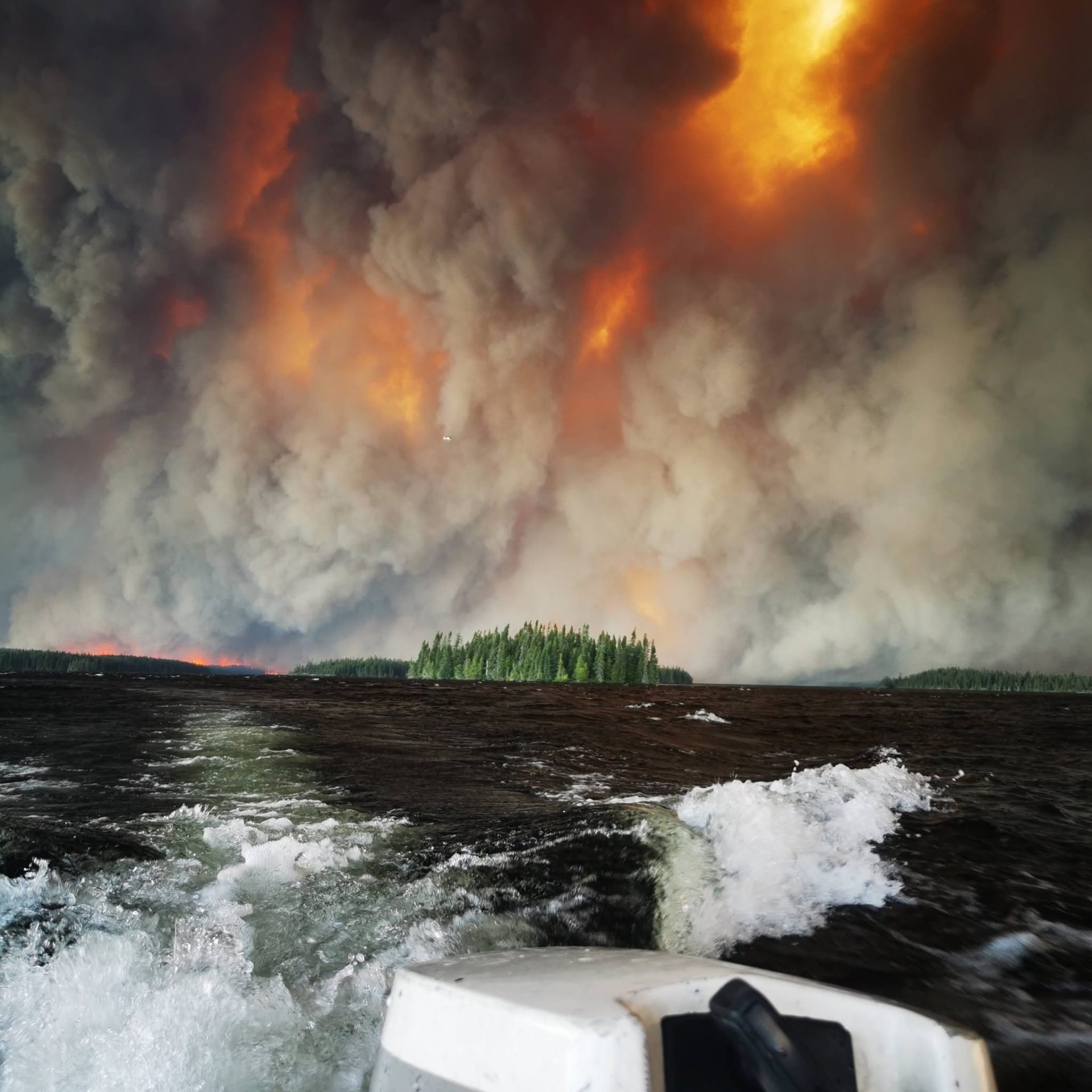
This year is set to be Canada’s fourth-worst fire year on record. In recent decades, not only has the frequency of wildfires more than doubled, but they have begun to spawn firestorms—extreme weather events never before seen in history, which are almost impossible to fight.
Firestorms are conflagrations so intense that they generate their own weather systems. They create their own wind and heat, which makes them burn hotter and sends embers or lightning kilometres ahead, creating new fires and fuelling the storm. This makes them qualitatively more powerful than regular wildfires.
Capitalism is squarely to blame for this horrific phenomenon. It is the capitalists who have pumped greenhouse gases into the atmosphere for over a century, despite knowing virtually the entire time what it was doing to the planet; it is the capitalists who have created the conditions for this monstrous new type of wildfire.
As global temperatures rise, the surface of the planet gets drier—meaning that not only do forests burn more easily, they burn faster and hotter too. And when a wildfire gets big and hot enough, a firestorm appears. The wildfire’s massive smoke plumes create clouds that stretch high into the atmosphere. These fire-generated storm clouds create weather that can only be described as hellish. For example, the 2003 Canberra firestorm spawned the world’s first “fire tornado”. In 2016, the Fort McMurray fire dropped flaming black hail.
By generating their own weather systems, firestorms burn incredibly hot and spread incredibly quickly, becoming impossible to suppress with any of the wildfire fighting methods that currently exist. While in the past, firefighters could hope for rain or a lack of wind to help put out a fire, firestorms burn up to 1,200 °C—hot enough to melt copper, meaning water evaporates before it can even touch the flame. As one firefighting account from the Bald Range fire this year explained, “fire behaviour was so extreme that helicopter bucketing was virtually useless.”
Firestorms produce lightning strikes meaning they can jump over firebreaks, areas of land with flammable material cleared away. In some cases, they even generate superheated, upward gusts of wind and thick layers of smoke which make aircrafts impossible to use at all.
But just because they’re impossible to suppress once they arise, doesn’t mean no action can be taken to prevent them. Fire ecologists and firefighters are calling for better forest management. This could reduce wildfires by up to 72 per cent, which would stop the fires before they could spawn firestorms.
Wildfire fighting can also put out small fires before they become firestorms. But currently, the Canadian ruling class is not even keeping up with the current wildfire fighting needs—despite Canada being home to some of the worst wildfires to ever exist.
As it stands, the federal government leaves coordinating the scattered firefighting resources largely in the hands of the provinces, and as capitalism sinks deeper into crisis, firefighting budgets have been slashed.
In Ontario, that meant slashing the 2025 provincial firefighting budget by tens of millions of dollars. Similarly, the government of Alberta had been cutting wildfire fighting resources since 2016, only to be forced to increase it after the devastating wildfires of 2023. Due to this underfunding, companies are holding back on the production of waterbombers, leading to shortages of this vital equipment.
This chronic underfunding has led provinces to consistently go over budget when faced with out-of-control fires. For example, Saskatchewan put less in its wildfire fighting fund than it actually spent fighting the fires last year: $140 million compared to last year’s $392 million. Ontario also ended up spending double its 2025 budget fighting fires. Using emergency “surge funding” rather than preparing ahead of time is known to dramatically weaken the firefighting response.
Capitalist politicians are well aware of this, but continue to underfund the fire departments, simply hoping that the fires will spare them. “Hopefully, we don’t have the kind of year we had last year,” the Saskatchewan finance minister said. Instead of investing in preparedness and prevention, emergency burst funding is spent on flying in hundreds, or even thousands of firefighters from other provinces and countries like Australia and Mexico to make up the shortfall. As fire seasons get worse across the globe, this will only become increasingly insufficient.
But this is the type of extreme shortsightedness that we can expect from the managers of a system in crisis: refuse to acknowledge reality, cut the budget, finally increase it, but never invest to prevent or prepare. Yet the latter is the only possible response to firestorms, since they cannot be suppressed.
This means that capitalism has created a crisis that it is fundamentally incapable of responding to. By its very nature, capitalism is anarchic and unplanned, meaning it simply cannot prepare for weather catastrophes. Worse yet, because of the deep crisis of the system, it cannot stop exacerbating the problem. The ruling class demands cuts to anything that is not profitable—including money for firefighting—and scrambles full-steam ahead for whatever is profitable—which includes fossil fuels. That is why Carney recently called it “too expensive” to meet our climate targets, while laying out a plan to boost oil and gas production.
What is needed is socialism—a rationally planned system in which all of the resources of society can be brought together and planned. With this, we would be more than capable of fighting wildfires and preventing firestorms. We could invest billions in preparedness, detection and evacuations where necessary, billions in systematic forest management, and billions more in a well coordinated national fire department. Already, the Canadian Association of Fire Chiefs is demanding $4.1 billion to create a National Fire Administration which could coordinate fire prevention and suppression nationally. Socialism would simply bring this to fruition.
A rationally planned economy would also allow us to deal with the root causes of climate change. We could shift our economy away from fossil fuels without any loss of jobs—retooling factories and retraining workers for other industries such as in renewable energy sources. All of this is absolutely possible with the working class in the driver’s seat. But capitalism will never achieve it, because it is not profitable.
As John Vaillant, author of the 2023 book Fire Weather, put it, “fire has no heart, no soul, and no concern for the damage it does, or who it harms. Its focus is solely on sustaining itself and spreading as broadly as possible, wherever possible.” In other words, capitalism has created a monster, but like a mad scientist, it has created it in its own image and is powerless to stop it.

