
“This is Canada working.”
That’s how Mark Carney triumphantly described the agreement for a new pipeline he signed with Alberta premier Danielle Smith on Nov. 27.
In the memorandum of understanding (MoU), the federal government promises to support the construction of a pipeline from Alberta’s oil sands to the northwest coast of British Columbia. Carney will designate it as being of “national importance” so that it can circumvent regulations under the new Building Canada Act—specifically, the ban on oil tankers in B.C.’s rough northern waters. In the meantime, the government will lift greenhouse gas emission caps and clean energy regulations on Alberta—something the oil barons have long been asking for.
At the signing, Carney and Smith gleefully talked about “nation-building” and a “new relationship” between Alberta and Canada.
However, far from showing Canada working, what the agreement really demonstrates is all the ways that Canadian capitalism does not work.
What pipeline?
The agreement specifies that any pipeline must have a private proponent in order to move ahead. Currently, none exists.
That’s not surprising, given that recent attempts at building pipelines have been lengthy, controversial, fraught with conflict, and grossly over-budget. Meanwhile, oil prices have been declining, and are projected to dip even lower in 2026. Investment in oil and gas in Canada has dropped dramatically over the years, from $80 billion in 2014, to about $35 billion now.
The point of the MoU is to try to turn that around and attract investment. It signals to the oil bosses that the Canadian government is willing to remove as many obstacles as possible, starting with headline environmental policies from the Trudeau era.
None of this changes economic reality, though. Private oil companies are predicting a sizable decline in global demand for oil in the coming period. In China specifically, the market that a new pipeline would largely be used for, demand is expected to peak in 2030—a year after Albertan officials optimistically think pipeline construction can begin.
The fact is that any pipeline is unlikely to be built without heavy government involvement. Smith has estimated that the project will cost around $20 billion—but that’s only an estimate. We need only remember that the Trans Mountain pipeline started with an estimated cost of $7.3 billion, but then needed the government to step in and carry it over the finish line as costs ballooned. In the end it cost tax payers $35 billion. It is likely that if the hypothetical pipeline ends up getting built, it would be a similar boondoggle.
Team Canada?
But even with the government providing all of the funding for a pipeline, it still would face massive hurdles.
For starters, Carney negotiated the deal with Smith behind the back of B.C. Premier David Eby; that is, the premier of the province where the development would take place. This has pissed off Eby as well as many other politicians from British Columbia—including members of the federal Liberal caucus!
One anonymous MP called the MoU “really dumb”. In response, Energy Minister Tim Hodgeson reportedly told off the B.C. caucus, calling them “naive” and chastising them for being “boy scouts”.
But at least Carney doesn’t need to worry about Alberta separatism anymore, right? Afterall, the obvious elephant in the room is the brewing separatist movement in Alberta (and to a lesser extent Saskatchewan), resulting from the popular sentiment that the federal government stands in the way of developments that will benefit Alberta—in particular pipelines. The fact that Carney negotiated the deal with Smith and involved the Saskatchewan premier Scott Moe—but not the B.C. premier—shows that his principal concern was helping to assuage the separatist mood in Alberta and Saskatchewan.
Danielle Smith, who has played on this mood for political purposes, was confident that the deal would help undercut separatist sentiment.
But, while Carney got a standing ovation at the Calgary chamber of commerce, the reception has not been the same among the separatist ranks of the United Conservative Party. Two days after the MoU was announced, Smith was booed by the UCP conference when she referenced the MoU saying, “I hope people today feel a lot more confident that Canada works.” They then gave a standing ovation to separatist Jeffrey Rath when he asked, “how many of all of us favour a free and independent Alberta?”
And that’s not the only independence movement that Carney has to worry about. The sidelining of British Columbia is ringing alarm bells for Quebec politicians, who fear the same thing might be done to them. Bloc Québécois leader Yves-François Blanchet has promised to fight for BC’s right to refuse any pipeline project.
As Steven Guilbeault, who resigned from Carney’s cabinet over the environmental impact of the MoU, said, “Frankly, by going so far to please the Alberta government on this MOU, he is fueling another separatist movement in my home province of Quebec. And in Quebec, it’s not a nascent movement, it’s an organized political party that has won elections, that has done two referendums to separate from Canada.”
With the Parti Québécois leading in the polls by 20 per cent and pledging to hold an independence referendum if they win next year’s provincial elections—that’s no small concern for the Liberals.
When Carney talks about “nation building,” he probably doesn’t mean independent nations of Quebec and Alberta.
Collision course with First Nations
The MoU between Smith and Carney has also reignited anger among Indigenous groups.
Chief Na’Moks of the Wet’suwet’en First Nation called the deal “colonial violence masked as ‘economic development’,” stating that they “will not be collateral for private profit.” An alliance of Coastal First Nations have signed a statement stating that a “north coast pipeline will never be built.” Similar statements have been made by First Nations leadership bodies in B.C. Heiltsuk Nation Chief Marilyn Slett pledges that they “will use every tool in our toolbox to ensure that this pipeline does not go ahead.”
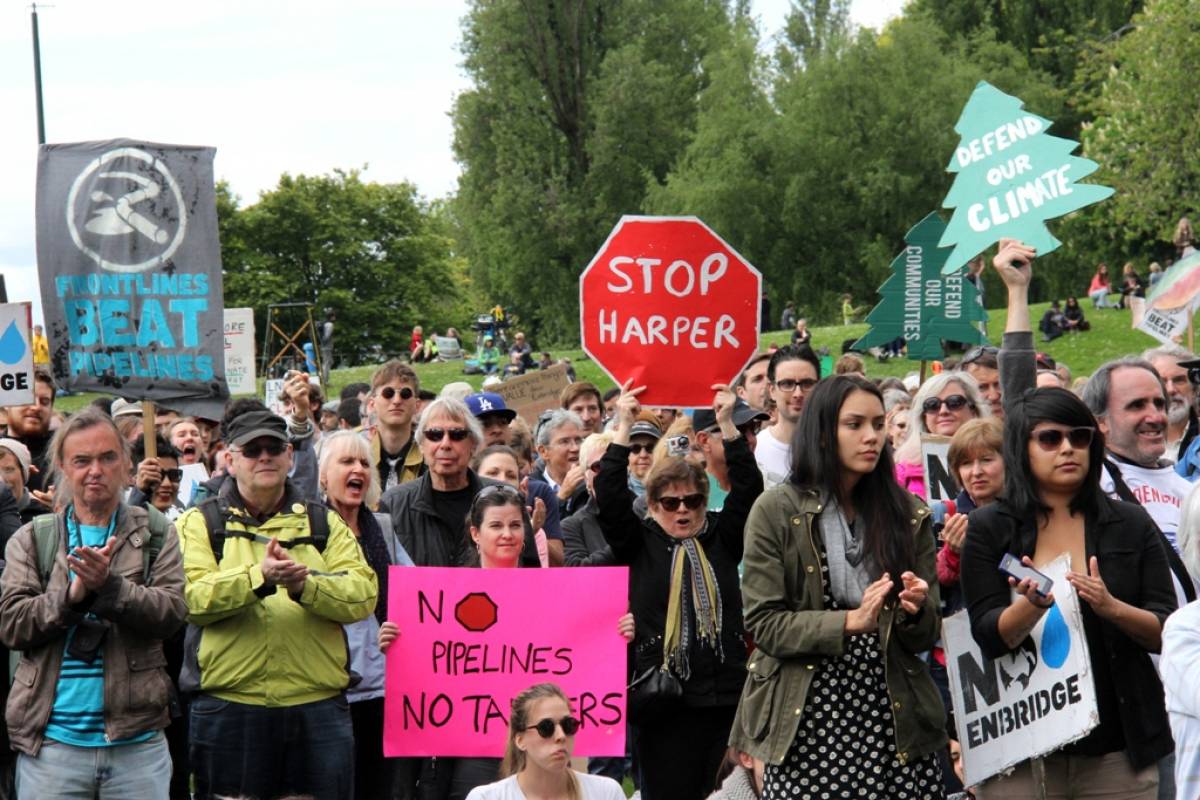
One major sticking point is the oil tanker ban which has been in place since 1972. If a pipeline is going to be viable, the tanker ban will need to be lifted. But the whole reason the ban was put in place is because the waters of northwest B.C. are rough and dangerous, making an oil spill very likely. A spill runs the risk of destroying the salmon fishery there, and the entire way of life of First Nations in the region.
Unsurprisingly, the MoU talks about making the “appropriate adjustment” to the tanker ban. But B.C. premier David Eby has described the idea of exemptions to the tanker ban as being “like explaining to a vegetarian that they’ll still be a vegetarian if they eat a few steaks.”
Equally, the Coastal First Nations have been clear, stating, “We will never tolerate any exemptions or carveouts, period.” This has been made more significant by a British Columbia court ruling in September which stipulated that the Haida First Nation had authority over the Archipelago of Haida Gwaii and the surrounding waters. That sits smack dab in the middle of the tanker ban area. It will be impossible to lift the tanker ban without violating the court ruling and the control of the Haida over their land and waters.
Smith and Carney have of course both paid lip-service about the need to consult Indigenous groups—but Indigenous groups aren’t looking to be consulted, they are explaining that no project can go ahead without their consent, which they do not give.
While Carney talks about reconciliation and consultation, he is preparing the bourgeois state with the necessary tools to ram through a pipeline project, using violence if necessary. That is why Bill C5 was rushed through the parliament over the summer. The bill gives the government extraordinary powers to ignore legislation protecting the environment and Indigenous rights. In order to enforce it, Carney has also increased funding for the RCMP.
Far from uniting the country, a new pipeline could turn into a flashpoint for struggle against the Canadian state, as the struggle of the Wet’suwet’en against Coastal Gaslink pipeline did in 2020.
Pipe dreams
Mark Carney came to power on the back of a whole slew of big promises. He promised to build “one Canadian economy” and to turn Canada into an “energy superpower”, as well as re-orient the economy away from the United States.
The pipeline memorandum is presented as a step towards these goals. But at every turn, the problems facing Canadian capitalism come to the surface. From the capitalists’ reluctance to invest, to incessant provincial divisions, to Indigenous resistance against violations of their rights, the ruling class in Canada faces immense challenges.
In order to overcome these challenges, the ruling class will be forced to shed the smiling face and instead adopt the mailed fist.
The world order is collapsing and Canada has lost its privileged position. No longer able to rely on cozy trade relations with the United States, the Canadian ruling class desperately needs to find a way forward. With productivity stagnating, the government is scrambling to make Canada a profitable field of investment, which requires making it cheaper to do business here. That means getting rid of regulations and delays, steamrolling opposition to development, and driving down the cost of labour.
In other words, they are preparing to sacrifice the environment, Indigenous rights, and the conditions of the working class on the altar of profit.
Whether they will get away with it is up to us. The working class must revive its revolutionary traditions and challenge this reactionary capitalist agenda head on.

