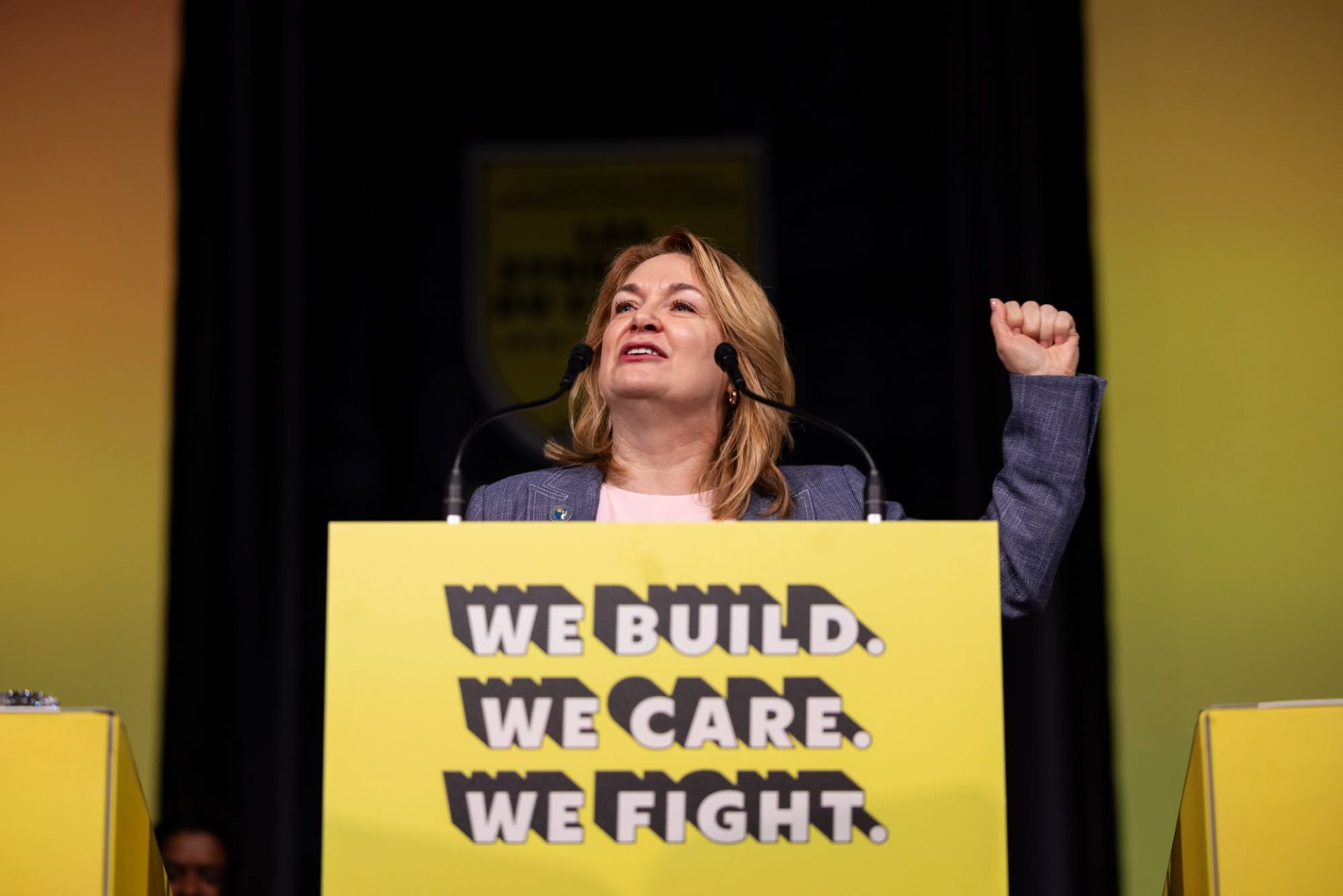
The 31st convention of the Canadian Labour Congress (CLC), held in May, unfolded at a pivotal time. The Canadian economy is teetering on the edge of a major crisis, and the working class is coming under unprecedented attacks. And yet, the most notable aspect of this convention was how little the leaders of the largest union federation in Canada had to offer in terms of solutions.
Failing to meet the moment
With workers staring down the barrel of a historic crisis of Canadian capitalism, the need for the CLC to serve as a fighting organization has never been greater. Caught between the vice grip of stagnant wages, overwork, rising unemployment, inflation and debt, many families are reaching a breaking point.
If this isn’t bad enough, the Carney government is dead-set on making the working class foot the bill for this crisis through cuts to social services, privatization of public infrastructure, mass layoffs of public employees, and attacks on the right to strike.
Faced with this situation, the meeting, which gathered over 2,000 delegates and guests from unions across Canada, expressly aimed to “organize, strategize, and show the power of workers coming together.”
Throughout the convention, six separate action plans were discussed. Each action plan had a punchy title—“We Fight for Democracy”, “We Build the Future”, “We Build Worker Power”, etc.
However, as the details of each plan were presented, it became clear that the so-called “action” was confined to lobbying efforts on Parliament Hill, lawyering efforts in the courts and mobilizing the vote in elections. The role that the CLC’s three million affiliated union members were to play in any of this, aside from getting out to vote once every few years, was unclear, to say the least.
For example, the “We Fight for Democracy” plan correctly notes that the popularity of far-right demagogues like Trump and Poilievre is rooted in “working-class insecurity, inequality and resentment toward a cross-party political consensus that long ignored working-class needs and interests.” But the only solution this plan proposes is to lobby the same institutions of the capitalist status quo, the very cause of the problems of the working class, in the vain hope of pushing them to embrace what it calls “worker-centered economics”.
In the “We Build the Future” plan, a call is made for an “integrated industrial strategy aimed at building up Canadian physical infrastructure … and generating good, union jobs … [through] public investment.” And yet nearly nothing is mentioned about the exodus of good, unionized jobs that the auto, steel and aluminum sectors are facing, nor the nearly 100,000 unionized federal civil service and postal worker jobs on the chopping block. Worse still, no action is proposed to fight back against these mass layoffs.
Finally, despite acknowledging in the “We Build Worker Power” plan the routine violations of the right to strike by federal and provincial governments in recent years, the CLC’s only plan is to continue challenging these violations in the courts. This approach thus far has not stopped the right to strike from being violated.
And while one would think that the two times when these back-to-work orders have been defied and defeated—first in 2022 by the Ontario education workers and then in 2025 by the Air Canada flight attendants—would be studied to provide the blueprint for future struggles, they are not even mentioned in the plan!
Across all of these action plans, there was virtually no mention whatsoever of the need for strike action, picket line support, or cross-union solidarity strike action to advance workers’ interests. The question of workers taking action to stop factories from being shut down by occupying them was not discussed, nor was there any clear call to take industry into public ownership.
Faced with a dire situation, the proposals from the CLC leadership failed to meet the moment. Instead, they seemed content to stick their heads in the sand, and to continue using the failed methods of the past.
Appetite for a general strike
Throughout the week, expressions of discontent with the leadership’s approach were on display. From one action plan to the next, speakers lined up at the mics, stating that these plans do not go nearly far enough, and that asking the government nicely to do the right thing has simply not worked. Notably, this took the form of recurring calls from the floor to organize general strikes.
The loudest ovation of the week came from a contribution made by Ontario Public Service Employees Union (OPSEU) leader Sara Labelle. She argued that the creeping advance of privatized two-tier healthcare needs to be stopped in its tracks with the threat of general strikes.
OPSEU President J.P. Hornick echoed this the next day by stating that “we’re in the middle of a damn class war,” and calling to prepare a general strike movement.
As rank-and-file CUPW delegate and RCP member Robert Hohnstein argued at the convention, preparing explicitly for general strike action is the only way to truly build workers’ power today. As he explained, this year marks the 50th anniversary of the only pan-Canadian general strike in history, which the CLC itself organized in 1976—the CLC did it once, it can do it again.
There is clearly an appetite for militant action, as workers see their wages and working conditions being battered.
These calls for general strikes are positive, but this is not the first time they have been made by provincial union leaders.
Last year, president of the Alberta Federation of Labour Gil McGowan made a big fuss about a general strike, and had significant popular support for it, before snuffing out the idea. The leaders of the FTQ and CSN, the largest union federations in Quebec, both peacocked on the biggest talk-show in the province, talking about organizing a “social strike” in response to government attacks on union rights… and then never mentioned it again.
Judging by the track record, it appears that these leaders may have made these militant statements more as a result of pressure from below, and out of desire to appease the sentiment among their ranks for a real fight, rather than to actually lead one. Now these words must be translated into action, otherwise they are just so much hot air.
Out-of-touch
The reality is that the problem goes beyond bad leadership at the head of the CLC. The problem is one of outlook and ideology.
For the leaders of the CLC, the bosses and government are not enemies but partners. The fact that they systematically attack workers is just the result of a confusion that can be remedied through lobbying to make sure workers’ interests are included in government policy-making.
This outlook is a product of the post-war boom and the social contract it created. When Canadian capitalism was booming, the ruling class could afford to concede higher wages and other reforms in order to purchase class peace. This created the illusion in the minds of these labour leaders that the interests of the bosses and the workers could be reconciled, and that peaceful class collaboration and backroom negotiations were the way to go. They were systematically roped in, bought-off and co-opted by the bosses, to serve as their agents within the labour movement.
In reality, the interests of the workers and the bosses are fundamentally opposed. The profits of the capitalist class are obtained through the exploitation of the workers. They are rich because we are poor. And now that the post-war economic boom is a distant memory, the basis for that social contract has disappeared.
The capitalist system has entered a prolonged period of crisis. The bosses are on the offensive, clawing back every concession, every reform of the past. They are aiming to plunge entire sections of the working class into destitution and hyper-exploitation.
Meanwhile, the labour leadership are holding on firmly to their illusions in the capitalist system and clutching to the worn-out rulebook of class collaboration, despite the ruling class not returning their calls in years. As one guest on a panel discussion said, “we need to get our shit together (…) we play by the rules, but they are nowhere near the rulebook we play with.”
Indeed, the labour movement needs to get its shit together. The class war is back in a big way, and the labour movement will only start to gain victories when it starts waging a war back. But this requires shedding its illusions in this system, and fighting for a socialist program.
Status quo maintained… for now
Despite the expressions of discontent with the status quo at the convention, this sentiment did not coalesce into a real organized opposition with a clear program. The furthest it got was the near-defeat for the final action plan, “Building Workers’ Power”, with 40 per cent of delegates against. A continuity slate for the CLC executive was elected at the end, without any opposition.
As a result, the status quo has been maintained. Faced with the crisis of our lifetime, the labour leaders of the largest federation have plugged cotton in their ears, not wanting to accept what is happening around them.
But it’s only a matter of time before the discontent finds an expression. The deepening crisis of Canadian capitalism means open class warfare is on the agenda. And try as they might to ignore it, the labour leaders will be forced to address this situation or be elbowed to the side by fresher elements who are prepared to take the fight to the ruling class.
The Canadian labour movement, which has long been dormant, will be shaken from top to bottom in the coming period. Out of this situation, the Revolutionary Communist Party aims to build the leadership that our class deserves. If you are upset with the state of the labour movement and want to build real workers power, join the RCP!
Smothering democracy
The CLC’s subservience to the bosses is particularly egregious on the question of solidarity with Palestine. While some delegates tried to mobilize the labour movement against Israel’s genocide, their efforts were undemocratically smothered at the convention.
A resolution was submitted which would have committed the CLC to “work with relevant unions to declare arms shipments to Israel to be ‘hot cargo’, not to be touched by workers of conscience.”
Such hot cargo resolutions have been passed by four provincial labour federations (in Ontario, New Brunswick, Nova Scotia and Newfoundland), two national unions, four municipal labour councils, and many more union locals. The tactic of workers’ boycotting shipments is also a tactic with a real history in the Canadian labour movement. In the fight to stop the ongoing program of ethnic cleansing by the Zionists in Gaza, the West Bank and Southern Lebanon, aided and abetted by Canadian arms manufacturers, this boycott could have a real impact.
Faced with the resolution’s momentum, the CLC leadership moved to stop it in its tracks. An unelected resolution committee blocked the resolution, preventing it from even reaching the convention floor.
The working class is international, and the fight against the capitalist class is an international fight. International solidarity with workers and the oppressed is not only a longstanding tradition of the labour movement, but one of its basic tasks. Shame on the CLC leadership!

