After decades of austerity and underfunding, everybody can see that public services are cracking. And yet, the cold logic of capitalism demands another pound of flesh.
This is the conclusion of a new report from the Institute of Quebec (l’Institut du Québec, IDQ), based on the budget framework presented by the CAQ last March. Citing figures, the report explains that “the worst of the cuts is yet to come”. A period of austerity and class struggle is opening before us.
Couillard: Small potatoes
On March 18, without much fuss, the CAQ presented what will surely be their last budget. It plans for a reduction of the government deficit until the books are balanced in 2030.
However, the report of the IDQ explains what wasn’t said out loud: for this to happen, there must be drastic cuts.
To simply maintain services, an annual increase of 3.7 per cent in public spending would be needed, according to the IDQ. However, the CAQ is planning an increase of just 1.5 per cent per year—less than inflation.
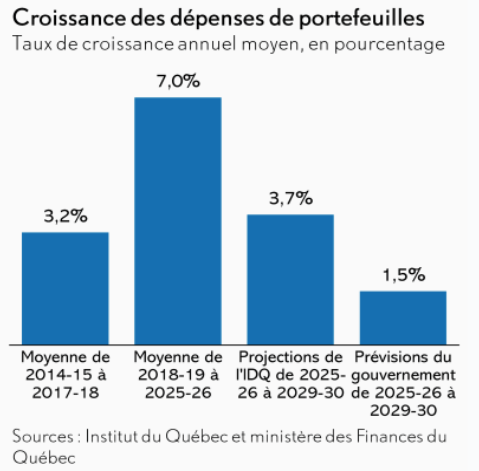
This means that all sorts of services will be underfunded or cut. The report says that it is “highly unlikely that such a drastic turn won’t affect the quality of services and the integrity of the core functions of the government.”
The portrait only gets more troubling when we compare it to the increase in department spending during Philippe Couillard’s Liberal government of 2014 to 2018.
Even though that government imposed brutal austerity, department spending still increased by 3.2 per cent on average—more than double the current estimate!
The inevitable conclusion is that if the government of Quebec does not change its trajectory, it is heading towards an unprecedented dismantling of the welfare state.
Consensus
As the CAQ prepares to be ousted from power, it is easy for them to pass on their wildly unpopular decisions to the next government. What then do the frontrunners have to say?
Charles Milliard, the leader of the Quebec Liberal Party, says that he will ask Quebecers to “be more rational about the state of public finances.” He said he wants to restore a balanced budget in his first term—which means complying with the austerity framework that the CAQ presented last March. Like we have already seen, this will mean some of the deepest cuts in history.
The Parti québécois, when asked, remained vague. Their leader, Paul St-Pierre-Plamondon, spoke about reducing state “bureaucracy”, making civil service “more efficient” and admitting that “difficult choices” will need to be made to maintain “the core functions of the government”.
He did not go so far as to mention austerity or a balanced budget, but not stating the truth openly is par for the course for bourgeois politicians. He is staying vague in order to signal to the capitalist class that he is a “responsible” manager of capitalism, without using the unpopular A word.
Incidentally, he uses almost the exact same language that the former PQ leader, Pauline Marois, used before she took office in 2012. And once in office, Marois imposed austerity measures, raised tuition fees, crushed the construction workers’ strike through back-to-work legislation, and granted generous tax breaks to major investors.
Dictatorship of the banks
It is not impossible that the next government delays implementing austerity and chooses to rack up more public debt, to avoid becoming instantly unpopular. But what would result?
The report warns that the accumulation of further deficits “would increase the net debt burden” and significantly raise debt service costs. In other words, Quebec would have to repay a larger debt, with interest.
Debt servicing in Quebec is already at $10.2 billion—billions that will line the deep pockets of a few bankers, instead of repairing our schools, roads, and hospitals. The rich have us by the throat through student debts, mortgage payments, and at every level of government.
According to the IDQ, if the next government delays balancing the budget, debt servicing will surge from $10.2 to $13.2 billion between 2025-2026 and 2029-2030, “increasingly diverting resources away from essential services.”
And this doesn’t even take into account the little dictators of finance who control credit scores. Downgrades in credit ratings from agencies like Moody’s or Standard & Poor’s reflect the “lack of confidence” in the capacity of a given government to repay. They result in increased interest rates on public debt, creating a vicious cycle of debt.
It is worth noting that Standard & Poor’s downgraded Quebec’s credit rating in 2025, in response to the CAQ’s record deficits. This could happen again, thereby increasing debt service even further. The IDQ study does not even take this scenario into account.
There will be no escaping the facts for the next government: there will be less money for services, one way or another.
Capitalism
Like we explained in a recent article, the trade union leaders must begin to organize a real movement against the attacks of the bosses’ parties. It is not the responsibility of the workers to pay for the crisis through deeper austerity.
But beyond the necessity to fight austerity, the question remains: what is the alternative?
The only party that refuses the logic of austerity is Québec solidaire. QS proposes instead to tax the millionaires to “reduce the deficits without cutting services.”
The Alliance du personnel professionnel et technique de la santé et des services sociaux (APTS), the health sector union, agrees wholeheartedly. They put forward a proposition to tax the rich that would allow the state to reap an additional $6.5 billion in revenues. Their president asserts in the same breath that austerity is a “political choice.”
There certainly is an element of “choice.” Governments always find hundreds of millions for the rich (Northvolt, Bombardier, etc.), but only have crumbs for the workers and public services. It will always be the workers who foot the bill for the crisis of public finances, while the bosses are treated like royalty.
But does this mean that austerity is simply a “choice” on the part of the government?
In reality, austerity flows from the logic of capitalism. The system is mired in a deep crisis. Economic growth is anemic, productivity is in the gutter, and this gloomy climate means a lower income for the state. For decades now the government has been borrowing in order to keep the system on life-support. Debt is racked up without an end in sight, and the banks will demand to be paid back eventually.
At the same time, because of the crisis, the capitalist class demands that the government creates an “economic climate” that is “favourable to investment.” In other words, they are precisely requesting that their taxes be lowered. The crisis is leading to increased competition among countries to attract investment. This pushes them to offer gifts to companies in the form of grants or tax breaks. This is why the CAQ lowered corporate taxes in Quebec, which are the lowest in both Canada and the United States. This also means less money for public services.
The next government, whether it be the PQ or the Liberals, will act according to this capitalist logic, and it is futile to try to convince them to make a different “choice.” But, even in a hypothetical scenario where the government breaks with the logic of austerity by, for example, taxing the rich, they would inevitably run up against the implacable hostility of the capitalists, who would have a field day moving their money to tax havens, halting investments, and offshoring production. And this, in the context of a trade war with the United States which has already started to provoke capital flight from Canada.
Capitalism in Quebec is in crisis. Whether the PQ or the Liberals win the next election, a period of austerity opens before us—and thus, equally, a period of class struggle against such attacks.

