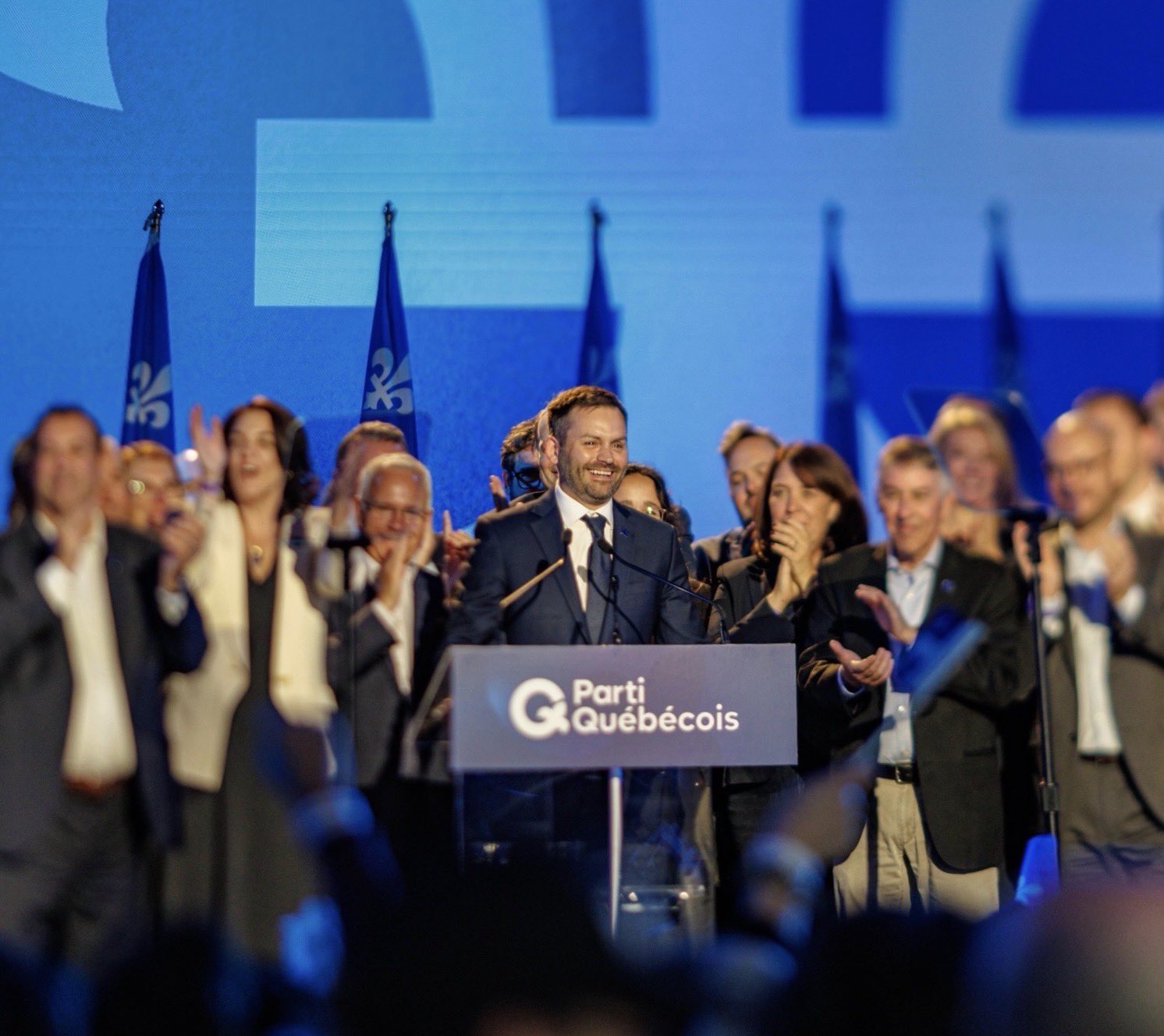
Radio-Canada political analyst Alec Castonguay summed up the Quebec election well a few days ago: “It’s a bit like hospital food: you know you have to eat it, but it’s not very inspiring.” This certainly echoes the sentiment of many Quebecers.
| Seats | Vote percentage | |
| Parti Québécois (PQ) | 59 (+56) | 28% (+13.4%) |
| Parti libéral du Québec (PLQ) | 40 (+19) | 24.2% (+9.8%) |
| Parti conservateur du Québec (PCQ) | 19 (+19) | 20.7% (+7.8%) |
| Québec solidaire (QS) | 9 (-2) | 12.4% (-3%) |
| Coalition avenir Québec (CAQ) | 0 (-90) | 13.3% (-27.7%) |
The Parti Québécois has experienced its anticipated resurgence, but there is no deep enthusiasm surrounding this new minority government. The PQ received the lowest percentage in Canadian history for a winning party. Its leader, Paul St-Pierre Plamondon (PSPP), is even less popular today than he was on the eve of the election campaign: 54 per cent of Quebecers have an unfavorable opinion of him, compared to 49 per cent two months ago!
The CAQ suffered one of the greatest political humiliations in Canadian history, falling from 90 seats in 2022 to zero today. This is a well-deserved fate for this party of careerists serving the interests of big business.
It is highly likely that this marks the end for the CAQ, as its remaining sovereigntist members will join the PQ, while the non-sovereigntists will end up in the Conservative Party (or the Liberals). The Conservatives are the only ones who can boast of having galvanized some enthusiasm—this will be discussed further down.
While we’re facing the most fragmented parliament in Quebec’s history, 118 of the 127 members of the National Assembly still agree on one thing—austerity is necessary. A period of instability, attacks on workers, and struggle lies ahead.
Vacuous election
Even “mainstream” commentators were forced to admit it: this election was vacuous. No “big projects,” no “big ideas.” This was particularly true of the four main contenders for power (PQ, PLQ, CAQ, PCQ), who were engaged in a contest to see who could cut the most public-sector jobs.
During an interview, PSPP was asked what his flagship promise was. Sovereignty? No. He replied: reducing government bureaucracy. How inspiring!
It was perhaps Charles Milliard, the Liberal leader, who most honestly summed up why this campaign offered nothing substantial: “People aren’t stupid. […] We can’t afford 150-page election platforms in 2026.”
From a capitalist perspective, Milliard is right. Capitalism in Quebec is in crisis. Quebec workers are struggling. And in these gloomy economic times, Quebec businesses are demanding a more favorable “business climate.” That is: lower their taxes and make life easier for them. So, there’s no question of taxing the rich to fund public services, let alone improve them.
And that’s not even considering the trade war, which will reduce economic activity in Quebec and will lead to job losses—further reducing government revenue. The PQ may be forced to implement even stricter austerity measures than expected.
The emptiness of this election reflects the deep crisis of the capitalist system, which leaves no room for “projects” or real progress for ordinary people.
Honeymoon?
François Legault’s CAQ enjoyed a long honeymoon period after its election in 2018. It had inherited large budget surpluses, allowing it to postpone austerity measures. Added to this was the COVID-19 crisis, during which Legault was able to falsely portray himself as the savior.
The PQ won’t have that luck. This government will face numerous problems.
PSPP will try to throw a few crumbs to the people in its first 100 days. The PQ talks about exempting used goods from sales tax, lowering the gas tax by seven cents per litre, and investing $100 million a year in food banks. But these half-measures will fall far short of lifting ordinary Quebecers out of their hardships, and will likely be insufficient to give the party any real momentum. Nor is there anything here to address the collapsing health and education systems.
The PQ also promises to abolish the office of lieutenant governor in Quebec (the representative of the British monarchy) within its first 100 days. This basic democratic move will undoubtedly resonate—and deservedly so. With all due respect to those who favor the status quo, the monarchy is rightly despised. To hell with these relics of the colonial past. The question remains as to how far the PQ will go down this clearly unconstitutional path—and what the federal government’s response will be. A constitutional crisis could erupt right from the start of this government’s term.
However, the core of the PQ’s platform remains potentially historic spending cuts. It proposes limiting spending growth to 1.9 per cent a year, which is less than during Philippe Couillard’s austerity era. If it sticks to this plan, it will mean cuts of $500 million in its first five months in office.
On top of that, the PQ has promised that all businesses will see their taxes cut by 20 per cent—a nice gift to bosses that will further reduce government revenue. Who will pay the price? It is the working class, in one form or another.
As we recently explained, four of the five parties lied during this election, denying that they would implement austerity. But the PSPP won’t be able to avoid the “A-word” forever.
The PQ may have to govern with the support of the Conservatives, who want to go even further down this path and who could make their support conditional on further cuts.
And all this while the PQ attempts to rally public opinion in support of a referendum. The PQ will face great difficulty in generating enthusiasm for a referendum while simultaneously implementing austerity measures that, once they take effect, will make the party widely unpopular.
PSPP has promised not to hold a referendum until after Trump leaves office, in 2029. But given the severe austerity measures on the horizon, he is highly likely to spark widespread public discontent before that date arrives. It is probable that his government will collapse before such an initiative is even launched.
Is there a ‘right-wing wave’?
The highlight of election night was undoubtedly the historic breakthrough by the PCQ, which elected 19 members of the National Assembly and secured 20.7 per cent of the vote.
It is the only party that is truly generating enthusiasm and has momentum. This is particularly evident in voter turnout: in the 19 ridings where the PCQ won, turnout was on average nine percentage points higher than the overall turnout.
How can this surge be explained? Éric Duhaime’s PCQ is proposing historic cuts of 47 billion in public spending. He proposes breaking with the “Quebec model” of a “strong state” and giving the private sector a greater role in healthcare in particular.
These proposals would certainly have devastating impacts on ordinary people, but it is precisely their seemingly “radical” nature that has allowed the Conservatives, in a distorted way, to tap into the thirst for change among a certain segment of Quebecers. The PCQ has presented itself as the only party proposing a break with the status quo.
By claiming that the other four parties wanted to defend the status quo of the “Quebec model,” Duhaime resonated with a large part of the population that is fed up with suffering while governments squander our money and fail to provide quality public services. The PCQ is capitalizing on the crisis of the welfare state in Quebec, which we have analyzed elsewhere.
The rise of the Conservatives, as well as the PQ’s sharp shift to the right, are sometimes presented as a “right-wing wave” surging for some obscure reason—a phenomenon over which we have no control. This is an illusion. The crisis of capitalism is leading to a questioning of the status quo and a rejection of the political centre, resulting in polarization not only to the right but also to the left.
There is widespread frustration with inequality in Quebec. Three-quarters of Quebecers want the wealthy to be taxed more. Young people, in particular, see that capitalism has completely failed to provide them with affordable housing. A recent poll even showed that young people in Canada are increasingly interested in socialism and communism.
But the only left-wing party, Québec solidaire, fails to offer radical solutions that could inspire enthusiasm among workers and young people. As a result, radicalization on the left finds no expression at the ballot box, and the picture is thus distorted, exaggerating the influence of the right.
QS rightly presented itself as the only “bulwark against austerity” and called for the defence of public services. But the party has been unable to present itself as a clear anti-establishment alternative that stands in stark contrast to the status quo.
Instead of explaining that capitalism is broken, the party actually gives the impression that it wants to make only certain modest and “reasonable” adjustments to the system. Ruba Ghazal has repeated many times that their wealth tax was budgeted “prudently,” and that it was simply a matter of making them pay their “fair share.” The overall impression is of a party that is afraid to rock the boat, that tries to win over the bosses rather than mobilize workers against them. It’s no wonder, then, that it is the right wing that is going on the offensive and moving forward with confidence.
The rise of the PCQ and the right’s dominance in the National Assembly are by no means inevitable. There is immense class anger in Quebec, which unfortunately has not yet found a clear form of expression.
Instability on the horizon
The demise of the CAQ marks the beginning of a new era of instability. No party currently enjoys broad support. It is impossible to predict the full parliamentary arithmetic of the coming term. But all indicators point toward austerity, in one form or another.
The labor movement must prepare for the struggle. Let’s remember how the PSPP denounced the STM strike and boycotted the FTQ convention last fall. This government is not on the side of the workers.
And yet, union leaders seem to be doing everything they can to ensure the movement is as unprepared as possible for the attacks on the horizon. The FTQ is calling on the PQ to agree to “social dialogue.” The CSN speaks of “respectful debates and exchanges” with the government. The president of the CSQ (a teachers’ union), for his part, reassures the PQ that “we are not seeking confrontation.” Instead of preparing workers for the austerity measures to come, they are lulling the labour movement to sleep.
For more than forty years, Quebec workers have endured one setback after another, and this will continue. The era of major reforms that improve workers’ lives is long gone. The younger generation will live in greater poverty than their parents.
But this crisis of capitalism will push workers to take up the struggle. Let’s not forget the glimpse we got of this with the “Communautaire à boutte” movement last spring, when tens of thousands of workers mobilized against the meager funding of community services. Other sectors of the working class will join the struggle in the coming period against the austerity measures on the horizon.
What is missing, however, is a force that explains how the crisis of the “Quebec model” and austerity stem from the crisis of capitalism—a system incapable of advancing society. It is this vacuum that the Revolutionary Communist Party is working to fill. We invite all those who want to fight to overthrow capitalism to join us in this task.

