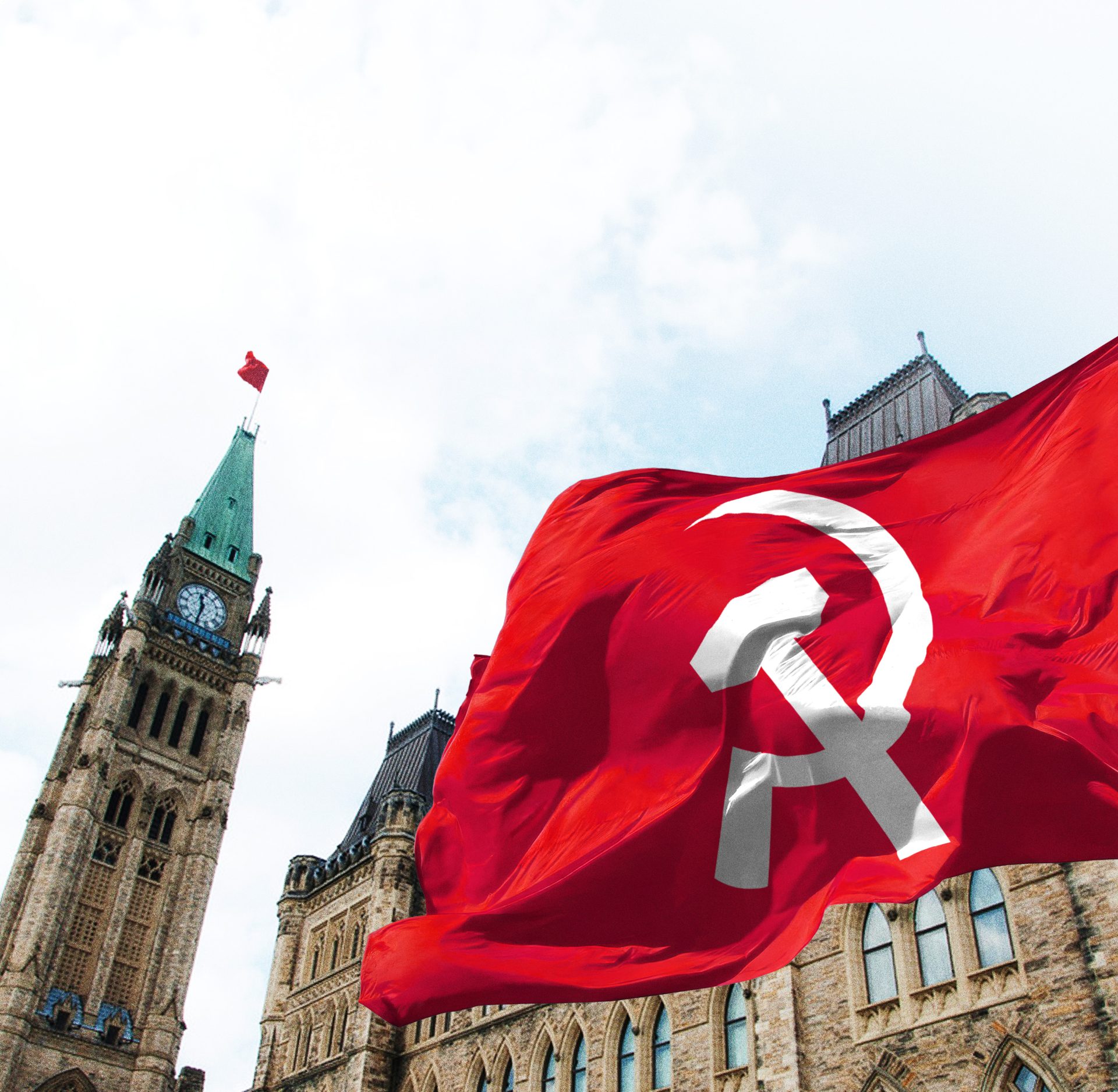
Not long ago, the idea of a communist revolution in Canada would have met with either outrage, disbelief, or a fit of uproarious laughter from virtually every corner of the country—and often a combination of all three. Canada, it was believed, was no better suited to Marxism than socks were to sandals.
No longer. In a July 2026 poll by Abacus Data, 26 per cent of those aged 18–29 said they have a positive view of communism—only four points shy of those with a similar view of capitalism (30 per cent). When asked about their thoughts on “socialism” and “democratic socialism,” the numbers crept even higher—tallying 39 per cent and 43 per cent, respectively.
Even among the general population, nearly as many people view socialism positively (29 per cent) as do capitalism (33 per cent)—while communism earns the approval of a still impressive 12 per cent of Canadians aged 18 and over, or some 4 million people. In the same poll, 41 per cent of respondents agreed that Canada’s economic system is either in need of “major changes” or needs to be “completely changed.” These are numbers that would have seemed unthinkable a few decades ago.
In short, while communism and socialism are still far from enjoying universal support, the idea of a collective and radical rehaul of society is considered a real option by a large minority for the first time in generations—particularly among the youth.
But what would it mean for Canada to actually “go communist”? Could such a thing really work? And furthermore, is such a drastic move even necessary?
The dead end of capitalism
Marx once argued that no economic system is replaced by another before the first has exhausted its potential to develop the conditions of life. In this respect, capitalism in Canada has long since reached its sell-by date.
Canada is a country endowed with abundant resources, developed industry and a highly educated population. Despite this, one in four Canadian families is considered “food insecure”—meaning they worry about running out of food during the week, or go days without eating. Close to 6 million Canadians do not have a family doctor, in part due to shortages in the profession. These figures may help to explain why life expectancy has largely stalled in Canada and, in recent years, even fallen—the first such reversal in generations.
Capitalism not only fails to provide the necessities of life—increasingly, it even fails to provide the ability to work. In Canada today, close to 1.5 million people looking for jobs are unemployed, or over 6 per cent of the workforce. However, among youth, that figure is closer to 15 per cent, and reaches as high as 20 per cent in cities like Toronto and Windsor. Canada’s youth face recession levels of unemployment—but at a time when the economy is technically growing.
The problems facing Canada are not just the fault of this or that government. In the final analysis, they stem from the inability of the country’s capitalists to develop the productive forces—things like machinery, technology and technique—to the same degree as they did in the past. Marx long ago explained that a system which fails to raise its productive capacity would also struggle to provide the necessities of life—and so is eventually doomed.
In Canada, productivity growth has been on a steady decline since the middle of the 20th century. The 1960s delivered an impressive growth rate of 3.6 per cent per year. However, it later dropped to 2.1 per cent in the 70s, 1.4 per cent in the 80s, 1.07 per cent between 2000 and 2019 and a measly 0.47 per cent between 2020 and 2025.
Between 2014 and 2025, GDP per capita grew by only 0.5 per cent per year—the worst rate of growth over a 10-year period since the Great Depression. Business investment per worker fell over the same period—another feat only matched during the 1930s.
In recent years, Canada has at times recorded negative rates of growth for both GDP per capita and productivity—meaning that the average worker is increasingly producing less with the tools given to him than in the past. In short, capitalism has not only stalled the development of the productive forces—in many cases, it has started throwing them backwards.
However, not everyone has been forced to suffer from the prolonged decline of Canadian capitalism.
Between 1999 and 2018, the number of billionaires in Canada more than quadrupled from 23 to 100, while their total wealth quintupled—a rate of growth faster than that of the U.S. In 2019, a report from the Parliamentary Budget Officer (PBO) revealed that the wealthiest 100 Canadian families own more than the bottom 40 per cent of Canadian society, or some 6 million households. David Thomson, one of Canada’s richest men, could give $2,000 to every man, woman and child in the country, and still have $11 billion left over in his portfolio.
Marx predicted that the accumulation of wealth at one pole of society would lead to an accumulation of poverty at the other end. In Canada, as in other countries, Marx’s predictions have been remarkably confirmed—although even he would be shocked by the obscene levels of wealth inequality reached in the 21st century.
In the past, this gap in wealth was justified by the fact that capitalism was growing—new factories were always going up, cheaper and better consumer products were being rolled out, and the life of most people was generally improving, if only very slowly.
But this is no longer true today. The capitalists today preside over a faltering economy and a steady erosion of the living standards obtained in the past—all the while gorging themselves on profits obtained through unproductive means and amassing fortunes that would make Scrooge McDuck blush.
The total failure of capitalism in Canada helps to explain people’s rising distrust of the system, and why so many see both socialism and communism as viable alternatives. People reason that if the “free market” has failed so miserably, then perhaps a reorganization of society along collective lines could produce better results.
They would not be wrong.
Is communism undemocratic?
Capitalism’s defenders argue that it serves as a bulwark of democracy, civil liberties and independent thought—while communism would rob society of all of these privileges. In reality, capitalist democracy has always been a democracy for the bosses.
Under capitalism, political democracy means that people get to vote periodically for which establishment party gets to misrepresent them, to paraphrase Lenin. The most important decisions affecting society aren’t made at the ballot box, but in some bureaucrat’s office or inside a corporate boardroom—far removed from the prying eyes of the public.
In Canada, the limits on democracy go even further. The Senate and the state bureaucracy—including roles like judges, generals and police commissioners—aren’t voted on by the public at all. Even the U.S. has an elected senate and the right to elect lower state officials, however limited.
Further, even if people were to vote the “wrong way,” the capitalists have the power to overturn or sabotage the wishes decided by the majority. In 2015, Albertans elected an NDP government on a promise to modestly increase royalty rates on oil companies to fund public services. In response, the oil barons launched a hysterical campaign threatening to shutter operations and withdraw investment from the province—forcing the government to back off. Canada’s history is filled with other examples.
In the workplace, no form of democracy exists whatsoever. Instead, each company functions as its own private tyranny, with workers being offered only one of two options: either to submit or be sacked.
In the past, workers fought to have their unions recognized and their right to strike protected by law so as to even the odds. But even this has been restricted as of late. In recent years, governments have routinely erased those rights in practice by forcing strikers back to work with one obscure order or another. In every serious dispute involving workers’ pay and conditions, their “rights” have turned out to be worth no more than the paper they’re written on.
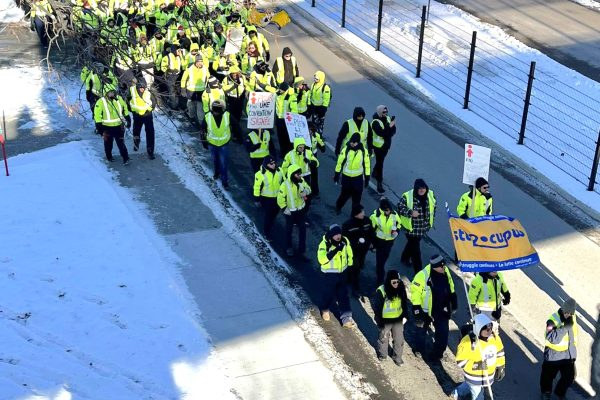
In practice, capitalist democracy is no democracy at all—at least not for the working class. In most cases, politics is not something exercised by the masses—but something performed on the masses by men and women in suits.
In a communist society, genuine democracy—that is, democracy for the millions and not the millionaires—would flourish as never before in Canada’s history.
In some people’s minds, the word “communism” might conjure up images of totalitarian government, prison camps and firing squads. In actual fact, the genuine ideas of Marx and Lenin bear as little relation to the regimes of Stalin and Mao as the teachings of Jesus Christ do to the Spanish Inquisition.
Communism means the exercising of power by the working class—not by a totalitarian bureaucracy. The idea of a minority ruling against the wishes of a majority has more in common with capitalism than it does the writings of Marx. Further, such a society could only result from a revolution encompassing the large majority of society.
The active force of a communist revolution is workers themselves—assembled democratically through their own organizations. In the Russian Revolution of 1917, this took the form of “soviets”—the Russian word for “councils” or “committees”—through which workers organized their own workplaces, elected representatives from within their ranks and sent delegates to higher “soviets” at a regional and national level. The revolution resulted in the assumption of power by the soviets—that is, by the organized workers. Lenin’s Bolsheviks, later renamed the Russian Communist Party, were then elected to its leadership with a large majority.
In Canada, communists defend a similar course. The triumph of the Canadian revolution would mean the coming to power of the “Canadian Soviets” (they would no doubt be called something else), with the communists representing just one force among many inside of them.
If the communists were elected to a majority, other parties would naturally be permitted to operate freely—provided only that they respect the democratic will of the majority and spurn violence against the workers’ government. Communists lead by winning workers’ approval for their ideas—not by creating a one-party state.
Under a communist government, the electoral principle would extend to all important positions of state with the right of recall. Workers’ control would be introduced into every large factory, energy installation and retail outlet in the country, allowing groups of workers to decide for themselves the appropriate conditions of work. The takeover of capitalist industry would rob them of their powers of sabotage, allowing a workers’ government to fulfill its mandate without fear of interruptions or backsliding.
The involvement of workers in running society would also serve an important economic function. Trotsky once said that a planned economy requires workers’ democracy in the same way that the human body requires oxygen. No such thing existed in the Soviet Union under Stalin, which was one of the factors that led to its eventual collapse.
In Canada, the universal presence of workers’ control would act as a “feedback mechanism” for central planners—suggesting improvements to production, the quality of its products and other measures necessary to raise productivity. Canada’s workers would not be chastised for pointing out faults and inefficiencies in their workplace’s operations—as they all too often are under capitalism—but empowered to put those observations into practice under their own control.
In short, a communist government would mean handing the keys of state machinery and industry to working people for the first time in Canada’s history. The possibilities for how to operate society and improve its functioning will be endless once the creative potential of the masses is unleashed.
Monopoly capitalism
In the final analysis, political power stems from economic power. You can’t control what you don’t own—as the old saying goes. Thus, a workers’ government led by communists would dismantle the capitalist economy and replace it with a system in which the largest enterprises are publicly owned, democratically controlled and operated on the basis of a rational plan—or a planned economy.
On the face of it, the idea of large-scale planning might seem far-fetched in Canada—and therefore impractical. However, what are large companies like RBC, Loblaw and Bombardier if not their own planned economies?
In fact, no large company is operated internally by “free market” principles, but by a high level of organization, definite forecasts and established methods of work. Planning means adapting these methods and applying them to the economy as a whole under democratic control.
Moreover, it is these giant companies—some more like monopolies—which dominate Canada’s economic landscape today.
In 2024, government data showed that “large” companies (those employing over 500 workers) employ some 36 per cent of the total private sector workforce, despite accounting for only 0.3 per cent of businesses in Canada. The 10 largest companies account for 10 per cent of private sector employment roles, or some 1 million people. The five largest grocery chains alone employ some 600,000 people between them.
The picture is even more stark when looking at other metrics. Large companies account for some 50 per cent of Canadian GDP and over 60 per cent of goods exported abroad. This puts to bed the myth that small and medium sized businesses serve as the “backbone” of the Canadian economy. In fact, it is big business—and in particular the largest monopolies—which dominate the Canadian market. Building a planned economy on these foundations would therefore be a relatively simple task.
But even these figures do not paint the full picture. Lenin observed in his book Imperialism, The Highest Stage of Capitalism how capitalism prepares the way for socialism by concentrating industries into ever fewer hands. In doing so, it “simplifies” industry and makes possible planning at a national and even international scale. In Canada, this process has gone further than in most countries.
For example, Canada’s four largest banks alone control some 75 per cent of all domestic deposits held in the country. The comparable figure for the U.S. is just shy of 50 per cent.
Other industries follow a similar pattern: in domestic air travel, two companies (Air Canada, WestJet) control 80 per cent of the market; in groceries and home essentials, five companies control 80 per cent of the market; in telecoms, three companies (Bell, Rogers, Telus) control 90 per cent of the market; in freight travel by rail, two companies (CN, CPKC) control 100 per cent of the market; in ammonia (a fertilizer), four companies control 95 per cent of the market; in urea (another fertilizer), four companies control 100 per cent of the market; in pork processing, four companies (Maple Leaf being the largest) control 70 per cent of the market; in beef processing, two companies (JBS, Cargill) control 99 per cent of the market. Similar figures could be reproduced at will for other sectors, with only a few exceptions.
Furthermore, the pace of industrial concentration has not been slowing down, but ramping up in recent decades. Since 1998, concentration in half of Canada’s industries has increased by 40 per cent, while one third have increased by 50 per cent or more. The idea that Canada is just “three companies in a trench coat” might be something of an exaggeration—although it becomes more true with each passing day.

But there is more. Canada’s big companies not only plan their own operations. They also routinely “plan” with each other—a practice more commonly known as collusion.
Between 2001 and 2015, Canada’s big grocers famously conspired to increase the price of bread—a scheme that milked $5 billion from their customers before it was uncovered. In a 2025 report, the Competition Bureau raised concerns that Air Canada and WestJet had concocted a plan to carve up the Canadian market between them, including by suspending flights in each other’s “territory” so as to avoid competing and jack up prices. In this case, no meaningful actions were ever taken to punish the companies in question.
The idea of planning Canada’s economy is therefore no Marxist pipe dream. In actual fact, “planning” already takes place at almost every level of the Canadian economy—both inside the large companies and between them.
However, the plans of the capitalists are not designed to satisfy public needs, but to defraud consumers, undercut their competitors and to maximize shareholder returns—however odious the means. In effect, it is a semi-planned economy for the rich.
In the 1930s, Trotsky noted that, on a global scale, conditions were not only “ripe” for socialism, but had even begun to “rot.” He warned at the time that a “catastrophe threatens the whole culture of mankind” should the productive forces remain in the hands of the capitalists for too long.
Trotsky’s words apply perfectly to Canada today. One hundred years and more of capitalist development have concentrated industry to such an extent that its economy could be planned with an almost relative ease. However, in the hands of the capitalists, Canada’s productive forces have been turned into tools of systematic robbery and left to decay.
Only communism can help rescue and give a fresh impulse to what capitalism itself built over many generations—and which it now threatens to destroy.
A planned economy
Under a workers’ government, the foundations of a planned economy would be laid through the expropriation of the few hundred largest companies—among them the “big six” banks, the “big five” grocers and the oil and gas giants. The impact on people’s lives would be almost immediate.
Under capitalism, companies only invest insofar as they see a profit to be made. Further, they do so without any regard as to whether that investment will benefit society. The planned economy faces no such limits.
Canada’s industrial capacity utilization is currently at 78 per cent—having declined from a high of 85 per cent in recent decades. In other words, 22 per cent of Canada’s factories, refineries and other industrial components are currently idle. Why? Because their owners see little or no profit to be made by going full tilt in the current economic environment.
No longer guided by profit, a planned economy could immediately ramp up production to as close to 100 per cent as possible, with allowances made for downtime as required for repairs. Products which have no immediate buyers on foreign markets could be redirected at low cost or cost-free to service pressing domestic needs, such as steel needed for infrastructure. Factories producing unnecessary or unsellable goods could be retooled to cater to public needs. Machines producing military hardware, for example, could be redesigned to produce commercial vehicles and other consumer products—the reverse of what Canada did during WWII.
In the case of finance, a planned economy would further “simplify” operations by merging the big banks and other large financial institutions into a single state bank. This too would have immediate positive impacts.
Canada’s banking regulator recently chastised the big banks for sitting on $60 billion in excess funds—money it argued could be lent out to small businesses. The new state bank could immediately deploy these funds to where they’re needed, whether it be to small businesses or to finance important projects in the wider economy.
Moreover, with the money saved from a larger economy of scale and the elimination of profits (estimated at over $70 billion for the “big six” in 2025), a state bank could slash loan rates to small businesses and eliminate most interest on mortgages for working families.
However, a state bank would serve a yet more important function—as a guiding tool for planning the economy.
Lenin once noted that, far from becoming irrelevant under socialism, finance would take on an even greater importance than it did under capitalism. That said, it would no longer be used as a vehicle for speculation and easy money-making—but as a tool for estimating a country’s resources and allocating them according to its needs.
In Canada, the “big six” banks are responsible for up to 90 per cent of all loans made by Canadian financial institutions, as well as perhaps 60 per cent of all loans made to businesses by both Canadian and foreign lenders. The latter figure is even higher when looking exclusively at loans made to the country’s largest companies.
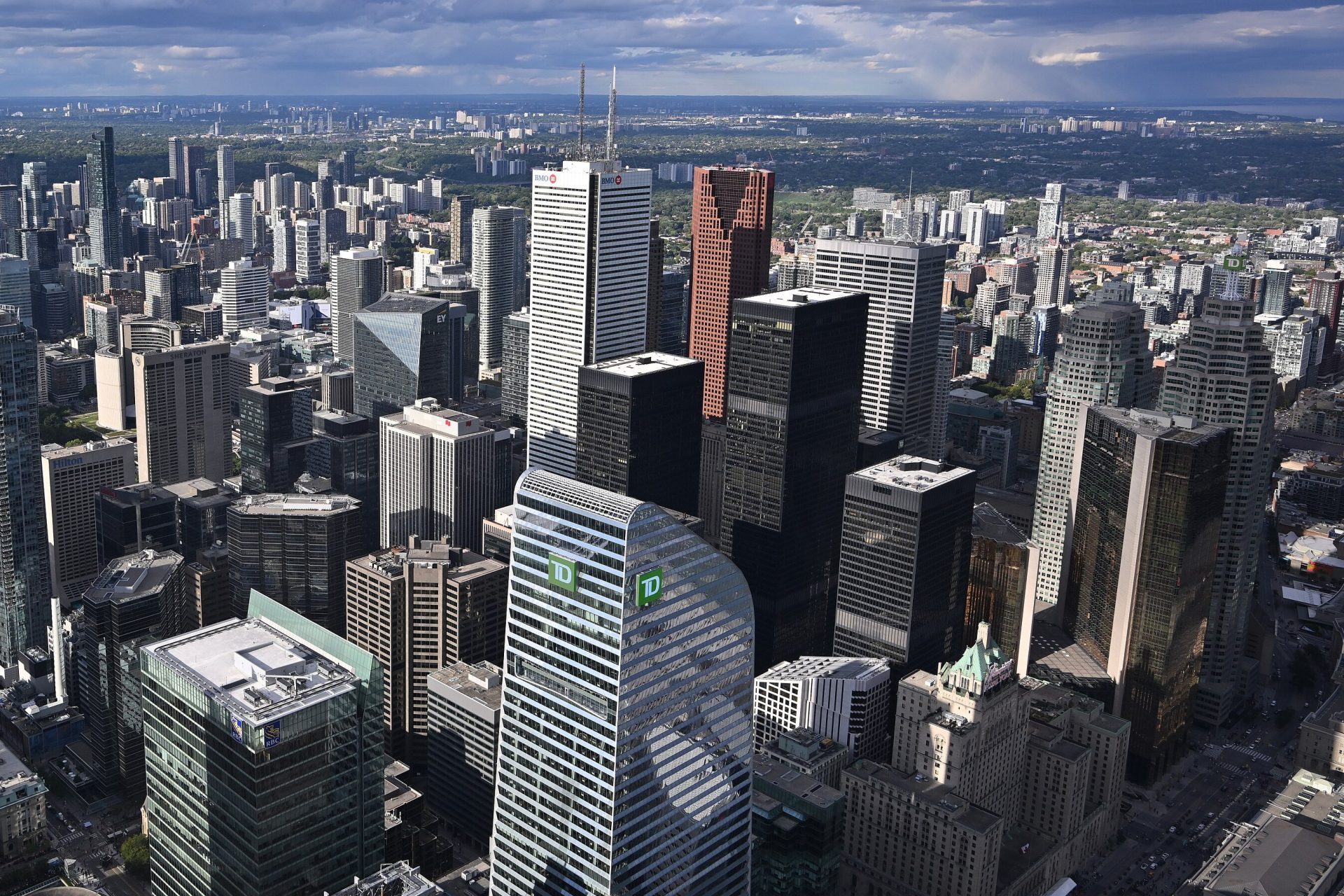
This gives the large banks a bird’s eye view of almost the entirety of the Canadian economy. Even more, it gives them a detailed account of the operations, performance and future plans of almost every company of any importance in the country.
The new state bank would draw on this information to help state planners in allocating the country’s resources and maximizing efficiency in every sector. Toronto’s Bay Street would become the home of a communist Canada’s central planners, while the records of the banks would become the planned economy’s guidebook.
The planned economy could also provide immediate relief on another important front—the price of groceries.
Under a workers’ government, the five big grocers would have their infrastructure confiscated and rapidly integrated into a single state grocer with only one basic aim—to feed Canadians at the lowest possible cost.
But things would not stop there. The monopolies that dominate food processing—an industry in which profit margins are higher and working conditions more detestable than with the grocers—would likewise be expropriated, as would the agribusiness giants.
The new state grocer could immediately pass onto consumers the savings made from its increased economy of scale and the elimination of profits—think the No Name brand model, but on a much vaster scale. Instead of fixing the price of bread, its cost at checkout could be immediately lowered. Moreover, a state grocer would immediately raise the wages of those working in its network—so that they too can afford to buy groceries without fear of breaking the bank.
These are just some of the measures that a planned economy could take almost instantly—and there are doubtless more.
The housing question
The planned economy would also take dramatic steps to solve Canada’s decades-long housing crisis—something which the market has proven particularly useless to address.
Between 2018 and 2023, Canada dedicated an average of 8.3 per cent of GDP to residential investment—the highest rate of any country in the world, and higher even than in the U.S. at the time of the subprime mortgage crisis. Canada’s real estate sector as a whole represents some 13 per cent of GDP, making it the largest single sector in the country. However, when things like mortgage financing and other related sectors are included, the figure might reach as high as 28 per cent of GDP, according to some estimates.
In other words, every year, perhaps a quarter of Canada’s total output is swallowed up by the real estate sector—a level of consumption that has few if any parallels anywhere else in the world.
This might lead one to believe that Canada excels at building homes. In fact, the opposite is true.
In his recent election campaign, Mark Carney pledged to double the pace of homebuilding to 500,000 units a year. However, more than a year on—and after a bevy of new tax credits and other goodies designed to entice developers to build—Canada’s rate of homebuilding is actually projected to decline in the coming years.
How can that be possible? The decline in homebuilding has nothing to do with the public’s lack of demand for homes—ask any worker looking to find an affordable apartment in Vancouver, or a young family trying to buy their first home in Toronto. The real culprit is Canada’s highly inefficient private homebuilding sector.
Building a home in Canada involves navigating a complex maze of developers, contractors, sub-contractors and more—each of which is designed to exact the highest possible cost from whoever hired them.
Moreover, due to their small size, most firms involved in construction are highly inefficient when compared with other sectors. Between 2001 and 2023, labour productivity in the overall business sector grew by 12.5 per cent. In residential construction, it fell by 37.3 per cent. Most firms still use the same methods to build homes as were seen in Canada decades ago—having either no incentive or ability to introduce more modern and efficient practices.
Building a home is made even more expensive by various unproductive actors who nonetheless take a cut somewhere along the line—sometimes known as “process parasites.” Fully one fifth of Canada’s total residential investment is made up of ownership transfer costs, which includes things like legal bills and brokerage fees—totalling billions of dollars annually. Purchasing land needed to build can add up to as much as 25 per cent of the cost of building a detached home.
The planned economy would clean up the mess in Canada’s housing market from day one—starting with the existing housing stock.
20–30 per cent of Canada’s existing rental housing stock, or 340,000 units, is owned by large institutional investors—many of which are notorious for jacking up rents and cheaping out on needed repairs. These units would be immediately expropriated and the money saved from yesterday’s profits used to lower rents for those living in them.
But that would just be a start. New homes would also need to be built at record levels in order to meet society’s needs.
In order to achieve this, a workers’ government would also expropriate all of the large developers and building firms—including companies like EllisDon and The Daniels Corporation—and fuse them into a single, all-encompassing homebuilding agency. This new agency would be tasked with building homes according to the most advanced techniques, including those like modular housing, which is already used to great effect in places like Japan. Integration of factory production with real estate would be the order of the day—something which would now be possible under a planned economy.

The new government would permit small firms and contractors to operate as they did before—on the condition that they pay decent wages and abide by basic quality controls. However, the new state homebuilding agency would offer above average wages so as to entice skilled trades workers to enter its ranks. Private land held by large investors would be confiscated so as to reduce the cost of building.
The efficiency of such a model is hardly theoretical. In Singapore, 80 per cent of its people live in homes built by the state, while 90 per cent of the land is state-owned. The private sector plays only a limited role.
The result? In Singapore, the price to income ratio for a public home is 4.5—meaning it takes 4.5 years of income to buy the property. In Canada, the comparable figure is over 7, while in Vancouver it stands at 12—making the average home in Vancouver roughly three times more expensive than a public home in Singapore. Further, home ownership rates are higher in Singapore than in Canada.
These are results achieved by a capitalist country—one can only imagine what a planned economy could do.
Of course, many people in Canada also treat their home as their retirement savings—making them fearful of what new construction might do to the value of their home. In order to address this, a communist government would immediately enhance pensions for all retirees—restoring them to the high levels enjoyed in the past. In turn, people would no longer need to gamble their futures on an unpredictable housing market.
In a short period of time, a planned economy would be able to build in excess of 500,000 units a year—and these of a high quality and at an affordable price. Before too long, talk of a housing crisis would become a thing of a dark and distant past.
Oil, gas and the climate crisis
No issue is capitalism less equipped to deal with than climate change.
The blind pursuit of profit by Canada’s oil and gas barons leaves no consideration for its consequences on the environment. Canada has blown past its own CO2 emissions targets more times than anyone can count—as have many other nations.
The results have been catastrophic. Insured damages from extreme weather events in Canada hit $2.4 billion in 2025—many of these, such as wildfires, being attributed to the rise in atmospheric temperatures caused by humans. In recent years, entire municipalities like Jasper, Alberta and Lytton, B.C. have been burned to the ground. Each summer, hundreds of thousands of Canadians wait to learn if they will be forced to evacuate their homes—whether because of fires, flooding or some other freak event that never seemed to happen before.

The need to transition towards more renewable forms of energy has never been more clear—that is, if we want to live on a planet that is not constantly threatening to kill us.
However, rather than move in this direction, Canada’s elite have locked the country into a seemingly endless dependence on oil and gas extraction—excellent for profits, terrible in almost every other respect.
The costs are not just environmental. Increasingly, taxpayers have been asked to shoulder the burden for new oil and gas infrastructure in the country. The recently announced pipeline from Alberta to B.C.’s coast will be built almost entirely by a state company, at a cost of at least $35 billion to the public. Further, no one can say for sure that the price of oil will remain high for decades into the future—doubtful when countries in Asia are rapidly moving towards renewable energy. This makes such projects a dangerous gamble indeed.
The only beneficiaries of these seemingly illogical moves are a handful of oil and gas companies—as well as the “big six” banks that finance them. If the planet burns and the taxpayer has to pay for it—then too bad for them. This is the cold calculus of capitalism in all of its miserable glory.
In a workers’ state, the needs of the population and the environment they live in would be put first.
First, the large oil and gas installations would be expropriated—including those belonging to CNRL, Cenovus, Suncor and Imperial Oil. Canada would join the ranks of many other countries (Norway, China, Saudi Arabia) where oil and gas is held as a virtual state monopoly.
Canada’s state planners would not immediately shut down its oil and gas operations—as is suggested on some corners of the left. Instead, it would redeploy its profits—totalling some tens of billions annually—towards renewable energy projects being built across the country. In time, as Canada’s energy grid abandoned its reliance on fossil fuels, and as the price of oil fell on foreign markets, state planners would gradually retire installations or retool them for other purposes.
Big Oil will no doubt accuse communists of wanting to throw oil and gas workers out of a job. In fact, no one has destroyed more jobs in the sector than the oil and gas CEOs themselves. Since the mid 2010s, some 35,000 jobs have been shed in the industry—more even than in Ontario’s auto sector. In about the last decade, companies have reduced the amount of labour required to produce a barrel of oil by roughly 40 per cent. The greatest threat to oil and gas workers is not renewable energy—but the status quo offered under capitalism.
In fact, a planned economy would offer many upsides to workers in the industry. Under capitalism, no worker can ever be 100 per cent guaranteed a new job after being terminated—let alone a job of equal pay and convenience. Their fate is left up to the market. However, a planned economy could not only reassign a redundant worker with relative ease—it could also provide paid training where necessary to equip that worker for their new role. No worker would ever again have to fear losing their job without another being already lined up.
But a workers’ government would go still further. Decisions related to hiring, firing and reassignments would not be left up to central planners alone. Every installation would also be placed under workers’ control—a system whereby workers would elect their own representatives empowered to make decisions related to their workplace. The same would be true of the rest of the economy. In turn, no worker would ever be reassigned without the sign off of the workers themselves—a right that would never be allowed under capitalism.
Taken together, these measures would rapidly “greenify” Canada’s energy mix—all the while enjoying support from affected workers and keeping production moving. Canada could finally take full advantage of its remarkable geographic features (an enormous landmass, millions of waterways, etc.) to deploy renewable energy at a titanic scale.
Unemployment and work
Capitalism doesn’t just waste resources—it also wastes people.
In Canada today, hundreds of thousands are unemployed, millions more are underemployed, and most of those working full-time jobs receive little compared to what they put in. The situation is made more absurd considering the personnel shortages faced in one profession after another, particularly in medicine and the skilled trades. In short, there is no lack of work that needs doing—and no lack of people willing to work.
This high unemployment level is particularly astounding given that the country routinely ranks as the most educated country in the world—at least when measured by those completing a postsecondary degree.
That said, Canada also ranks near the bottom of OECD when it comes to state funding for things like skills training and employment matching for jobseekers—spending less than half the average. Canadian businesses spend even less than their international peers on jobs training—only $240 per worker on average, compared with $750 across the OECD. The capitalists are handed gold from Canada’s universities—and turn it into lead.
The predicament facing Canada’s jobseekers seems to defy all logic. However, it is perfectly logical from the standpoint of capitalism.
Every business owner is concerned first and foremost with expanding the market share of their own company—and this at the lowest possible cost. Moreover, what takes place outside the walls of their business is only of secondary concern to them—and thus is somebody else’s problem. In turn, the education of each new generation of workers takes place in a halfhearted and disjointed fashion, both inside and outside of the workplace.
Furthermore, a certain level of general unemployment is a positive thing for most capitalists, as it exerts a downward pressure on wages. The incentive to eradicate unemployment altogether does not exist, with full employment only being reached by way of accidental factors—namely war.
In a workers’ state, prolonged periods of unemployment would become a thing of the past. Capitalism benefits from having what Marx described as a “reserve army” of labour (i.e. the unemployed). The planned economy has no such use for unemployment. The Soviet Union suffered from many serious problems—however, mass unemployment was not one of them.
Economic planning would allow for large numbers of the unemployed to be immediately put to work—with tasks being shared out where necessary, and work hours reduced correspondingly with no loss in pay. Funding on higher education and jobs training would be significantly increased, particularly in occupations where the country faces shortages.
Further, the practice of disallowing workers trained in foreign countries from practicing their trade in Canada would be ended. Medical professionals should not be driving taxis when 6 million Canadians do not have a family doctor. The communists once in power will dramatically increase funding to expedite training for foreign workers and bring them up to Canadian standards.
In addition to unemployment, hundreds of thousands of Canadians also work in jobs that provide minimal use to society and which feel meaningless.
Take real estate agents. One hundred and sixty thousand are registered in the country, or one agent for every 260 people—a product of the country’s over-reliance on the housing market. Canada has more real estate agents than doctors.
However, the value of real estate agents is questionable even under capitalism (with all due respect to the hardworking men and women in the profession). Britain operates with about five times less the number of real estate agents as Canada, for the same number of transactions. In a planned economy, these individuals could be reassigned to more useful and meaningful forms of work where their talents could be applied—or retrained altogether at no expense. The same would be true of many in the legal profession and those employed in corporate advertising, as just a few examples.
The massive increase in employment and efficiency in a planned economy, combined with the redirection of capitalist profits towards more useful ends, would soon allow for a significant increase in workers’ real wages, as well as a reduction of the work week. Canada’s median wage of $46,000 could rapidly become the new minimum wage, while a four-day work week could be introduced in short order—with further enhancements to workers’ lives made down the road as society’s fortunes grew.
In short, in a planned economy, workers would not only be guaranteed a meaningful job at a decent pay. In time, they would also be gradually freed from work altogether—allowing them to pursue those things in life that make them human. This is the ultimate aim of communism.
Will communism stifle innovation?
The most frequent objection to a planned economy is that it would throttle innovation and kill off productive investment—while mass poverty would ensue. In fact, capitalism itself has become the greatest obstacle on both these fronts.
In a recent article, the economist D.T. Cochrane looked at the profits made by Canadian companies over the years and how they were spent. Between 1985 and 2014, he found that 38 per cent of profits went to shareholders, while 36 per cent was plowed back into investment—the remainder being spent on things like taxes and interest. Thus, even in Canada’s recent past, more of the profit made by companies went to their owners than were re-invested into production.
But things would get worse. Between 2015 and 2019, the ratio had shifted dramatically—50 per cent of profits now went to shareholders, versus 20 per cent for investment. In the years between 2020 and 2022, the amount going towards investment declined still further—only 10 per cent, compared with 50 per cent disbursed to shareholders.
In other words, in recent years, only a small share of the profits made by the capitalists have gone towards productive investment. The majority is now paid out as dividends, where it often becomes transformed into yachts, mansions and other luxury products which serve no useful purpose to society.
The lost economic potential is enormous. Cochrane estimates that Canadian companies now rake in some $400 billion a year in profits. If the share of productive investment were equal to the level going to shareholders (50 per cent), it would mean $160 billion more being invested in useful things than is now the case. Put into perspective, $160 billion is more than the federal government spends on the military and healthcare combined. In a planned economy, there is no reason why the figure dedicated to investment could not be pushed even higher.
In a separate article, Cochrane looked at how Canadian companies spent the money they raised from issuing shares or borrowed from lenders—or “non-operational funds.” He found that from 2020 on, firms dedicated 8 per cent to productive investment, 16 per cent to research and development (R&D)—and 76 per cent to mergers and acquisitions.
In sum, fully three quarters of funds were used to help one company swallow up another, while only one quarter went to things which could be actually considered useful. Yet again, there is no reason why a planned economy could not raise the figure going towards investment and research to a much higher per cent.
The potential innovative power of a planned economy can also be demonstrated through Canada’s past forays into public ownership.
From 1914 to the 1980s, Canada had a publicly-owned pharmaceutical company—Connaught Labs. It produced low-cost insulin and other life-saving vaccines for both Canadians and the rest of the world, among other achievements.

However, more impressive was its contribution to medical research. In 1968, despite representing only 2.5 per cent of all pharmaceutical sales made in Canada, it made up a whopping 20 per cent of all R&D investment made by the industry as a whole—or eight times what the private companies were managing. This leaves one to imagine what an entirely nationalized pharmaceutical industry could possibly achieve, instead of just one small corner of the market.
In the midst of WWII, Canada’s political leaders were forced to implement forms of economic planning in order to support the Allied war effort. During that time, the federal government created 28 new wartime crown corporations, employing some 229,000 people, most of which were tasked with manufacturing advanced military kit. This included companies like Victory Aircraft, which produced British-designed fighter jets—and this at a very high level of quality.
Moreover, even outside of the public sector, the government subjected private companies relevant to the war effort to strict production orders and partially took over their management. The results of all these measures were quite impressive, to say the least—and this under a form of state capitalism.
In short, during one of Canadian capitalism’s darkest hours, its leaders chose to sideline the capitalists and resort to state control in order to save their skin. This alone should demonstrate the superiority of economic planning—albeit in an indirect way.
The opponents of state planning further argue that it would deprive society of its most brilliant minds—these being the capitalists. However, a quick glance at Canada’s richest people reveals anything but “brilliance.” Precisely the opposite.
Of the 25 richest people in Canada, six are members of the Thomson family—owners of the Thomson Reuters Corporation and the Globe & Mail. Each one of them obtained their wealth through their family. The richest man in Canada, Changpeng Zhao, made his billions by founding the cryptocurrency exchange Binance—a glorified casino that became a favourite tool of criminals and terrorist groups to move illicit funds. In 2023, Zhao was charged by the U.S. Department of Justice for failing to prevent money laundering on his platform. He was sent to jail for four months—and later pardoned by Donald Trump.
In truth, many of Canada’s billionaires have never invented or built anything useful in their lives—let alone something so incredible as to justify their inflated wealth. In fact, among their ranks are many nepo babies, hucksters and more than one convicted criminal. If communism means depriving society of these types of individuals, then society has much to gain indeed.
Far from depriving society of its brilliant minds, a planned economy will greatly increase their number. It will do so by making education free at all levels, breaking the influence that corporations have over university research, and expanding funding for all types of scientific projects—not just those that promise to make a quick buck.
In fact, profit has never been the only motivator for scientific and other discoveries. Frederick Banting, the Ontario-born scientist who discovered insulin, believed that patenting his medicine for profit was unethical. In 1923, he sold his patent to the University of Toronto for $1. Norman Bethune, regarded as one of Canada’s greatest medical minds, was a communist. He died treating soldiers in Mao’s army during the Chinese Revolution.
In a workers’ state, the barriers placed on innovation and discovery will at last be removed—resulting in achievements of industry and science yet to be imagined.
A communist world
In the Communist Manifesto, Marx describes the revolutionary role played by capitalism throughout its early history. In Canada, this process led to the establishment of modern industry, the unlocking of its natural wealth and helped with the formation of its large and educated working class.

Of course, this process often involved the brutal exploitation of workers and the violent expropriation and ethnic cleansing of Indigenous people, as well as injecting the poison of national strife. Nonetheless, its achievements were broadly progressive.
However, that process has now entered into reverse—as Marx predicted it would. The market no longer acts as a boon to Canada’s productive forces, but as an albatross hanging around its neck. Instead of building up industry, it destroys it. Instead of boosting living standards, it makes life increasingly unbearable. Instead of pushing the bounds of human discovery and invention, it keeps people’s minds in a stultifying, vice-like grip that smothers all possibility of further advance.
In short, capitalism has long since outlived its role for human progress. Canada’s people are thus offered a choice: either to topple capitalism and replace it with a higher form of social organization—or to have their conditions of life thrown backwards by an order in its death throes.
The collective organization of society is the logical next step in society’s forward march. The concentration of industry has reached such a degree as to make planning not only possible, but necessary in order to realize its full potential. The tasks facing humanity—from building millions of homes to tackling the ever-looming climate crisis—have become too enormous to be dealt with by the money-grubbers who sit at the summits of economic power. Canada’s highly educated and skilled workforce would prove a hundred times more capable at managing society than the buffoons and thieves who currently sit in the driver’s seat—if only they could be given the chance. Under communism, they will.
Canadian communism will usher in a golden age that will put all past achievements of our country’s history to shame. Industry will flourish under democratic planning, while new industries and technologies will make their appearance due to the strengthened hand of science and research. The necessities of life will be guaranteed to all who contribute an honest day’s work, supplied in increasing abundance due to a highly productive economy. Most importantly, those who work will finally be rewarded the fruits of their labour, including through a reduction of the working day—providing them with the free time to enjoy everything that the new society has to offer.
Of course, the new Canada would soon face challenges from outside of its borders. In particular, the U.S. capitalists would be none too pleased about suddenly having a communist country as their neighbour. Further, as the ongoing U.S.-Canada trade war shows, U.S. capitalism has all kinds of means at its disposal to exert pain on Canada and dictate its actions—including measures like shutting down cross-border infrastructure, which have yet to be deployed.
However, it would not be too long before the example set by Canada’s workers spread to their counterparts in the U.S.—that is, if U.S. workers hadn’t already made the first move, which seems the more likely outcome. The Russian Revolution had its impact on almost every nation of the world—spurring revolutions in Germany in 1918, Hungary in 1919 and even helping to inspire the Winnipeg General Strike. The Canadian or American socialist revolution would have a still greater impact—particularly in the age of globalization and social media.
The fusion of the Canadian and U.S. economies under socialist planning would present limitless possibilities and make the northernmost half of the American continent an almost impregnable fortress. Mexico’s entry would shortly follow, and behind them the entirety of Central and South America. The various parts of the world that had been long exploited by both U.S. and Canadian imperialism in the Middle East, Africa and beyond would be delivered their economic freedom and invited to join with a communist federation of the Americas on an equal footing—a proposal that few would reject.
In the end, the triumph of communism in North America—that bastion of the most reactionary kind of capitalism in the world—would mark the beginning of its triumph everywhere. In the course of one generation, the world would be presented with an entirely new reality of universal labour-saving technologies, superabundance and freedom from all kinds of undesirable work. Marx’s maxim of “from each according to his ability, to each according to his need” will at last be given a real material foundation.
In sum, Canada would do well to “go communist.” But unshackling this country from class slavery would only be a prologue to freeing the entire world.
A communist solution to the Quebec national question
Julien Arseneau
The above article outlines what a socialist society would look like within the Canadian state. But what about Quebec and the national question? This is a central issue that remains unresolved. Communists have an answer to this as well.
Self-determination
Under capitalism, Quebec does not truly have the right to self-determination. The Clarity Act is the most obvious example of this. It allows the federal government to decide what constitutes a “clear majority” in a vote for secession. And Mark Carney clearly explained what that means last spring: “It’s not 50 per cent plus one.” Canada is fundamentally undemocratic.
In the event of a successful referendum in Quebec, the result would have to be ratified by a constitutional amendment, approved by the House of Commons, the Senate and the legislative assemblies of at least seven provinces representing at least half of Canada’s population. We might as well say it won’t happen through legal means.
The Canadian ruling class fights tooth and nail against any strivings for independence. It deliberately fosters Anglo-chauvinism and gross misunderstandings of Quebec’s national aspirations. The fundamental reason is simple: it has no interest in losing 20 per cent of its GDP and 22 per cent of its population—even less so during a time of existential crisis for Canadian capitalism.
But even if formal independence were to be achieved, Quebec is caught between a rock and a hard place—between Canada and the United States. Small nations are mere small change in the hands of the imperialists.
This is what Parti Québécois Leader Paul St-Pierre Plamondon tacitly admitted when he said there would be no referendum as long as Trump remains in power. Similarly, the Parti Québécois is already announcing that it will align its policies with U.S. demands—for example, on military spending, which it plans to increase to five per cent of Quebec’s GDP. Plamondon even speaks of “loyalty” to the United States. Is this what “liberation” really means?
Revolution
Unlike the bourgeois and petty-bourgeois nationalists who simply aspire to withdraw from the Canadian federation, communists want to overthrow it.
Among numerous Quebec workers and youth, nationalist aspirations reflect a progressive sentiment—the desire not to be oppressed, the desire to be “masters in our own house.” And that is precisely what will come about with a socialist revolution in Quebec and Canada.
The abolition of the Clarity Act, the Senate and other colonial relics would finally lay the groundwork for a lasting democratic solution to the national question. Quebecers would then be free to choose whether they want a separate state or a voluntary union, without coercion or pressure.
The national question is, above all, a question of bread and butter. When set against a backdrop of poverty and decline, national tensions flare up. But against a backdrop of a marked rise in the standard of living, these tensions tend to lose their significance. Communists aim to create conditions in which no people are oppressed or disadvantaged, and in which all national privileges will disappear.
Unlocking the enormous wealth lying dormant in billionaires’ bank accounts would make it possible to provide massive funding for the education system, French-language courses, culture and the arts. This is a program that right-wing nationalists, who constantly try to use these issues to gain political capital, could never accomplish.
The Revolutionary Communist Party is active throughout Quebec and English Canada. In this struggle, we fight against any and all Anglo-chauvinist prejudice. Similarly, in Quebec, we consistently expose bourgeois nationalism, which, under the guise of defending “the nation,” in reality defends the interests of “Quebec Inc.” against the interests of workers.
It is on this basis that we want to mobilize young people and workers, with the aim of building a voluntary union of a socialist Quebec and a socialist Canada, as an integral part of a Socialist Federation of the Americas. This is what true national liberation consists of.

