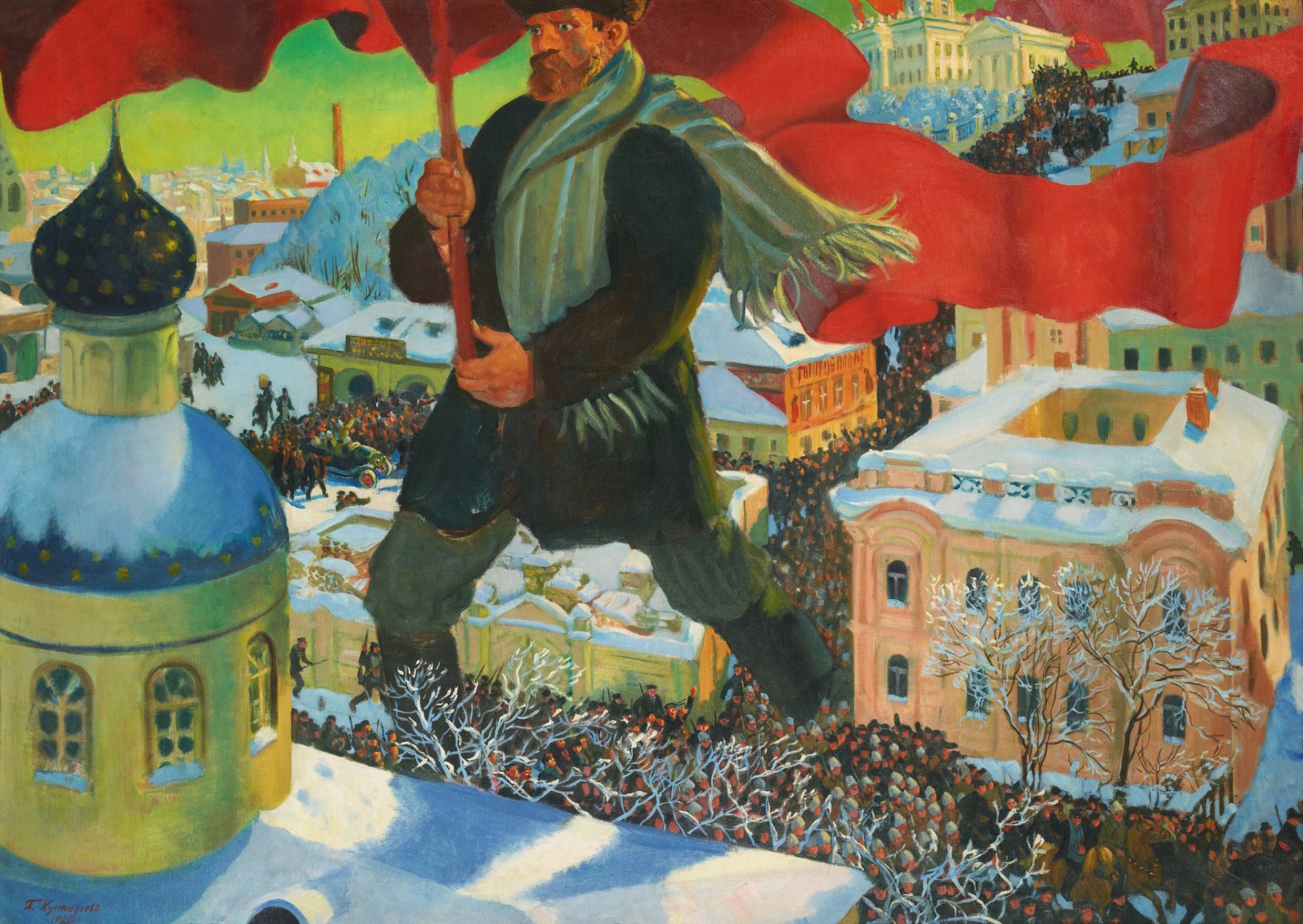
Perhaps no other event in history has stirred as much inspiration and as much vitriol at the same time as the Russian Revolution of 1917.
For the rich and powerful it is a nightmare they can’t forget. That’s why the revolution is so maligned by the powers that be today, from school textbooks to Hollywood movies. They describe 1917 as a coup or a plot, something foisted on the people by the elitist conspiracy of Lenin and his Bolshevik Party.
For revolutionaries, however, it is the greatest event in history. Except for the brief, heroic episode of the Paris Commune of 1871, this was the first time the working class took power into its own hands and began building a socialist society. Thanks to this, Russian society advanced tremendously, going from an undeveloped semi-feudal society to an advanced industrial power in a few decades, lifting tens of millions out of miserable drudgery and backwardness.
Revolutionaries today have much to learn from the Russian Revolution. This history is packed with lessons on the dynamics of revolution, but most importantly, by studying the example of Lenin’s Bolshevik Party, we learn what it takes to win. No party before or since has ever connected so deeply with the class it led, nor led a revolution resulting in such a powerful transformation of society. Studying the Bolsheviks’ role in 1917 is essential to learn what type of party we must build today, and what ideas and tactics we must base ourselves on, so that we can help lead today’s revolutions to victory.
It is imperative that we study the Russian Revolution, and dig it out from under the mountain of slanders it’s been buried under. We can only scratch the surface of this history in a short article, but we hope that it will inspire a much deeper dive into this great event.
Roots of the revolution
The immediate background to the revolution was the First World War, which plunged Russian society into violent crisis.
It is estimated that, by 1916, 5.6 million Russian soldiers, led into a pointless war by a callous and shortsighted ruling clique, had been killed. These soldiers were overwhelmingly peasants, who, despite having been “freed” from serfdom in 1861, were still dominated by rich landlords. They therefore faced exploitation at home and death at the front.
Overseeing this was Tsar Nicholas II, who led a police regime and ruled by decree with an iron fist. He refused to end the war, because he was expected to supply cannon fodder for Russia’s imperialist allies, France and England, and hoped to annex even more territory for the Russian Empire.
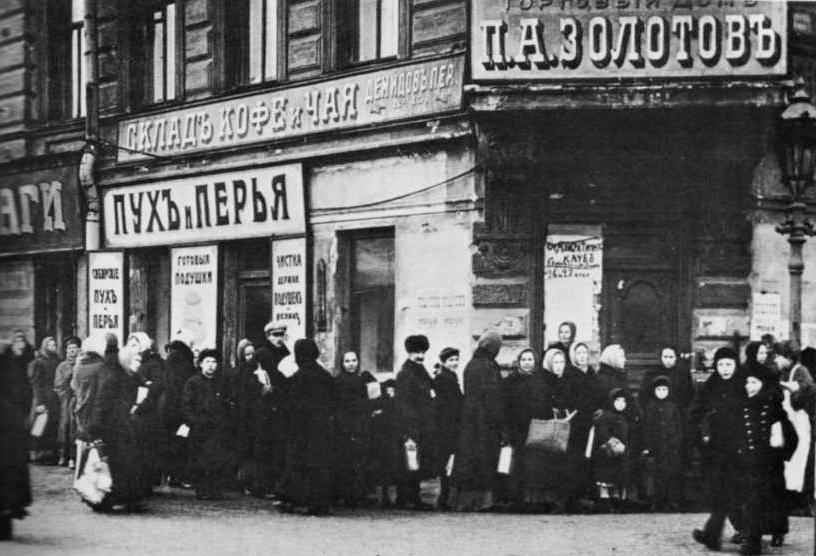
Meanwhile, the breakdown of the economy under the war caused shortages of nearly every basic necessity. This was crushing for the already exploited and impoverished urban working class. Workers, mostly women, had to line up for an average of 40 hours a week to get rations. In Moscow the price of rye—the basis of Russian black bread—rose 47 per cent in the first two years of the war.
The capitalists profited lavishly off soaring prices and from arming and supplying the army. They lived large while the poor suffered and died.
As a British spy wrote, “The champagne flowed like water … And in the streets were the long queues of ill-clad men and garrulous women waiting for bread that never came.”
All of this was on top of accumulated rage from decades of misery and oppression, not to mention accumulated experience in struggle from a failed revolution in 1905. In this situation a strike wave swept Russia in late 1916 and early 1917, involving hundreds of thousands of workers. It was especially strong in the capital, Petrograd.
The February Revolution: The floodgates open
Going into the year 1917, the strike wave gathered steam. International Women’s Day (Feb. 23) would be the turning point.
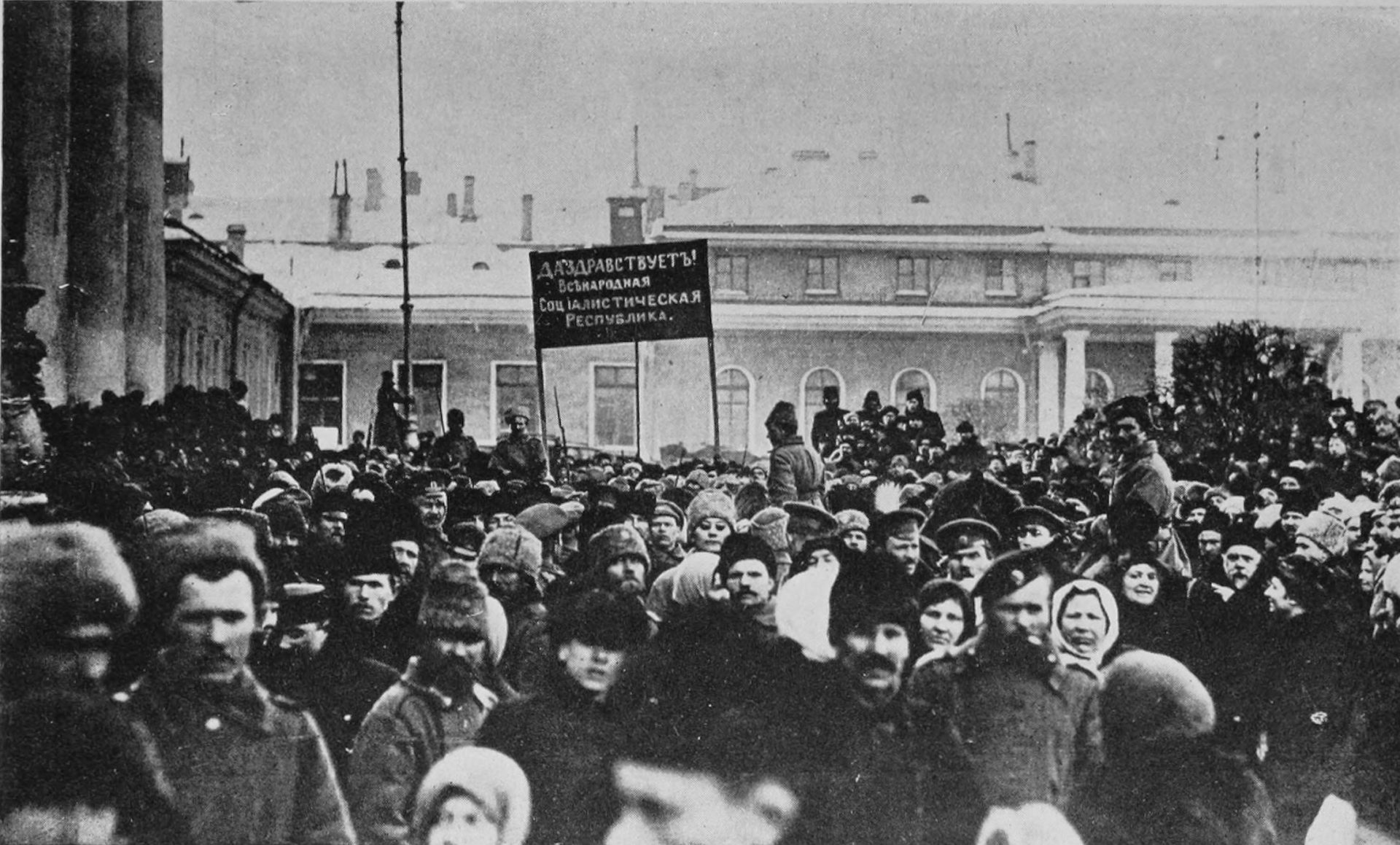
Women workers in several textile factories in Petrograd walked off the job that morning. They sent delegates to other factories to incite them to join. By the end of the day, 90,000 were on strike in Petrograd. Seas of banners demanded peace, bread, and freedom. Two days later, 240,000 workers were on strike. The city was at a standstill.
The tsar sent in the troops. But things did not go as he planned.
A story from the Bolshevik Kayurov is emblematic of what took place all over Petrograd. He was in a crowd of workers being whipped by police, and took some of them to talk to Cossacks (a privileged, martial caste, which the Tsarist regime used to repress the people): “Brothers—Cossacks, help the workers in a struggle for their peaceable demands; you see how the [police] treat us, hungry workers. Help us!” In a few minutes, the workers were raising in the air a Cossack who had felled a police inspector with his sabre.
All over Petrograd, the workers made this type of revolutionary appeal to the soldiers. And it worked. The soldiers were, after all, mostly peasants, who hated the landlords and the war—the same things the workers were fighting.
Thus, on Feb. 26, when the tsar ordered troops to start shooting, it had the opposite effect. A minority did shoot, but a majority refused under the force of revolutionary class appeals from the workers. By the next day, “only those did not mutiny who did not get around to it,” and the workers had won the “struggle for the heart of the soldier,” to quote Leon Trotsky.
The soldiers helped the workers arm themselves, seize police stations, disarm the officers, and liberate political prisoners. The fearsome tsarist state was in ruins.
This incredible feat was achieved in days, through sheer heroism and weight of numbers, with no centralized directing force. The movement was so strong that in the days to come, the rest of the country “adhered” to the revolution, as Trotsky put it. Two weeks later, the tsar abdicated.
Dual power
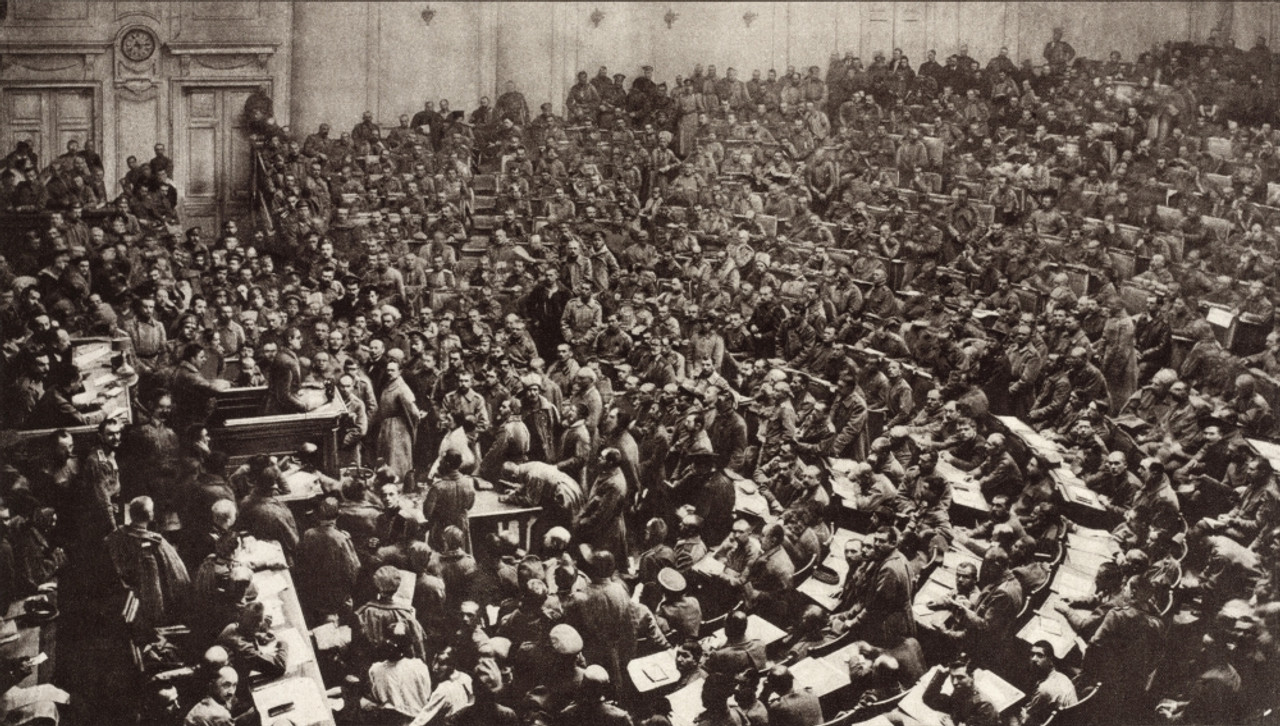
In the heat of the February insurrection, the workers formed soviets (the Russian word for “council”). These were democratic councils based on neighbourhoods, factories, and barracks, where all the oppressed masses could meet, discuss, plan, organize the struggle, and elect a leadership. District and factory soviets sent representatives to city soviets, which would soon meet in all-Russia congresses. This soviet system would be described by Lenin as the embryo of a future workers’ government.
Rapidly, the soviets took steps to run society themselves. For example, during the insurrection, the Petrograd Soviet organized a food commission, organized the workers’ militias, took charge of the mutinous soldiers, and authorized all telegrams and travel.
Behind it was the only armed force in the city—the armed workers and mutinous soldiers. Thus, all real power was in the hands of the masses, through their soviets.
The capitalists were terrified, correctly seeing workers’ power as a threat to their property. Having everything to lose from the revolution, representatives from the capitalist parties—mainly the Constitutional Democrats (Cadets)—formed what would be called the “Provisional Government,” which assumed power on March 15.
This was a scheme to head off the revolution, as revealed by one bourgeois politician, Vasily Shulgin. He said: “If we do not take power, others will take it for us, those rotters who have already elected all sorts of scoundrels in the factories.”
This so-called “government” was unelected, and composed of 13 capitalists, landowners, and representatives of the bourgeois parties. These people would be perfectly happy to bring back the monarchy at the first opportunity—and indeed were scheming to do so.
This strange situation, with the two powers representing hostile classes existing side by side, is known as “dual power”. But the nature of power is that only one class can wield it for long. Dual power is therefore unstable. Sooner or later, one side must win.
As Lenin would explain, the Provisional Government could solve none of the problems of the masses. It also did not have the support of the troops. Yet it was able to assume power. How?
The paradox of February
The Executive Committee of the Petrograd Soviet was dominated by the Mensheviks and Socialist Revolutionaries (SRs). They had urged the bourgeoisie to take power on Feb. 27, and when it finally did, supported it. The vice-chairman of the Soviet Executive Committee, Alexander Kerensky, was named Minister of Justice.
Thus, “the Mensheviks and Social Revolutionaries directly transferred the power to the Cadet party, rejected by the toilers and despised by them,” as Trotsky put it. Revealing the real situation, the new Provisional Government could not even pass a decree without the rubber stamp of the Soviet Executive Committee.
Why did the Mensheviks and SRs hand over power? Their logic was explained by Nikolai Sukhanov, a Menshevik member of the Soviet Executive Committee: “The power destined to replace tsarism must be only a bourgeois power … We must steer our course by this principle. Otherwise the uprising will not succeed and the revolution will collapse.”
This expressed the Mensheviks’ theory, known as the “theory of stages.” This theory said that Russia needed a bourgeois revolution to establish a modern capitalist democracy—socialism would only be on the agenda after several decades of capitalist development. Furthermore, since this was a bourgeois revolution, it could only be led by the bourgeoisie. The duty of the working class in the revolution was therefore to act as an auxiliary to the bourgeoisie. Similarly, the SRs viewed the revolution as neither socialist nor bourgeois, but as “democratic”—a confused notion which in practice led them to support the bourgeoisie.
This flows from the mentality of the reformist—i.e. class-collaborating—Mensheviks and SRs. These parties distrusted the masses and feared their independent initiative. Thus, paradoxically, the leaders of the revolution handed the very power they had conquered to the bourgeoisie that opposed the revolution.
Why did the workers and soldiers elect these reformists in the soviets? Except for a small layer of advanced—and generally Bolshevik—workers, masses of people had just awoken. They were politically inexperienced. So they gravitated to the socialist parties without differentiating between them, being unable to distinguish between them based on seemingly small programmatic differences. The SRs were especially popular at the beginning of the revolution, precisely because their program was not very clear. As Trotsky explains, “To vote for the Social Revolutionaries meant to vote for the revolution in general, and involved no further obligation.”
In this way, the popularity of the reformists at that time was a reflection of the fact that the revolution was in its early stages: still “immature, unformulated and confused”. Events would eventually expose the gulf between the “socialist” parties that supported the capitalist Provisional Government and the Bolsheviks who steered clear from it. But for that, Lenin first had to rearm the Bolshevik Party.
Lenin rearms the party
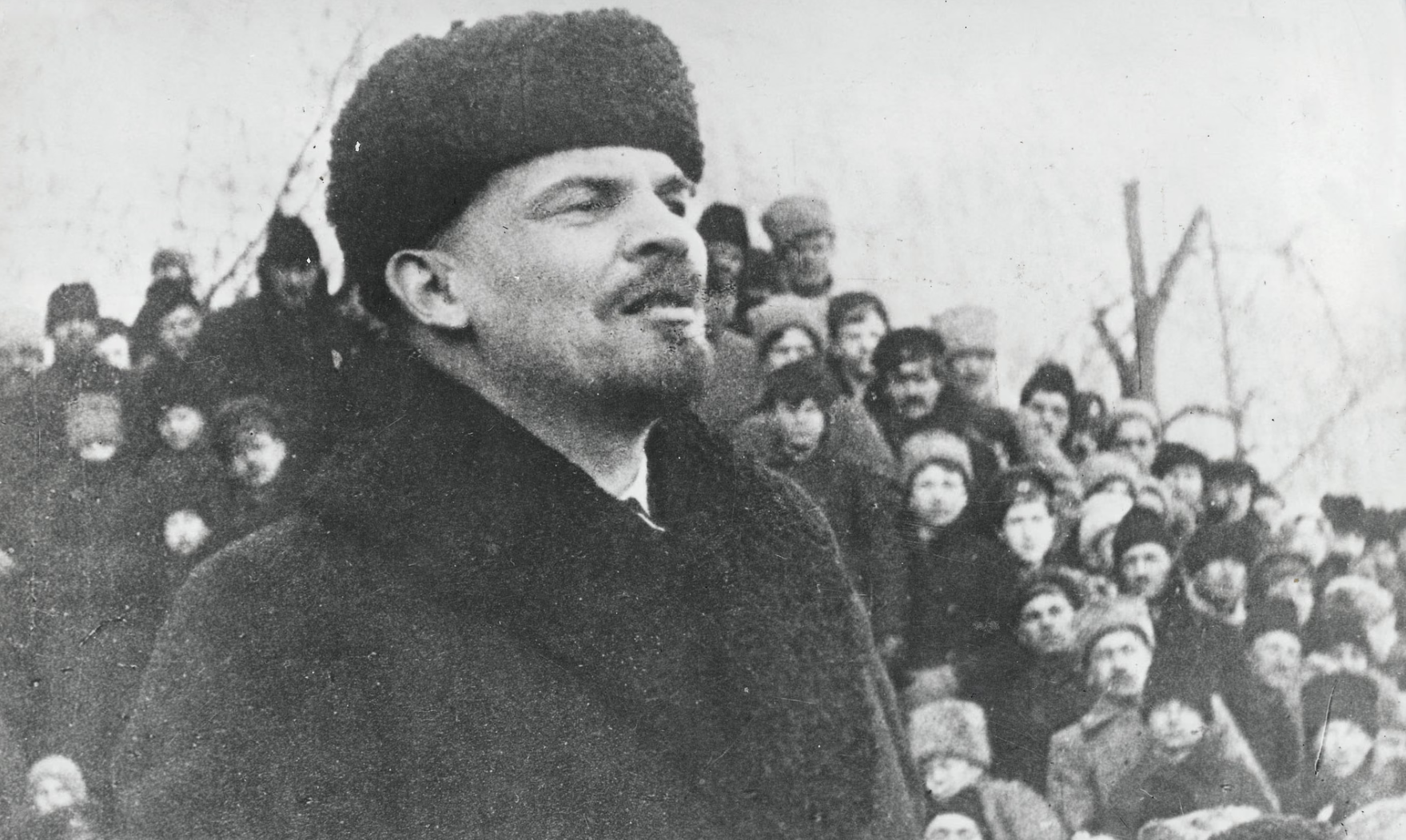
The February insurrection was mainly led by local worker-Bolsheviks, who instantly distrusted the Provisional Government. But the upper echelons of the Bolshevik Party took a confused perspective fundamentally indistinguishable from that of the Mensheviks.
This was disseminated especially by Stalin and Kamenev, editors of the Bolshevik newspaper, Pravda. Their perspective was summarized by Stalin at a Bolshevik conference on March 28: “Insofar as the Provisional Government fortifies the steps of the revolution, to that extent we must support it; but insofar as it is counter-revolutionary, support to the Provisional Government is not permissible.”
Similar quotes from Stalin and Kamenev can be multiplied at will. What this position meant in practice was to merely act as a loyal opposition to the Provisional Government. But far from being a power that “fortifies the steps of the revolution,” it was trying its best to contain it, continue the war effort, and reinstate the monarchy.
Thus, the leading Bolsheviks were tying the party to a capitalist government that could satisfy none of the demands of the revolution, instead suffocating it.
Alan Woods summarizes in Bolshevism: The Road to Revolution:
Instead of appearing as an independent revolutionary force, the Bolshevik leaders in Petrograd acted as the fifth wheel in the cart of the “progressive democrats”. This reflected the pressure of petty-bourgeois public opinion. The general mood in the aftermath of the February overthrow was one of euphoria and universal rejoicing. Intense pressure grew for the unity of all “progressive forces”, and weighed heavily on the leading stratum of the most radical wing which was constantly urged to modify its stance and fall into line with the majority. This threw the Bolshevik leaders off balance, and they moved towards accommodation with the Mensheviks. In many areas, local committees of Bolsheviks and Mensheviks spontaneously merged.
This kind of mood of euphoria is a recurrent feature of the early stages of revolutions. In such a context, there is a tendency towards unity within the revolutionary camp. It can be difficult to adopt political positions that break with that unity, and to appear like you’re raining on the parade. But the role of a revolutionary party is to keep a cool head and point the way forward, and not to be swayed by whatever is the dominant opinion at the moment.
It would take the return of Lenin to Russia to shake the Bolshevik leadership out of their policy of accommodation with the Mensheviks.
On March 6, just after learning of the revolution, Lenin sent a telegram from Switzerland to the Petrograd Bolsheviks: “Our tactics. No trust in and no support of the new government; Kerensky is especially suspect; arming of the proletariat is the only guarantee … no rapprochement with other parties.”
He then bombarded the Bolsheviks with letters, now known as Letters from Afar. Instead of formulas like “bourgeois revolution”, Lenin began his analysis from the key demands of the February uprising—peace, bread, and freedom:
[The Provisional Government] cannot give peace because it is a war government … It is a government bound hand and foot by Anglo-French imperialist capital. Russian capital is merely a branch of the world-wide “firm” which manipulates hundreds of billions of rubles and is called “England and France”.
It cannot give bread because it is a bourgeois government … Bread can be obtained, but only by methods that do not respect the sanctity of capital and landownership.
It cannot give freedom because it is a landlord and capitalist government which fears the people and has already begun to strike a bargain with the Romanov dynasty.
In other words, the Provisional Government could solve none of the demands of the revolution. Lenin concludes that the soviets must take power. And he draws the practical conclusions for the Bolsheviks’ work:
The masses must be made to see that the Soviets of Workers’ Deputies are the only possible form of revolutionary government, and that therefore our task is, as long as this government yields to the influence of the bourgeoisie, to present a patient, systematic, and persistent explanation of the errors of their tactics.
Lenin was in a minority of one on the Bolshevik Central Committee, whose members believed he was “raving”. Pravda published only his first letter—heavily censored.
Lenin finally arrived back in Russia on April 3. At a Bolshevik meeting the following day, he delivered his April Theses. These “produced the impression of an exploding bomb,” according to the Bolshevik Zalezhski. Lenin was breaking with the long-held view in the party.
Since the 1905 revolution, Lenin’s slogan had been that of the “democratic dictatorship of the proletariat and peasantry”. When the revolution broke out in February, the leadership of the party in Russia routinistically held on to that slogan. The proletariat and peasants had risen up in revolution, and won a “democratic” government—was the task not to defend it?
Instead of concretely analyzing the events and adapting their slogans to the situation, they operated through static formulas that they tried to rigidly apply to reality. But Marxism is not a set of formulas and dogmas, it is a scientific method—a tool to understand living reality. And reality had changed—soviet power was the only way to accomplish the tasks of the revolution.
After fierce debate at the April 2–10 Bolshevik Party conference, and despite starting from a position of extreme minority, Lenin won a majority of the party to his perspective, encapsulated in the slogan “All power to the soviets!” Through immense political authority, acquired over years through a mastery of Marxism, Lenin was able to politically rearm the party. This was a major turning point in the revolution, without which the victory of October would not have been possible.
’Patiently explain’
Now politically strengthened, the Bolshevik Party had grown from 7,000 to over 50,000 members by mid-April. The Bolsheviks had won over a large number of the most advanced workers. The task now was to win the millions of politically inexperienced workers and poor peasants to Lenin’s perspective of soviet power.
In the beginning of every revolution, in the mood of unity and jubilation after initial victories, the broad layers of the people believe they have already won. They are not yet aware of the necessity of setting up an entirely new type of power—a power run day to day exclusively by the masses themselves, without any of their old supposed “superiors.”
In Russia this meant that, after the February uprising, the majority of people, especially the soldiers and peasants, did not yet see that the Provisional Government could solve none of their issues—that soviet power and beginning to construct socialism was the only serious path forward.
But because revolution awakens and mobilizes the broadest layers of people, the oppressed masses learn incredibly quickly during a revolution. In particular, these broad layers learn from experience, especially great events, which are abundant in revolution.
In every revolution a process known as “successive approximations” occurs. The masses test various methods, parties, and ideas in practice. Finding more moderate options lacking, through this experience, they move to more extreme options. Finally, as the last option, they can be won to a fully revolutionary program like that of the Bolsheviks—if, and only if, a revolutionary party is there to offer this path.
Given this, the only way for a revolutionary party to win the millions of ordinary people—not just the advanced layer—is to accompany them in this process, advance slogans which correspond to each stage of the movement, and patiently explain that a complete transformation of society is the only way out. As events teach, people will begin to look to the party that has been pointing the way the entire time.
Thus, after the April Conference, Lenin directed the Bolsheviks to “patiently explain!” Thousands of Bolsheviks agitators, in every district, factory, soviet meeting, and mass demonstration, were now occupied with this task under the slogans: “Down with the ten capitalist ministers”, “All power to the soviets”, and “Peace, land, and bread”.
And events were already supplying the necessary experience, showing that the Provisional Government could not solve the masses’ problems.
The war—the most burning question of all—did not stop. The capitalists locked out workers and wasted supplies, attempting to take the revolution down with the economy. This only worsened the deprivation of the masses.
A massive lesson that no propaganda could replace was delivered on April 18. Provisional Government Foreign Minister Pavel Milyukov sent a note to the Allied Powers declaring Russia’s intention to fight the war to the end and annex more territory.
The note leaked, showing people that the new government was just as imperialist as the old one. The masses were outraged. Demonstrations immediately broke out. Armed soldiers took to the streets, with banners on their bayonets reading: “Down with Milyukov!” Whole factories joined. The anger was so great that Milyukov and War Minister Alexander Guchkov (who was also involved in the note) were forced to resign from the Provisional Government.
As for the Mensheviks, their newspaper did denounce the note, calling it “a mockery of the democracy” and demanded from the soviet decisive measures “to prevent its disastrous consequences.” Yet they refused to break with the Provisional Government.
The Milyukov note plunged the government into a protracted crisis lasting one month. Russia’s imperialist allies were terrified that the government would collapse and the masses would force Russia out of the war.
Finally, under imperialist pressure, the reformist soviet leaders saved the situation. On May 18, six socialist ministers from the Menshevik and SR parties joined the government. George Buchanan, British ambassador to Russia, called this new coalition “the last, and almost the only, hope for salvation of the military situation on that front.”
Immediately after its formation, the new government coalition began planning a new military offensive against Germany. As these plans became known, the workers were still more enraged. After all this, a significant layer of the working class was sick of empty words and was losing faith in the reformist leadership in the soviets. The lessons of these events, as well as the worsening economic crisis, also powerfully vindicated the Bolshevik slogans. Through the rest of May, the Bolsheviks’ agitation won large layers of the Petrograd working class to their banner.
A turning point would come with the Second All-Russian Congress of Soviets, set to take place in Petrograd on June 3–24. Seeing that they had won significant support for soviet power, the Bolsheviks organized a march to call on the Soviet Executive Committee to break with the Provisional Government.
The executive caught wind of this and illegalized all demonstrations for three days. A Menshevik paper wrote: “It is time to brand the Leninists as traitors and betrayers of the revolution.”
The Soviet Executive then organized their own demonstration for the same day, intended to be a show of support for the planned offensive at the front. But when the day came, the Mensheviks and SRs were shocked to see a sea of placards reading “Down with the ten capitalist ministers”, “Down with the offensive” and “All power to the soviets.”
Everyone then knew that the Bolsheviks had won the capital. This terrified the capitalist class and their reformist hangers-on. The capitalists accelerated their plans, in the works for months, to unleash a counter-revolutionary offensive on Petrograd.
The July Days
Within days, the offensive collapsed. But Kerensky, feeling obliged to show the imperialists that Russia would not abandon the war, announced a new offensive. For this purpose, the 1st Machine Gun Regiment, which was known as one of the most revolutionary, was ordered to send troops to the front—that is, to their deaths.
This produced an agitated mood in Petrograd, only compounded by starvation and economic dislocation, which were reaching an apogee. Among the soldiers, the mood turned desperate. They drew their own conclusions: the time to take power was now.
Several thousand soldiers from the 1st Machine Gun Regiment began planning an armed demonstration. They did not intend it to be an insurrection. But an armed demonstration against the government would be extremely open to provocations from counter-revolutionary forces, and could quickly turn into an insurrection.
So the Bolsheviks opposed this demonstration. The time was not yet ripe. Petrograd was ready to take power, and even capable of doing so. But the rest of Russia was still several steps behind. An insurrection in Petrograd would not be understood by the decisive majority of the country. Petrograd would be isolated and crushed.
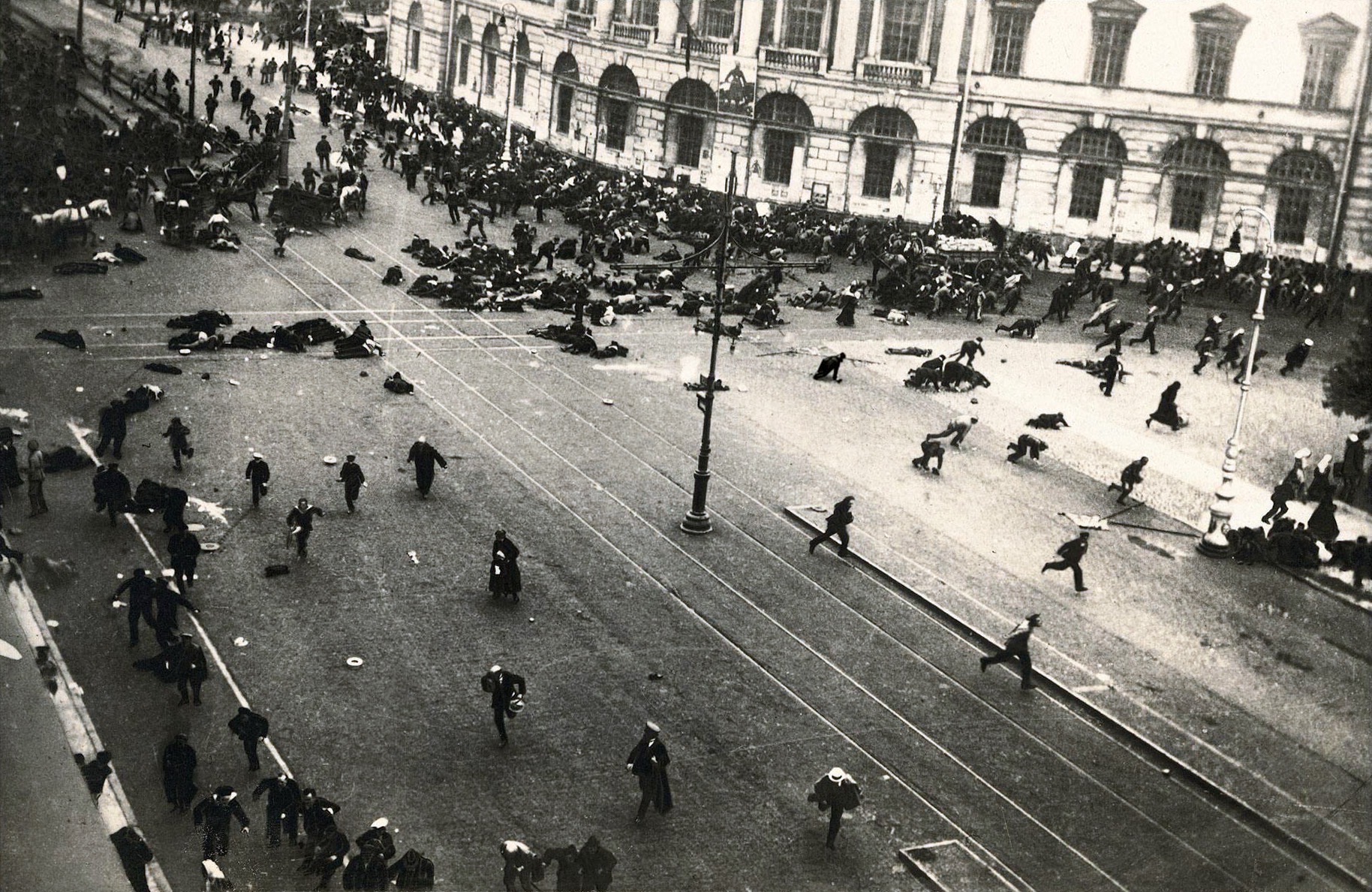
But the Bolsheviks were unable to get the demonstration cancelled. On July 3, soldiers, sailors, and workers poured into the streets, many of them armed to the teeth.
This was an acid test of Bolshevik leadership. They could not abandon the people in this hour of great danger. To let the demonstration take on an insurrectionary character could be fatal for the revolution. And if they were conspicuously absent when the counter-revolution struck back, it would tarnish their banner forever. Thus, despite their misgivings, they did their duty and went with the demonstration to do everything possible to keep it organized and peaceful.
The demonstration was huge and threatening. Hundreds of banners showed slogans like “Down with the ten capitalist ministers!” and “All power to the soviets!”. The mood was jubilant.
Demonstrators demanded to see the socialist ministers. When the SR Agriculture Minister Viktor Chernov appeared, one worker allegedly grabbed him by the collar and yelled at him to “take the power, you son of a bitch, when they give it to you!” Trotsky had to personally rescue him from arrest. This tells you everything about the mood on the streets that day.
It was this mood that the Bolsheviks had to try to calm. On every street corner, they spoke to the demonstrators, urging patience. Trotsky relates that the response was “sullen” and that “it was only with difficulty that we could keep them within the bounds of a bare demonstration.”
The Bolsheviks did manage to keep things peaceful. But as the procession reached the bourgeois districts, government troops began shooting. Machine guns returned fire. The government called in what few troops it could to put down the demonstration. Hundreds were killed.
This deliberate provocation was the signal for the counter-revolution. The bourgeois press unleashed a witch-hunt against the Bolsheviks and anyone deemed to be with them. They claimed that the Bolsheviks had tried to stage an insurrection to sabotage the war effort. Lenin was accused of being a “German agent” paid with German gold.
The socialist ministers joined the chorus, denouncing the demonstration as an insurrection and an affront to democracy. This contributed to the fact that even many workers were taken in by the anti-Bolshevik hysteria.
A period of counter-revolutionary terror began. One Bolshevik was shot. Many others, like Trotsky, were arrested. And government forces hunted Lenin, aiming to execute him. The Bolsheviks were forced underground. But they preserved the bulk of their forces—they had averted complete catastrophe.
These events reveal a general law of revolution. Different layers of the population draw conclusions at different times. There is always an advanced layer that runs ahead. This vanguard, lacking a cohesive picture of the state of consciousness in the entire country, can easily end up lured into premature battles before the rest of the forces are ready for action.
The role of the Bolsheviks was to give these layers a grander, strategic picture, which helped prevent a premature uprising. This was possible because they had forces in all major centres of struggle, giving them a finger on the pulse of the movement nationally. With this, and because they had skilled and trusted agitators, they were able to convey their strategic understanding to the advanced layer. This is one of the essential roles of a centralized revolutionary party.
The Kornilov coup: The price of class collaboration
Despite the anti-Bolshevik hysteria, the continued disaster at the front and at home made workers bristle at their reformist leaders’ support for the Provisional Government against the so-called insurrection.
The Bolsheviks began to experience a revival. By mid-summer, Bolshevik support was great enough that Bolshevik resolutions began being passed at soviet meetings across Russia. For example, a trade union conference representing 150,000 workers in the Urals overwhelmingly passed Bolshevik resolutions on all questions.
At the same time, the government was in crisis following the July Days. Most of the bourgeois ministers had resigned in an attempt to place responsibility for the disaster at the front on the “socialists”. So a new cabinet, mostly composed of SRs and Mensheviks, was formed. Kerensky became prime minister. As we’ve often seen in history, when the bourgeoisie is too discredited to rule by itself, they use the reformists as stewards of their system.
At that point, the ruling class, emboldened by the routing of the July demonstrations, was ready to terminate the revolution. So the capitalists began looking for a strongman to crush it.
They found one in the reactionary General Lavr Kornilov. Kornilov had recently been appointed commander-in-chief of the army by Kerensky, and tasked with reinstating army discipline and stamping out the infection of Bolshevism in the ranks.
Kornilov wanted to go further, however. As he put it: “It is time to hang the German agents and spies, Lenin first of all, and disperse the Soviet of Workers’ and Peasants’ Deputies–yes, and disperse it so it will never get together again.” He was angling for a counter-revolutionary dictatorship.
Kerensky agreed with all this. He even attempted to set himself up as the new dictator. It was only when it became clear that Kornilov intended to take that role for himself that Kerensky tried to remove Kornilov from his post. He was unable to—by then, the ruling class was firmly behind Kornilov.
On Aug. 26, news broke that Kornilov was marching on Petrograd with three divisions. Unable to prevaricate in the face of this danger, and knowing only the Bolsheviks could mobilize the masses sufficiently, the Soviet Executive Committee, still under Menshevik and SR leadership, offered to form a united front with the Bolsheviks under the banner of the Military Revolutionary Committee. The Bolsheviks accepted.
There was opposition to this within the Bolshevik Party. After all, wasn’t the SR Kerensky at the head of the very government that persecuted them? True enough. But the survival of the revolution had to come first. And the united front agreement with the reformist parties did not—as certain Bolsheviks maintained—mean renouncing the struggle for power. Lenin emphasized: “We shall not overthrow Kerensky right now. We shall approach the task of fighting against him in a different way, namely, we shall point out to the people (who are fighting against Kornilov) Kerensky’s weakness and vacillation.”
Under the leadership of the Military Revolutionary Committee, 40,000 workers and soldiers were armed and prepared to defend Petrograd. They organized railway workers, postal and telegraph clerks, and soldiers. Workers broke up Kornilov’s communications, derailed and barricaded his trains, and made revolutionary appeals to his troops.
Once agitators spoke to them of peace, and especially land, Kornilov’s peasant troops refused to fight. In many cases, the troops had been lied to—they thought they were going to Petrograd to defend the revolution. Such was the weakness of the counter-revolutionary forces. Once the soldiers learned the truth, they turned on their officers. Before he even reached Petrograd, without any real battle beginning, Kornilov’s forces simply melted away.
The Bolsheviks were the party that mobilized and organized this resistance. Everyone saw that they were the most effective, most energetic and politically resolute force in the united front. Meanwhile, Kerensky had played a minimal role and looked weak. Even the Menshevik Sukhanov had to admit, “It was quite clear that in the Military Revolutionary Committee the leadership belonged to the Bolsheviks.”
For having played this role, the Bolsheviks won immense respect. Their standing in the eyes of the masses took a qualitative leap. They could no longer be slandered as selfish and power-hungry, having defended the revolution with no immediate gain for themselves. This tactic, still known today as the “united front”, remains an important tool in the arsenal of Leninism.
October: A new world is born
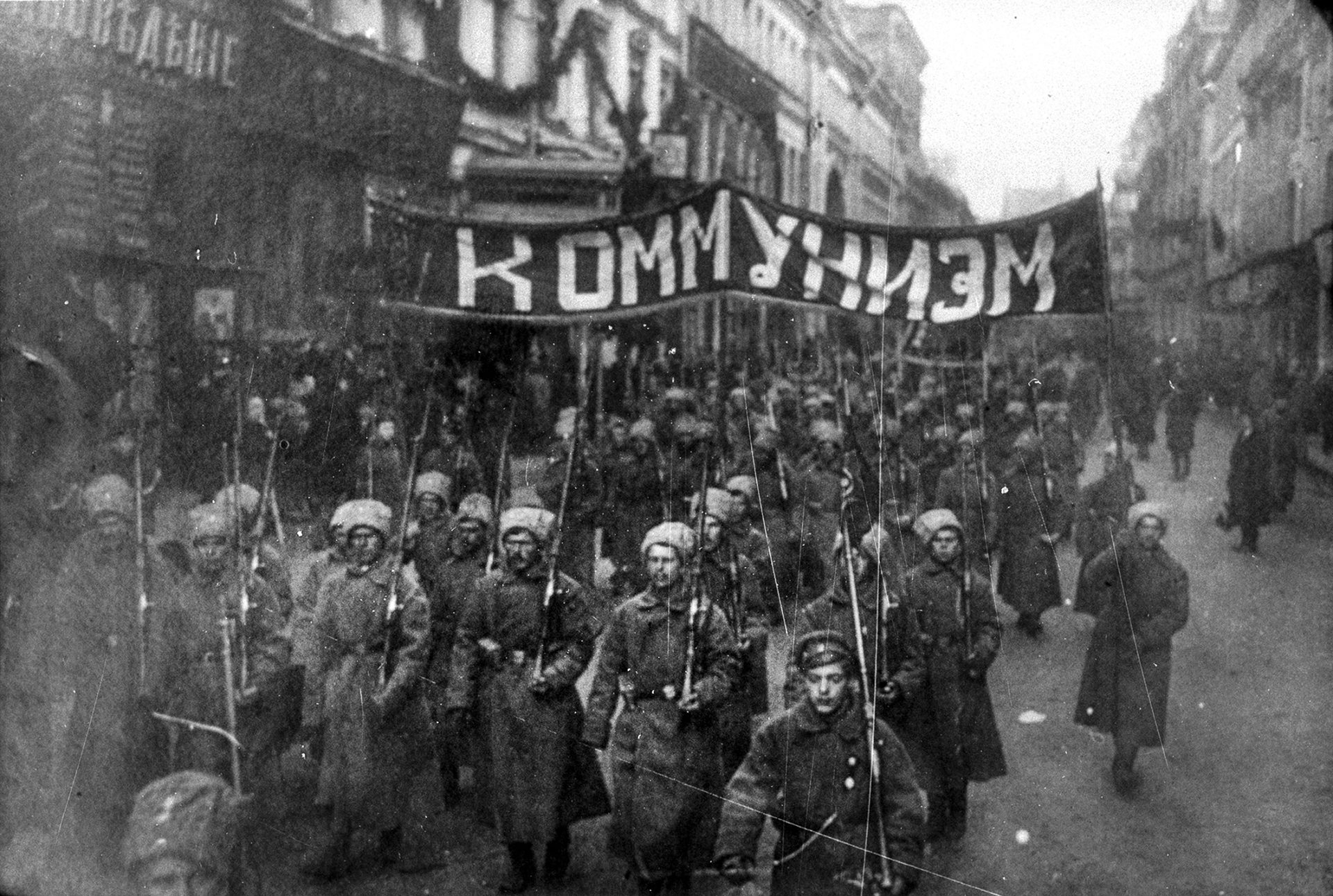
After Kornilov’s defeat, a new revolutionary tide swept Russia. The Bolshevik demand for soviet power was gaining ground everywhere.
As always, Petrograd was in the vanguard. In the first week of September, a resolution for a workers’ and soldiers’ government won an overwhelming majority in the Petrograd Soviet, prompting the reformist leadership to resign in panic.
Workers from all over the country bombarded the Soviet Executive Committee with telegrams demanding that it take power. On Sept. 5, the Congress of Soviets of Central Siberia declared for soviet power. Shortly after, so did Moscow, Kronstadt, Estonia, Finland, Reval, Dorpat, and Wenden.
The mood also swept the armed forces. Soldiers, just yesterday threatened with the death penalty, now arrested and even shot the worst of their officers. Soldiers’ assemblies voted for the signing of peace and soviet power. The arrival of radicalized soldiers from the front back to the villages sparked a wave of peasant revolts.
On Sept. 8, the Baltic sailors declared for the transfer of power to the proletariat and peasantry. Three days later the Central Committee of the Black Sea Fleet joined them. Soon 23 Siberian and Lettish infantry regiments of the 12th Army did too. Other divisions followed steadily. By mid-September the Bolsheviks were the masters of the army.
The Bolsheviks had won the masses, as the Menshevik Sukhanov had to admit:
They were among the masses, in the factories, every day and all the time … They became the party of the masses because they were always there, guiding both in great things and small the whole life of the factories and barracks. The masses lived and breathed together with the Bolsheviks. They were wholly in the hands of the party of Lenin and Trotsky.
The Bolshevik Party itself grew tremendously. On Oct. 16, it was reported by key organizer Yakov Sverdlov as having 400,000 members at least.
On Sept. 12, Lenin wrote to the Central Committee of the Bolsheviks: “The Bolsheviks, having obtained a majority in the Soviets of Workers’ and Soldiers’ Deputies of both capitals, can and must take state power into their own hands.”
The Bolshevik-controlled Petrograd Military Committee, under the leadership of Trotsky, began preparing the insurrection.
In the ensuing weeks, there was a general mobilization and public discussion. Meetings took place everywhere, constantly—sometimes spontaneous, sometimes organized; from the schoolhouses, clubs, soviet halls, theatres, to the village squares, factories, and trenches.
An anecdote from days before the insurrection, at a meeting of the Petrograd Soviet, brilliantly illustrates the overwhelming mood for soviet power at the time. A Menshevik went up and said, “It isn’t a question of who has the power. The trouble is not with the government, but with the war … and the war must be won before any change.” The audience hooted and sneered. “These Bolshevik agitators are demagogues!” Laughter erupted. “Let us for a moment forget the class struggle.” A worker called back, “Don’t you wish we would!”
The insurrection began on the evening of Oct. 25. Revolutionary troops seized the telephone and telegraph offices, the national bank, bridges, and other key points in the city. No one was willing to defend the old order, so the insurrection was nearly bloodless. In fact, at a council of war, convened to stop the insurrection, an admiral said, “I don’t know why this session was called. We have no tangible military force and consequently are incapable of taking any action whatever.”
The Third All-Russian Congress of Soviets opened as the insurrection drew to a close. Unable to get an echo, a majority of the reformists walked out. The Bolsheviks and their new Left SR allies were voted a clear majority (the Socialist Revolutionary Party had split over the question of soviet power).
Trotsky then mounted the stage and announced the transfer of all power to the soviets. Lenin, elected to the new soviet ministry, proclaimed: “We will now proceed to construct the socialist order.”
The soviets became the backbone of a new type of government, far more democratic than any yet seen in history. This government, under Lenin’s leadership, empowered the peasants to divide the land through their own land committees. It mobilized workers to establish workers’ control of industry, taking power from the profiteers. It aggressively combatted the famine. And, under the new soviet government, for the first time in history, a great power withdrew from war without annexing any land, violating the rights of any peoples, or taking any spoils. These are just some of the great achievements of the October Revolution.
Prepare for a new October
The Bolshevik Party was the decisive factor that transformed the unconscious strivings of the Russian people into a conscious, united revolutionary force able to take power—its leadership was the key to victory in October 1917.
All revolutionaries would do well to reflect on this in the context of the world today. Last year alone, more than a dozen insurrections, revolutionary movements and outright revolutions broke out across the world. But all of these “Gen-Z revolutions” have remained half-finished, just like the February Revolution in Russia.
What is needed for victory today is no different than what was needed after February 1917—a party like the Bolshevik Party. The building of parties like the Bolshevik Party to lead these revolutions to victory is therefore the great task of our generation, and the only way to liberate humanity.
But such a party must be patiently built, and cannot be improvised in the heat of the revolution. This is because it takes years of study and experience to prepare the necessary cadres—steeled revolutionaries with a grasp of theory and experience in the movement. The Bolshevik Party succeeded because it had thousands of them, who were able to wield the ideas of Marxism and the perspectives of Lenin to win the masses.
This is the mission that the Revolutionary Communist International has set itself—to build powerful revolutionary communist parties in every country on earth.
It was decades of patient effort from tens of thousands of ordinary workers and students that built the Bolshevik Party of 1917. It is the efforts of ordinary revolutionary students and workers that will build the Bolshevik party of the future Canadian revolution.
In the words of the great revolutionary Rosa Luxemburg: “The future everywhere belongs to Bolshevism.”

