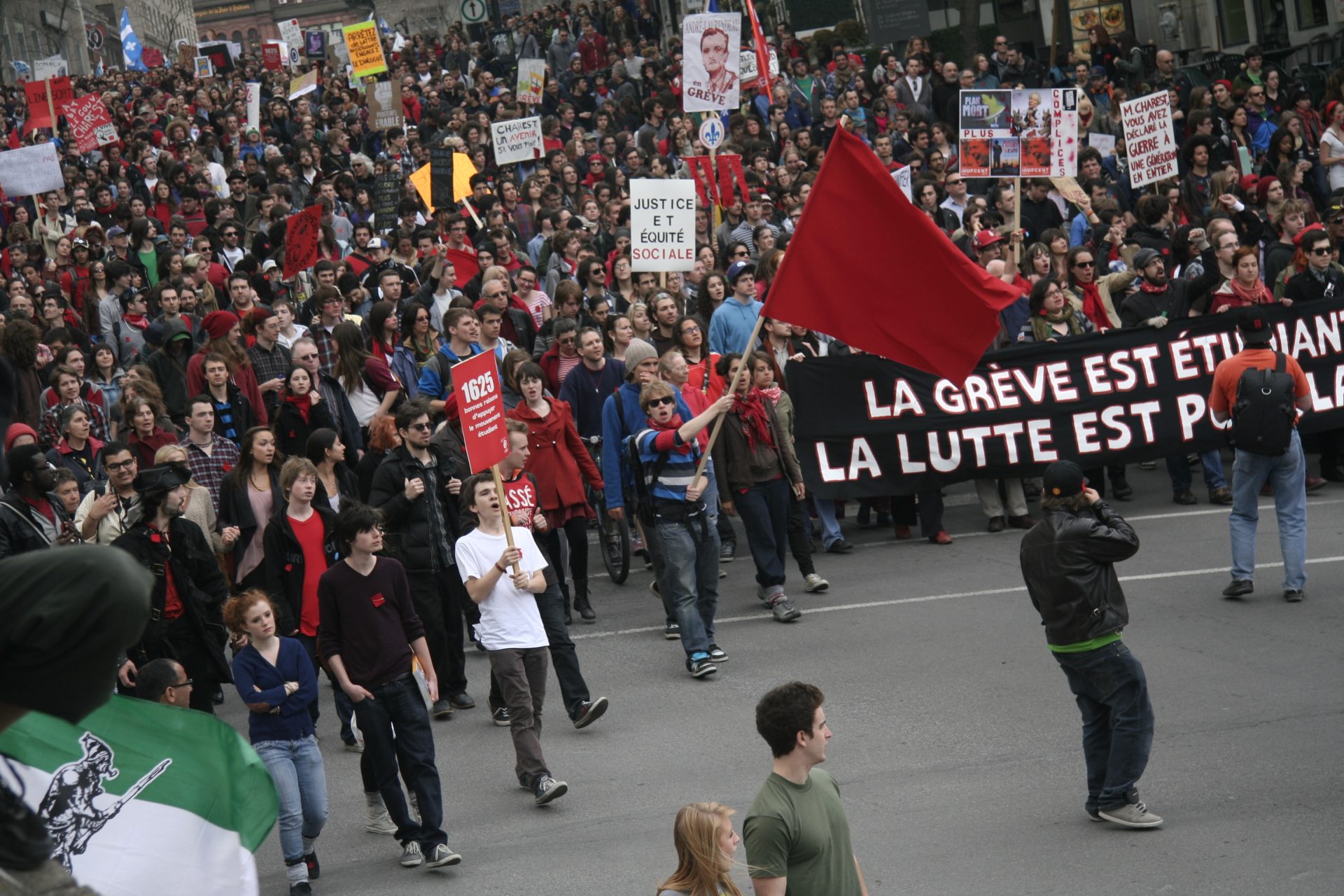
The following is the introduction to a new booklet, Lessons from the 2012 Quebec Student Strike.
You can pre-order your copy of the booklet here.
Postsecondary education in Canada is under attack.
In the early months of 2026, Ontario Premier Doug Ford announced that student funding to help pay for tuition would be changed from being mostly grants to mostly loans—plunging students deeper into debt. In New Brunswick, a government document revealed plans to slash spending on postsecondary education by $35 million from an already meagre budget of just $85 million. Budgets tabled in B.C. and Nova Scotia have projected major cuts across the board for the coming years, with education almost certain to fall in the crosshairs.
This is only the beginning. Canada’s provinces are saddled with enormous debts accumulated from a string of deficits going back to at least 2008. The threat of credit downgrades looms large. In turn, the country’s billionaires are demanding a restoration of “fiscal sanity” to help shore up their position on the global market and to free up taxpayer money to support their own investments.
The announced cuts have been celebrated by Canada’s CEO’s as a “good start,” but they are not enough. More cuts will doubtless need to be made. Students in Canada will be particularly affected by the coming austerity—if only because, unlike unionized workers, they are seen to be defenceless.
The student strike
Or so it seems. In recent months, students from across Canada have adopted the idea of holding student strikes as a way to fight the cuts. They model their arguments on one event in particular: the 2012 Quebec Student Strike, also sometimes known as the “Maple Spring.”
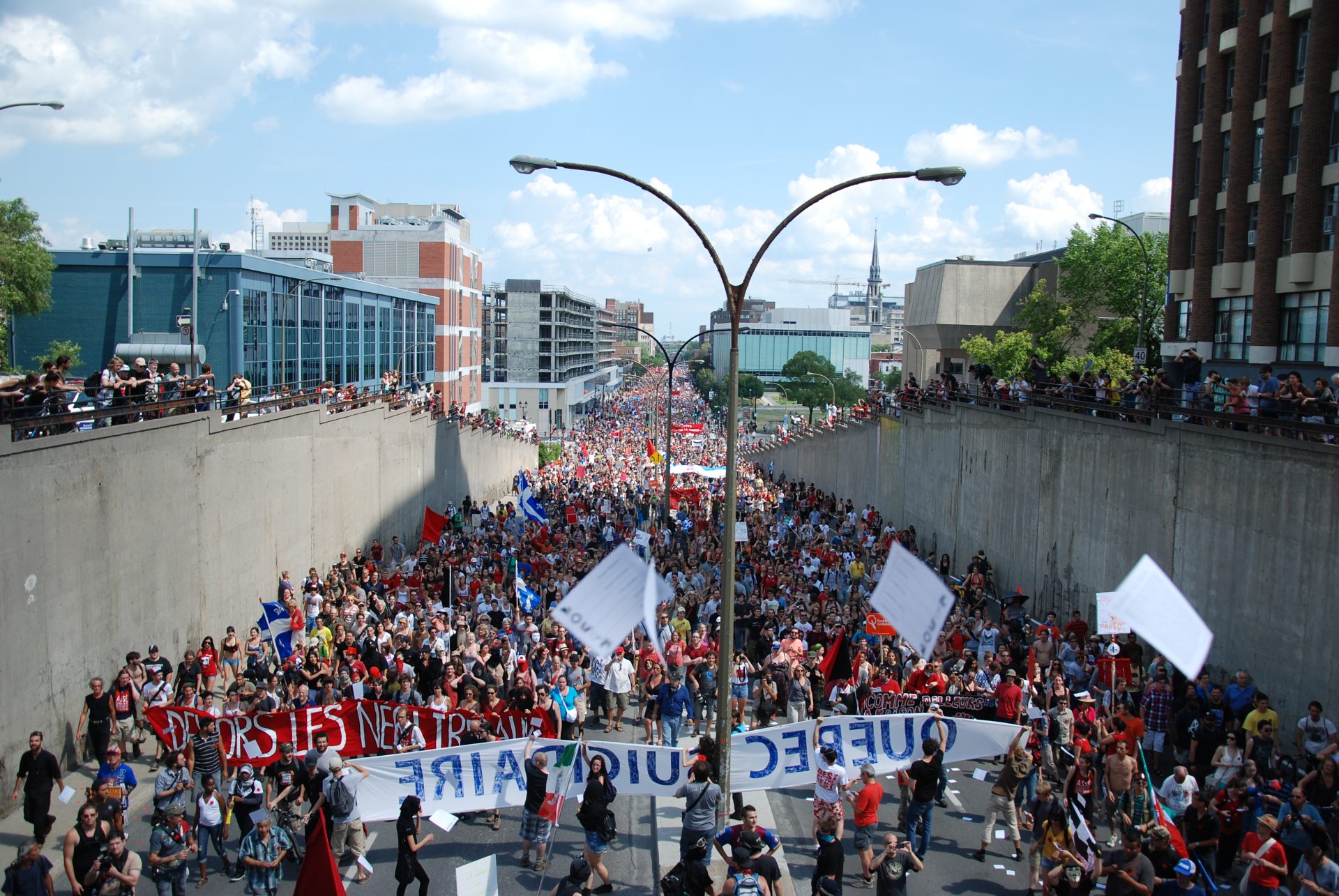
For months in 2012, students in Quebec went on strike to reverse a planned 75 per cent increase to tuition. At its height, hundreds of thousands of students refused to attend class—making it one of the largest movements in Canada’s history, and easily the largest in its modern history. It ended with the fall of the provincial government and the cancellation of the tuition hike. Quebec students had fought and won.
The lessons of Quebec 2012 and how to repeat it are being discussed today in English Canada like never before. In early 2026, student unions in Nova Scotia held strike votes at campuses for a tuition reduction—the first time in recent memory—citing the events of Quebec as their model. The red square, that indelible symbol of Quebec 2012, has started to make its appearance at student protests across Canada. More generally, the idea of holding a student strike has taken on a new popularity with thousands of students looking for a way to fight back in almost every part of the country.
But what are the lessons of the 2012 Quebec Student Strike? And perhaps more importantly, how can it be repeated today?
This booklet aims to answer those questions. It contains materials produced by the Revolutionary Communist Party (RCP) that provide a historical analysis of Quebec 2012 from a Marxist perspective. It also contains material that we produced at the time—not just from the standpoint of political analysts, but as active participants in that legendary movement.
Our aim with this text is to present students with a broad overview of Quebec 2012—how it emerged, how it was conducted, its strengths and weaknesses—as well as to arm them with the ideas they need to resist austerity today.
The role of leadership
But first, another question needs to be answered—is it even possible to repeat the events of Quebec 2012 in English Canada? If the answer is no, then a study of it would be something of a useless endeavour.
How does the situation in Canada today compare with that of Quebec in the leadup to 2012? Students are no less angry today than in Quebec at the time of its strike. There is also no shortage of students prepared to fight, as indicated by the numerous walkouts and demonstrations held at campuses and high schools around the country—some of these carried out with the least amount of organization and resources. The attitude of ordinary students, it seems, is not the problem. The main element separating Quebec 2012 from the situation today can be boiled down to one thing: a bold and decisive leadership at the movement’s head.
In Quebec, this role was filled by the Association pour une Solidarité Syndicale Étudiante (Association for Student Union Solidarity), or ASSÉ. ASSÉ was a militant student union that formed in the wake of the 2001 anti-globalization movement. Its leaders consistently argued for strikes and other mass actions as the most effective means for resisting austerity and defending students. They also produced a newspaper, Ultimatum, through which they educated students on the issues facing them and argued for militant action. In the decade since its founding, ASSÉ organized tens of thousands of students who were enticed by its radical message.
ASSÉ pushed heavily for the strike leading up to 2012, against more moderate student unions who preferred other methods. But once the strike was launched, these other unions were pulled into the fray, and ASSÉ emerged as its undisputed leader.
In English Canada today, many students are represented by the Canadian Federation of Students (CFS), which counts some 530,000 dues-paying members across the country— far more than ASSÉ’s membership in 2012. Tens of thousands more are represented through independent local student unions unaffiliated with the CFS. These unions (both CFS and non-CFS) are in the best position due to their size, influence and resources to prepare a strike along the lines of Quebec 2012.
However, while professing to support the idea of a student strike in the abstract, many of these unions’ leaders tend to pour cold water on efforts to organize a strike in practice. Instead, they have often resorted to less effective methods like lobbying, community programming, and the occasional demonstration to defend against government attacks—less like ASSÉ, and more like the moderate unions it argued against.
Incredibly, these same union leaders have often invoked the Quebec Student Strike—which they universally praise—as a justification for why a student strike outside of Quebec is not feasible in the near future.
It is then necessary to set the record straight.
‘Students don’t want a strike’
Perhaps the most common argument made by student union leaders against preparing a strike is that students themselves haven’t demanded one—and as such aren’t ready for it. To bolster this claim, they cite the “spontaneous” nature of the Quebec Student Strike, claiming that ASSÉ’s leaders simply adhered to what Quebec students were already demanding.
Of course, one of the hallmarks of the Quebec strike was its near-universal acceptance by students, and its at-times spontaneous character. However, that attitude did not materialize out of thin air. Instead, it was the product of the tireless efforts of ASSÉ’s leaders to promote the idea of a strike and secure the first few strike votes against difficult odds. These votes, once approved, provided a boost to the movement and earned the strike idea a wide acceptance with students.
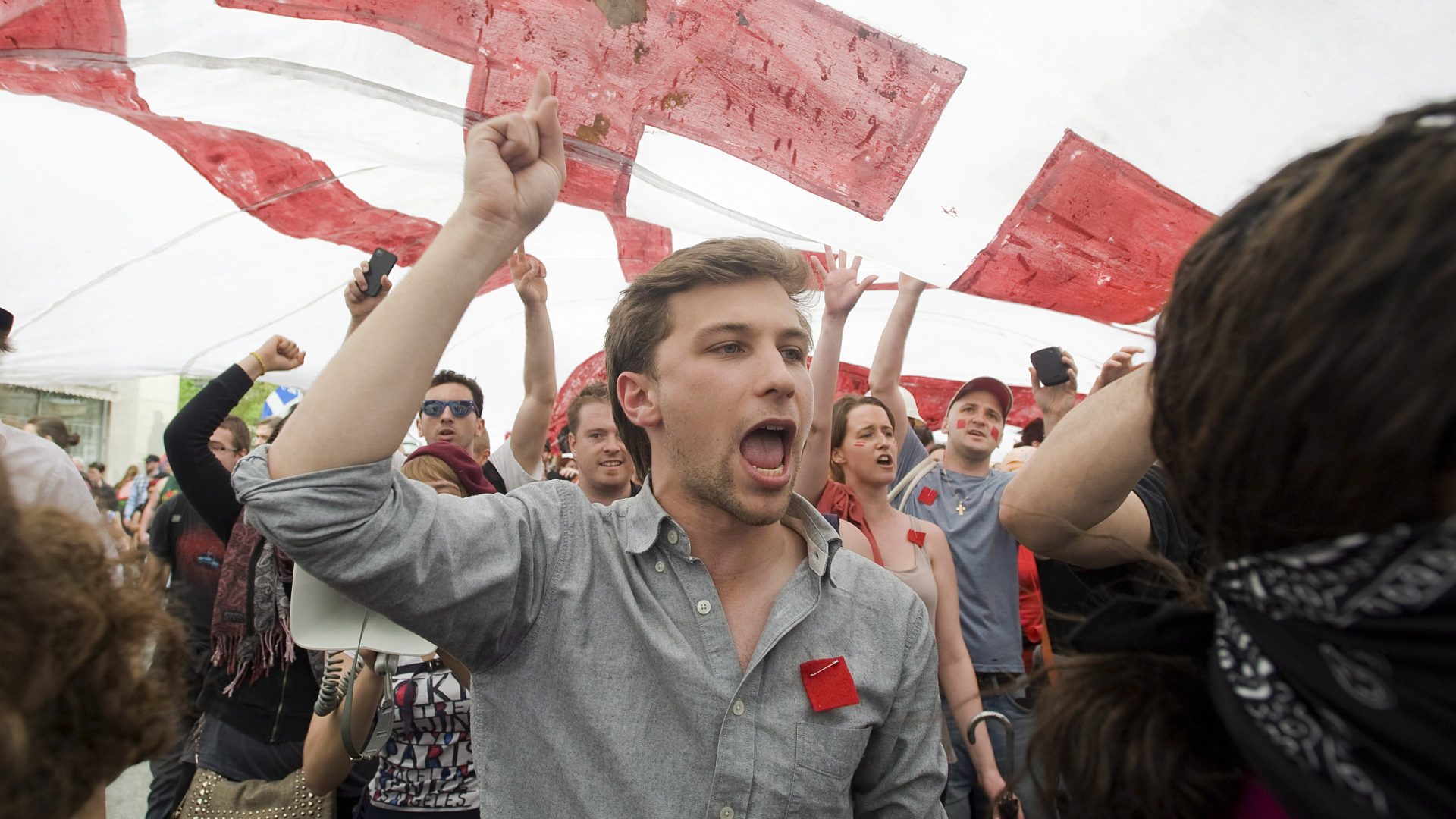
In his 2013 book In Defiance, then-ASSÉ leader Gabriel Nadeau-Dubois highlights the role played by ASSÉ’s activists in building the strike:
“We were all moved by the beauty, inventiveness, and spontaneity of the spring of 2012, but none of it would have been possible without the stubborn efforts of activists who stayed out of the public eye. We may marvel at this phenomenal political moment, but if we ignore the energies that were deployed to bring it out about, our praise will be meaningless, and, more importantly, we will run the risk of never again experiencing such events.”
Further, those who make this argument often don’t follow their own advice. When did students decide that the CFS’s method of resisting cuts should be to lobby the government? Or to hold a demonstration on a given day? In fact, there is likely more appetite in the student body for strike action than either of these two tactics.
In truth, these ideas did not come from “students themselves,” but from the brains and mouths of the student union leadership. Taken to its logical conclusion, the argument that students as a whole should first demand something before their union acts is not just an argument against a strike—it is an argument against any type of action whatsoever.
Of course, the student union leaders do not apply this logic universally—the result of which would be paralysis. They are simply looking to find any convenient excuse to avoid preparing a strike, which would then demand “stubborn efforts” from them.
‘Quebec took years to build’
Some student union leaders have also pointed out that Quebec has a unique tradition of student strikes and that, even then, the strike of 2012 “took years to build.” Therefore, we in English Canada will not be ready for a strike any time soon (or ever)—or so the argument goes. What is the truth?
Of course, Quebec does have a tradition of student strikes which doesn’t exist in the rest of Canada. This tradition dates back to at least 1968, with many strikes being held at regular intervals since then.
However, two things should be considered here. First, Quebec does have a tradition, but it did not always have a tradition. It had to be established at some point. And how else could it be established but through the “stubborn efforts” of student leaders from years gone by?
Second, while Quebec does have a tradition, traditions also need to be nourished and revived by the actions of the leaders. This is particularly the case with students since, unlike workers in a workplace, they are only at school for a limited period of time. This leaves few people with decades of experience passing down lessons to the new generation.
Before 2012, the last really successful strike in Quebec took place in 2005. How many students in 2012 would have also participated in the strike of 2005? The truth is, very few. In reality, these traditions were passed down, not by an automatic process, but through the actions of groups like ASSÉ which studied the movement’s history and transmitted it to students in the present day. This is why the movement’s leaders are sometimes referred to as “the memory of the movement”—or at least, some of them are.
But did the 2012 Quebec strike take “years to build?” Yes, but not in the sense meant by the student union leaders.
The Quebec government hinted that it was planning cuts and fee increases in the early months of 2010. However, those fee increases were not actually confirmed until March of 2011. In response, ASSÉ immediately called for one-day strikes in response to the announcement, as well as other actions.
Nadeau-Dubois describes the process:
“In the spring of 2011, Bachand played out the last act of the Liberal comedy and announced a fee increase of $1,625 spread over five years. The response was swift. In late March the pressure tactics were ratcheted up. A number of campuses affiliated with ASSÉ voted for a daylong walkout, and thousands of angry students paraded through the streets of Montreal. At the same time, a few key offices were occupied.”
The suggestion that ASSÉ moved slowly and with trepidation towards strike action, only to propose the tactic in the months leading up to 2012, is entirely untrue. In fact, ASSÉ consistently argued for the need for a strike, putting forward the idea as early as 2010. The moment the fee increase was confirmed in 2011, they seized the opportunity and put their words into action. The walkouts in the spring and a one-day strike of 200,000 in fall of 2011 helped build momentum for the all-out strike in 2012.
ASSÉ’s defining features, and what allowed it to lay the ground for the 2012 strike, were its ability to take swift and decisive action, combined with constantly hammering on the need for an ever larger and sustained strike—two features which we find absent in the student union leadership today.
‘Students are apathetic’
When all else fails, the easiest thing is to blame students themselves. Thus, we are also informed that students are “apathetic,” are “unwilling to fight,” and even that they have a “stunted political imagination.” Otherwise, of course we would organize a strike!
Apart from being insulting, these arguments are also simply untrue. The anger harbored by students towards their government is palpable for anyone who chooses to notice it. The fact that students are organizing without a clear lead from their unions, and without any resources whatsoever, is proof that they are willing to fight.
But this raises another question. Why should it be left to atomized students with no resources to lead the fight by themselves? Is this not the job of someone else, say, the student union leaders? Have they not been elected and provided with a large budget (paid for by students) for this very purpose?
In 2024, the CFS-Ontario projected that it would bring in close to $3.5 million in revenue for the next fiscal year, most of that being dues from students. Part of that is used to pay the union’s staff, whose ostensible job it is to defend the interests of students. This $3.5 million does not include the revenues made by the CFS-O’s affiliate unions, which maintain their own finances and staff on top of what the CFS-O has.
Could even a part of these resources be devoted towards laying the foundations for a strike? If no, then why not? And what does that say about the “political imagination” of the individuals commanding an apparatus that no ordinary student can lay claim to?
Even in Quebec, the leaders of ASSÉ were confronted with apathy, or at least what seemed like apathy, amongst a layer of students.
Nadeau-Dubois recounts:
“At the time, activism did not have the sheen of glamour that it would acquire at the height of the strike. Handing out flyers, doing the rounds of classes, and raising awareness—our efforts were generally met with widespread apathy, if not outright contempt.”
In fact, the mood in Quebec was such that the first strike vote in 2012 only passed by a margin of twelve votes, in an assembly of close to 1,000 students. Without the efforts of ASSÉ’s leadership to inspire students, the vote could have been easily lost—and with it, potentially, the entire Maple Spring. Instead, this early victory helped persuade students at other schools that the strike was not just idle talk, but something taking on flesh and blood that could grow and deliver results. The intervention of ASSÉ’s leadership was the decisive factor that turned the tide.
Oftentimes, what seems like apathy or an unwillingness to fight is rather an inability to fully envision what that fight looks like, or to believe that it can actually succeed. No soldier ever willingly marches into battle without a worked-out plan of attack and a trusted general staff behind him—no matter how much he may agree with the war’s aim. Moreover, it is those early, hard-fought victories that help to raise an army’s morale, preparing the way for even larger victories down the road.
The laws of war also apply to the laws of social struggle. ASSÉ did not create the mood of anger felt by students—the Quebec government did. However, its leaders helped raise the confidence of students to fight, set them on a bold but concrete plan to escalate the movement, and helped deliver them to victory.
Reviving the traditions of 2012
More than ever, the Canadian student movement needs to learn the lessons of the Quebec Student Strike. In the face of enemies like Doug Ford in Ontario or Tim Houston in Nova Scotia, a strike like that of Quebec in 2012 is the most powerful weapon that students themselves can deploy to stop the cuts and save their post-secondary education. However, many of Canada’s student union leaders seem more focused on delivering excuses than on delivering results.
But that does not mean a student strike is off the table. Student union leaders do not exist in a vacuum. The pressure from rank-and-file students acts as a counterweight to the conservative instincts of the student union bureaucracy. Once that pressure intensifies past a certain point, it can compel even the most dull union leader into taking militant action—much like with the moderate unions in Quebec.
This process can be helped along by pro-strike student groups, of which the RCP stands in front. The temptation of small groups to bypass the existing student unions and to stage our own “strike” or to form our own “unions” should be resisted at all costs. This can only lead to small actions that have little effect, while also letting student union leaders off of the hook.
Instead, we should fight for our ideas inside of our unions, enlist students who think the same way, and make the question of a student strike unavoidable. In time, student leaders who refuse to fight will be replaced with those that will. In one way or another, Quebec 2012 will find its expression in English Canada—and the RCP will lend its hand to help make it so.
However, our fight does not stop at the university gates. The austerity hitting students in Canada is also hitting workers and communities—and with equally disastrous consequences. Moreover, the move to slash spending is not just a “choice” of this or that politician, but the natural result of capitalism in crisis. Our qualm isn’t just with this or that policy, but with the system as a whole.
The RCP fights whole-heartedly for a student strike to stop the cuts to postsecondary education. However, this will just be one step towards the much larger battle looming ahead—the revolution against the billionaire class.

