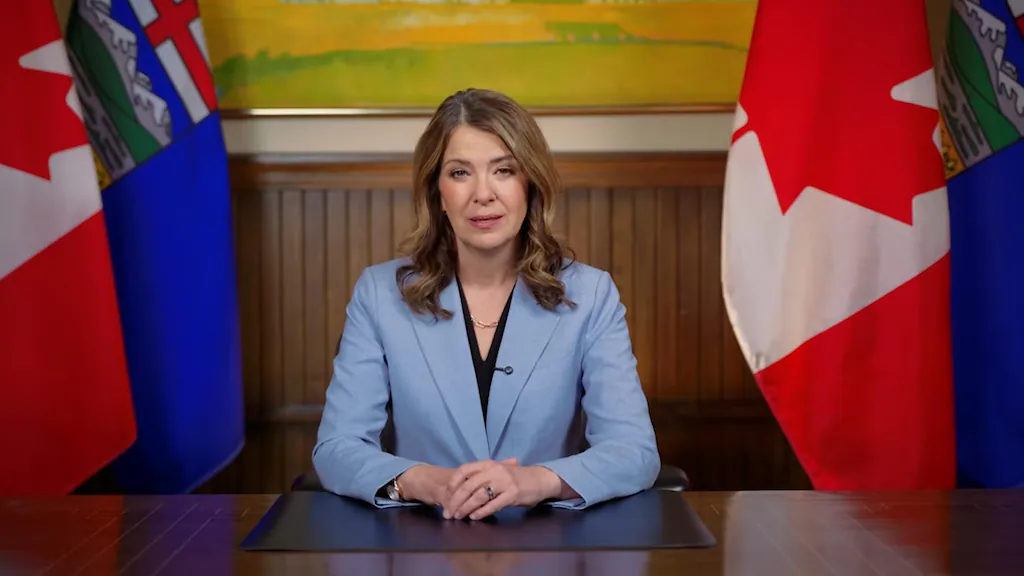
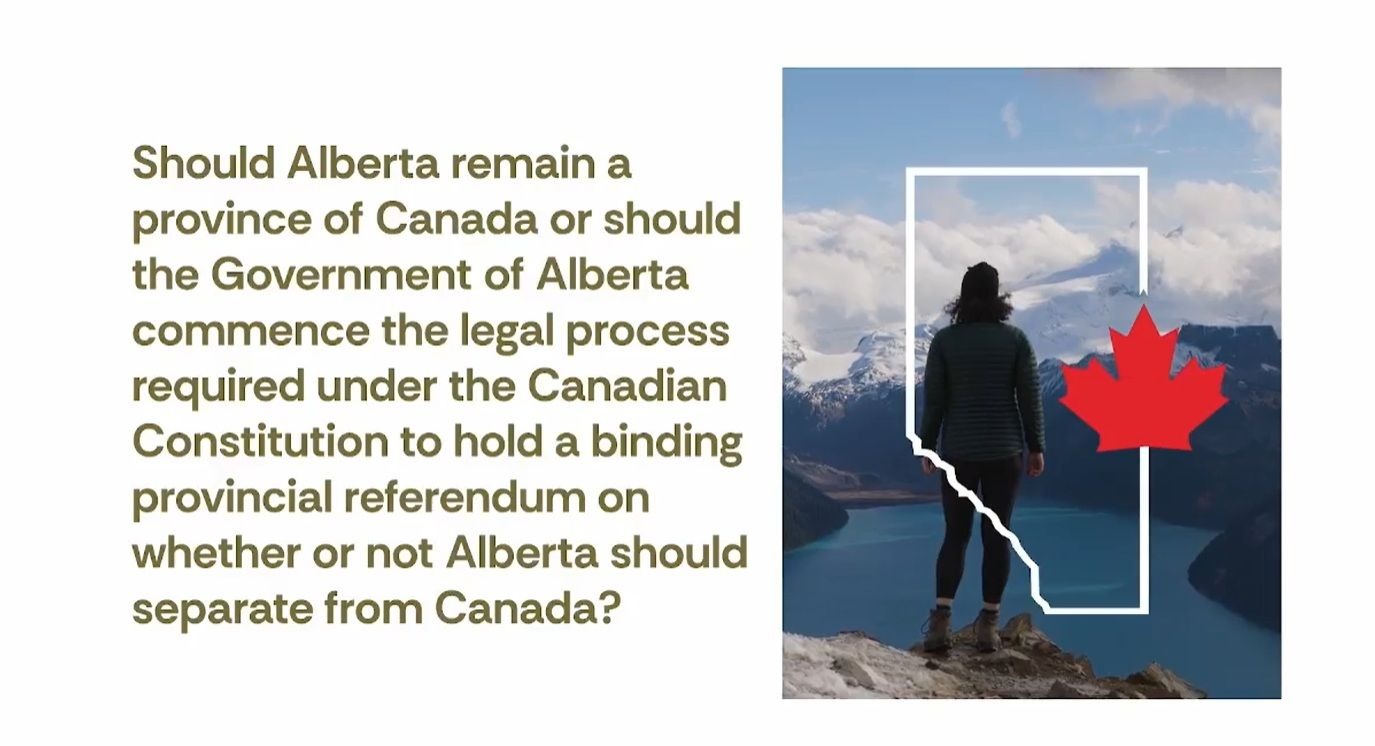
On May 22, Alberta Premier Danielle Smith announced that there will be a fall referendum on (whether or not to pursue a binding referendum on) Alberta separating from Canada. This might seem strange on the surface, but Danielle Smith is stuck between a rock and a hard place.
For her entire tenure, she has presided over an unholy marriage of two distinct parties within the “United” Conservative Party (UCP). If not contained, the infighting within the UCP threatens Danielle Smith’s own job, or even a fracturing of the party itself. Smith is desperate to avoid both of these fates, and this convoluted referendum is her attempt to hold everything together.
Unfortunately for Smith, it hasn’t worked. Smith is trying to balance on a tightrope between separatists who want independence, and oil barons who want stability. But the question she’s putting to a vote just made everyone angrier.
The reason for the referendum
The oil industry, who the UCP rules for, have long complained about federal regulations. They demand the removal of all barriers to profitability and expansion, like the B.C. North Coast tanker ban. Smith has spent the last few years lobbying on the oil barons’ behalf in her own populist way, intentionally stoking western alienation into a frenzy. She’s attempted to leverage this sentiment against federal government policies on behalf of oil and gas companies.
But this has activated and energized a right-populist faction of the UCP—the same people who ousted Smith’s predecessor, Jason Kenney. This faction, fueled by western alienation has since grown and evolved into a separatist wing that has come to dominate the party. The next logical step was to demand a referendum on the question of separation from Canada. Smith enabled this, so long as they could collect the requisite signatures.
But on May 13, a court threw out the petition which claimed 300,000 signatures for separation. Immediately politicians, labour leaders, journalists, and all forces of the establishment applauded the judge and breathed a sigh of relief. But instead of settling the issue, the ruling resulted in Smith just calling a referendum herself.
The ruling
Why did a court strike down the separatists’ referendum as unconstitutional? And how was Smith able to circumvent the court?
In her decision, the judge stated that the provincial government “failed to meet its duty to consult with the Applicants”—the Applicants being the First Nations who filed the legal challenge—as the reason why the petition had to be invalidated.
This is a novel ruling for Canadian law. In previous legal decisions like the 1998 Reference re Secession of Quebec, which set the stage for the Clarity Act, nothing states that consultation is required for a referendum to take place. This is why Quebec has had two referendums on independence.
But there’s multiple, confusing contradictions here. Anyone with a cursory knowledge of the history of Canada knows that the Canadian legal system is not friendly to First Nations. The courts, like the rest of the state, are organs of class rule and therefore cannot move beyond the limits of Canadian capitalism; which is hostile to separation in any case, Quebec or Alberta.
And the reality of “consultation” in most cases entails a government or company going to a band council, having a meeting, offering crumbs, and then doing whatever they planned to do anyway. When the Coastal Gaslink pipeline was rammed through Wet’suwet’en territory, there was “consultation”. There were no concessions, or agreements to protect the headwaters the hereditary chiefs were trying to protect, but technically there was “consultation”.
In Canadian law, this type of doublespeak on Indigenous rights is standard. Even in cases where “free, prior and informed consent” (FPIC) of Indigenous people is mandated, the courts turn it upside down. In 2025 a federal court ruling stated that “FPIC is a right to a robust process.” and “it is not a veto or a right to a particular outcome”. A right to a “process” is a mile away from “consent”.
In the May 13 ruling, the courts are using “consultation” as a convenient excuse to stop a referendum, after years of using “consultation” as a justification to force through projects that nations, or large groups within them, opposed. At no point do the nations actually get a say, unless they are already aligned with the interests of Canadian capitalism.
The reason the courts struck the petition down is the same reason why the entire establishment is hostile to the idea of even having a vote on separation. Because it opens the door to a constitutional crisis, and unmitigated disaster for Canadian capitalism. These are seen by Smith as acceptable risks to take, in order to keep the UCP from fracturing.
The double standards
The first initiative to qualify for a referendum after Alberta’s referendum laws were modified was the “Forever Canadian” petition, a Canadian nationalist project created by an ex-Tory minister. It asked “Do you agree that Alberta should remain in Canada?”.
The Forever Canadian petition’s question is fundamentally the same question as the separatists. The only difference is that, like Smith’s question, it would not pass the Clarity Act, an undemocratic federal law meant to give a legal cover to deny Quebec’s right to self determination. This effectively means that Smith’s referendum, if the “yes” vote wins, would result in a legal grey area, without a mandate for immediate independence.
But in contrast to the separation petition, the Forever Canadian petition faced no legal or procedural scrutiny. It was endorsed by establishment figures of all types, and even bankrolled by the union tops.
All these facts paint a picture of separatists as repressed freedom fighters. They are being blocked by unelected judges, patronized by politicians, and told that they are a threat to democracy by journalists, all for campaigning for a referendum!
In the context of economic crisis and general political dissatisfaction, this is an environment ripe for the growth of anti-establishment movements like separatism—particularly in Alberta which has been in a protracted economic crisis for over a decade. Since 2014 Alberta’s real disposable income per capita has fallen by 13 per cent, and is still trending down. Life has been worse for most people for 12 consecutive years compared to the past, and there’s no end in sight.
The arguments made by establishment figures seem to simultaneously argue that the separatist movement is a small minority with no chance to win, but also, they cannot be allowed to have their referendum. Why? If the separation vote is so marginal, why is the establishment scared of a vote?
Before the court ruling, some demanded the referendum be blocked on extremely dubious grounds, including the data leak of Alberta’s voter list, and allegations of “foreign content farms” and “dark money”. While the data leak is serious, it’s also the work of a handful of people, or less. Polls have shown that the number of people who would vote for separation account for a quarter of the province, or more. The separatist movement as a whole cannot be blamed for what one or two idiots did with the voter list. The alleged foreign interference is not only silly, but paternalistic towards ordinary people, as if Albertans are dumb enough to be pushed to separation by AI slop videos.
The issue of Western alienation
The question of democracy gets to the heart of one of the most potent aspects of western alienation, which is that people feel left out of the political process.
There’s a phrase in Alberta that’s said whenever there’s a federal election: “The election is already decided when polls close in Quebec and Ontario”, meaning votes in the West usually don’t matter because the population is marginal in comparison.
The economic centre of gravity of Canada is in southern Ontario. Most senators are from the east. Even though Alberta punches above its weight economically, nationally it rarely factors into federal politics. This is a reflection of the weakness of Canadian confederation but also the nature of bourgeois democracy.
Ordinary people feel left out of the process because there is no role for them. They can vote every four years, but then everything is left in the hands of the “experts” in Ottawa, who rule in the service of their corporate masters. When life is good and the economy is growing, this might work.
But when life is falling apart, like it is now, this is not good enough. People of all stripes are looking for some kind of democratic outlet to express their anger, especially people who look to the period of economic boom and prosperity that existed in Alberta before 2014. These people have been told for years, if not decades, by Danielle Smith, Jason Kenney and going all the way back to the Klein and the Lougheed years, that the federal Liberals are intent on preventing the oil industry from succeeding. It’s perfectly logical that they would look for some sort of solution to escape Ottawa’s grip, if they never heard a better explanation.
And yet they’ve been prevented from pursuing that outlet by a judge who was appointed by the federal Liberals. These events are exposing bourgeois democracy for what it really is; undemocratic. Why can’t Alberta have a vote on separation? Quebec has had two!
Separatist leader David Parker wrote a post after the ruling came down: “Democracy in Alberta is on life support.” This is not far off, but Lenin expresses it much clearer in State and Revolution,
“But this democracy is always hemmed in by the narrow limits set by capitalist exploitation, and consequently always remains, in effect, a democracy for the minority, only for the property classes, only for the rich.”
The reason behind the First Nations’ legal challenge
If Canada’s legal system has contributed to the oppression of Indigenous people, why would First Nations spearhead the legal challenge to stop the referendum? The answer is that the treaties and their relations with the federal government are the devil they know, and the leadership of the separatist movement is the devil they don’t want to know.
Separatism has historically been on the far-right fringe of Alberta’s political spectrum. The personal views espoused by the leaders of separatist organizations like Alberta Prosperity Project and Take Back Alberta include “getting rid” of unions, and privatizing healthcare and education completely. An independent Alberta led by these people is not a prospect these nations want to entertain. It is a reactionary right-wing project through and through.

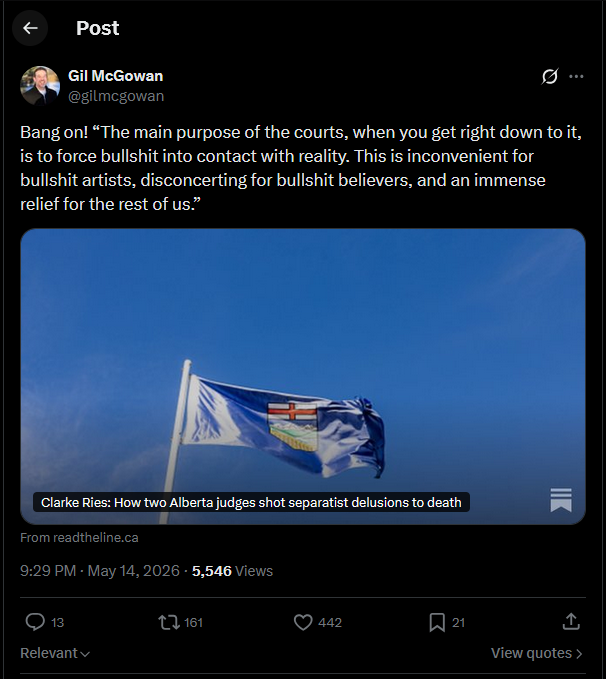
The left wing and the labour movement in the province recognize this, but instead of making a class-based case against this reactionary separatist project, they’ve tied themselves to the hated establishment in the camp of Canadian nationalism—against a democratic vote. Alberta Federation of Labour leader Gil McGowan stands shoulder to shoulder with ex-Tory ministers he once fought against. They both argue to stay in Canada for reasons of “peace, order, and good governance”, but Gil sprinkles in a mention of the (formal) right to join a union, the (pitifully low) minimum wage, and the (almost non-existent / mythical) right to strike.
This is a losing strategy. People will fight for a better world, they will not fight to maintain the status quo that gets worse by the day. In Alberta specifically, very few people will be motivated to fight on the side of Ottawa for a deteriorating Canada.
The communist position
The reality that the working class needs to understand is that Danielle Smith is cynically manipulating western alienation and distorted class anger towards Ottawa. She is doing this because of contradictions within her own party, which are a very real threat to her position.
In response to Smith’s referendum, Jeffrey Rath, a constitutional lawyer, and maybe the only separatist leader who knows what the Clarity Act is, wrote: “It’s time for Danielle Smith to go. Don’t make excuses for her. This is THE most corrupt political move pulled by an Alberta Premier in my lifetime.”
David Parker, the principal architect of the leadership review that removed Jason Kenney followed suit, writing: ”Danielle Smith has betrayed her base. Time for a new leader.” This is exactly the fate Smith was trying to avoid: a rabid group of engaged separatists gunning for her removal.
But what must be understood is that the sentiment towards separation is very real. People feel like they are getting ripped off, because they are getting ripped off. An unsatisfactory UCP drafted referendum on whether or not to have a real referendum will not make this sentiment disappear.
The problem with separation as a solution, is that the separatists are dead wrong about who’s exploiting hard-working Albertans.
Nearly a year ago we wrote:
“The fact of the matter is that the oil bosses extract massive profits off of the backs of the working class in Alberta and are the real enemy of the Albertan working class. For example, oil and gas companies in Alberta raked in $35 billion in profits in 2023 alone. This is far more than the $3 billion Alberta paid in equalization payments that same year. And, while some of the money from equalization goes to fund social services, the profits of the oil bosses vanish into the pockets of shareholders and executives.”
While the problems of Confederation, provincial rights and equalization payments are real issues, they are not the reasons for Alberta’s low wages, deteriorating living and working conditions, collapsing healthcare system, etc. The real culprit here is the capitalist system itself, specifically the oil barons, who have extracted out of the province hundreds upon hundreds of billions of dollars over the decades.
From our perspective, the referendum question should be: Should the people of Alberta expropriate the parasitic oil barons and robber capitalists who have plundered the province?
The separatist leaders in Alberta have theorized the essential difference between the east and west. They claim that westerners are builders, and providers, while easterners are takers, and moochers. But this is categorically false. Wherever there are working class people, whether in the east or west, workers are the builders of all of society. Not a lightbulb shines without the kind permission of the working class. There are “moochers and takers”, but they are not just from the east. They are from a different class that dominates the entire country—they are the capitalist class, the ruling class. These are the people who profit off the hard work of ordinary Albertans, Ontarians, and Québécois alike. The interests of working people of the entire world are the same. To overthrow these parasites who benefit from our expense.
The other lesson working people need to take from this episode is the nature of bourgeois democracy in our epoch. We should have no illusions in the courts, state institutions, parliament, or any other component part of bourgeois democracy to act in favor of the working class or the oppressed. These institutions are rotten, and in many ways, are a barrier to democracy. They serve the interests of the ruling class, which are often transparently hostile to any democracy, especially in the case of Quebec’s right to self determination.
Real democracy is only possible under socialism which would extend democratic decision making to the economic sphere. This is the only true way to have control over our lives and the only real way to guarantee that the fruits of our labour are not syphoned away by some clique of capitalists or unelected bureaucrats.

