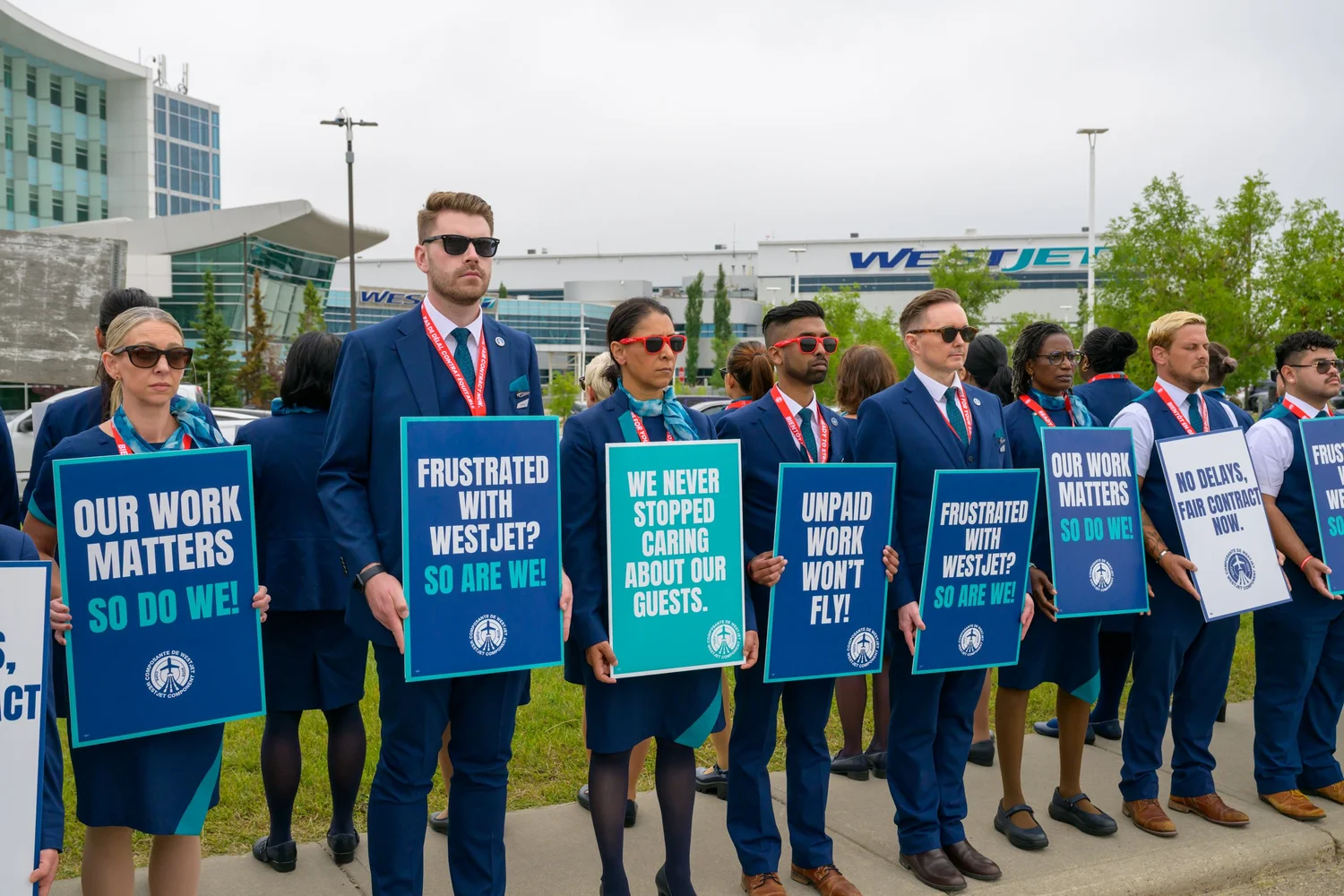
Over 4,000 WestJet flight attendants have voted overwhelmingly to strike. On July 14, 2026, CUPE Local 8125 announced a strike vote of 99.4 per cent, with a 97 per cent turnout. A strike could come as early as Aug. 2, almost a year after Air Canada flight attendants defied a federal back-to-work order for the exact same reasons—unpaid work and low wages.
This level of support is no surprise. WestJet flight attendants work an average of 35 unpaid hours monthly, a situation CUPE president called “archaic and exploitative.” Wages have also not kept up with inflation. The result is that, especially if flights are short or heavily delayed, flight attendants often make less than the federal minimum wage.
Yet WestJet has been intransigent. WestJet CEO von Hoensbroech even denied the existence of unpaid work. And management has refused to match the contract obtained by Air Canada flight attendants, which itself did not even eliminate unpaid work.
It is clear that strike action is the only way to defeat unpaid work and win an acceptable contract. And the workers are in a strong position. The workers are itching for a fight, as the overwhelming strike vote shows. And they hold massive leverage over WestJet. In just three days of strike action, Air Canada lost an estimated $375 million.
But in order to win, the lessons of the historic Air Canada flight attendants’ strike must be learned. In that strike, the federal government issued a back-to-work order, making the strike illegal. The flight attendants defied the order and, in less than a day of illegal strike, the government was forced to withdraw it. This earned the flight attendants the honour of being the first to defeat a back-to-work order in a generation. There is every reason to believe that the government will once again declare the strike illegal. So CUPE leadership must be prepared to defy once again.
However, one aspect of the Air Canada strike should not be repeated. After the back-to-work order was defeated, the union had the upper hand and should have continued the strike to defeat unpaid work once and for all. Instead, the union leadership took down the picket lines and recommenced negotiations behind closed doors. This was exactly what the Air Canada bosses wanted; taking down the picket lines allowed profit-making to resume, weakening the union’s position.
Unsurprisingly, the deal that came out of this was not much different from the one on the table before the strike. While CUPE leaders declared that “unpaid work is over,” the contract did not eliminate unpaid work, leaving workers furious. To add insult to injury, workers were only allowed to vote on the wages portion of the contract. And even when this was overwhelmingly rejected, union leadership sent the contract to arbitration, which unsurprisingly ruled in the bosses’ favour.
The WestJet flight attendants’ struggle cannot be directed down the same path. The workers themselves must be in full control of the strike. Picket lines should not be taken down without a vote and no deal should be accepted without the workers being able to vote on it. In order to guard against sellout deals negotiated behind the backs of the workers, the principle of open bargaining must be established so that every step of the way, the workers are kept apprised about all developments.
By striking to win and defying any back-to-work orders, WestJet flight attendants can defeat unpaid work and score a major victory for the entire labour movement.
Prepare to defy!
Strike to win!
Read about last year’s strike against Air Canada
Flight attendants in a fight for their lives against Air Canada
‘An abusive relationship’: Interview with an Air Canada flight attendant
Flight attendants defy the government—escalate the movement to win!
Flight attendants defeat back-to-work order—but leaders accept bad deal
Flight attendants vote a resounding NO – but leaders quash union democracy

