At the end of February, Doug Ford announced massive cuts to OSAP student grants and the end of the provincial tuition freeze. This immediately sparked huge anger, and there have already been a series of protests all across the province. Students everywhere are looking for ways to fight. Now, after an initial burst of activity, many are wondering, what next?
The emerging student movement
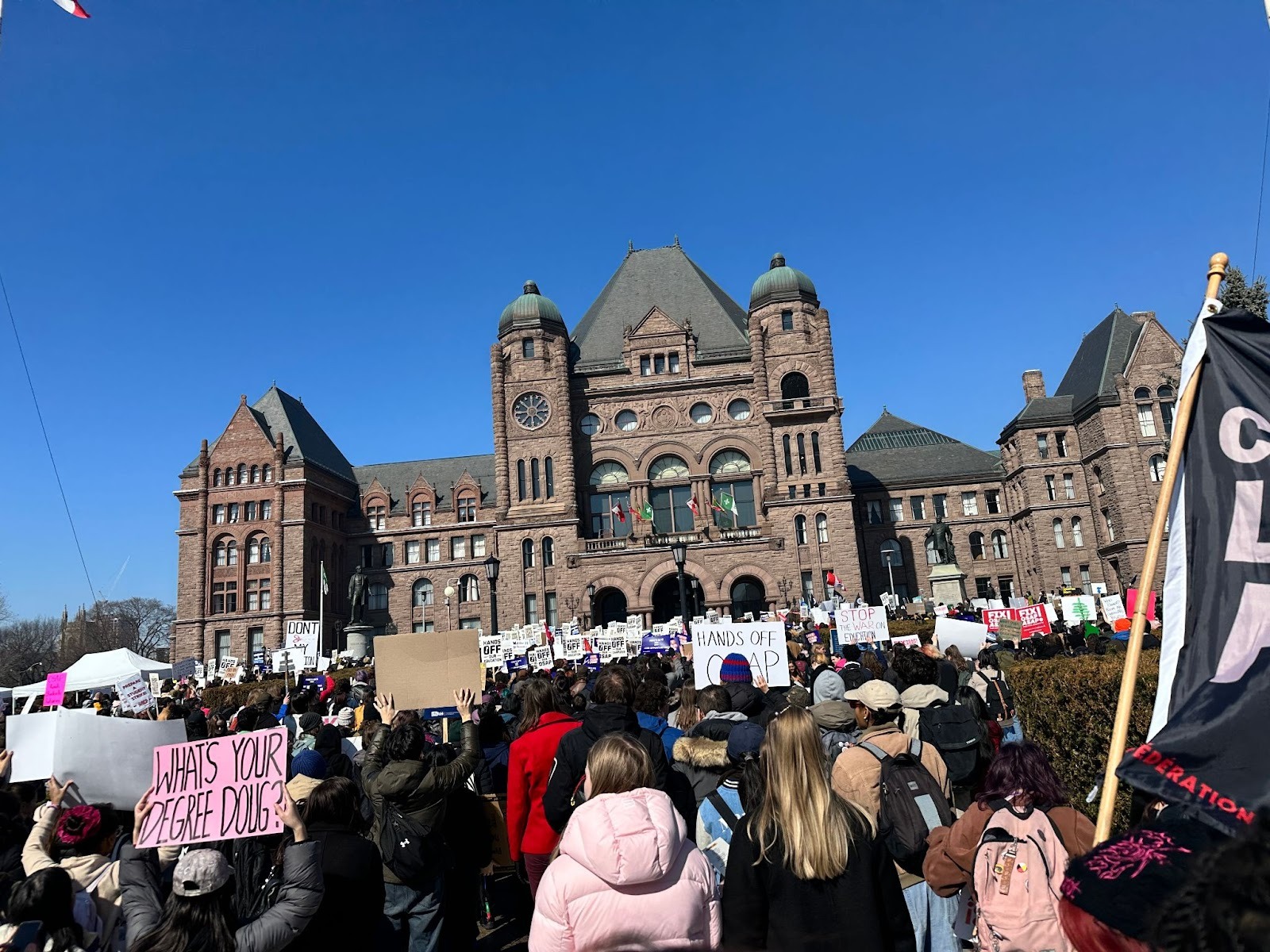
The clearest expression of this anger so far was on March 4. On the initiative of the Canadian Federation of Students (CFS), around 2,000 students gathered at Queen’s Park in Toronto to protest the OSAP cuts. There were students present from all of the main post-secondary institutions in the city, as well as campuses in places like Peterborough, Hamilton, and the Durham region.
On the same day, there was a rally of several hundred students in St. Catharines. But the best showing at any individual campus was at the University of Waterloo, where 1,000 students went on a one-day strike. Students marched around campus, chanting in favour of a “province-wide student strike.”
This anger isn’t just restricted to postsecondary campuses. High schoolers, many who feel like they’ve been robbed of an affordable education, have also been organizing protests.
Over the past few weeks, there has been a series of walkouts at high schools all over the province. A group of high schoolers from 20 schools across Durham walked out on March 1. Another group in Windsor walked out on March 4.
And it seems like this movement is picking up serious steam. Students from over 120 schools are preparing to walk out on March 11. This includes campuses in practically every major urban center in the province, including the GTA, Ottawa, London, Kitchener-Waterloo, Windsor, Niagara Falls, Barrie, and Guelph
Along with real-life protests, there’s been a flurry of activity all over social media. Instagram pages and WhatsApp groups have been kicked off by ordinary students in order to organize on their campuses. You can find “protest” or “strike” accounts for just about every major city or campus in the province.
By every indication, we are witnessing an emerging mass movement. In the same way that small bubbles float to the top of water before it boils, mass movements are always heralded by smaller bursts of anger. It may not take long for the pot to boil over.
Anger clearly exists for a serious struggle. Tens of thousands of students have already shown that they’re ready to fight. How can we best channel this anger and win a victory for students?
Ford not backing down
First, we need to base ourselves on a clear appraisal of the situation and an understanding of who we’re up against.
Despite anger from students, Ford and his cohorts have shown absolutely no hesitation. In fact, they’ve made all sorts of statements that seem intended to mock students. It’s very clear that the provincial government expects to get away with this.
For example, take Ford’s now-infamous comment that if students are angry about education costing more, they should go into “in-demand” programs instead of “basketweaving” courses. Nevermind that the OSAP cut will also make these in-demand programs more expensive. This is an insult that barely even attempts to justify his attack.
There were also his allegations of OSAP fraud. According to him, there’s a big problem of students who don’t need grants taking them out to buy “fancy watches and cologne”. But by the government’s own admission, in 2025, there were only 900 potential cases of OSAP fraud. With 437,000 students on OSAP, that’s less than 0.2 per cent of recipients in question—a miniscule figure.
There were also comments from Progressive Conservative MPP Andrew Dowie. When confronted with a group of angry high schoolers, he told them that it only took “a couple months” to pay off his student loans because he “went to work”. This shows how extremely out-of-touch these people are with the lives of normal people.
These statements deserve to be highlighted because they show the government has no plans to back down. They’re sticking to their guns and making no apologies for it.
This shouldn’t be surprising. The Ford government has been attacking workers and students ever since they got into power. They have no short list of public scandals attached to their name, yet they’ve very rarely apologized or backed down from anything.
This stems completely from their class nature. The Progressive Conservatives are the party of the province’s billionaires. They’ll always line-up to defend the interests of the rich. This is especially the case now, as capitalism sinks deeper into crisis. The instability of the world market and the trade war with Trump has introduced incredible instability in the Canadian economy—especially in Ontario, the heartland of Canadian manufacturing. In this context, public finances are strained, and the bosses are determined to hand the bill of the crisis to workers and students.
We can’t expect these people to back down through moral pressure. We can’t appeal to their deeper sensibilities. They are hardened class enemies. They won’t listen unless we force them to listen, so we must begin preparing now.
The need for a strike
As we’ve argued already, the goal of the movement should be to build towards an all-out, province wide student strike. By that, we mean a movement where students decide collectively and democratically to cancel all classes and organize to shut down campuses completely until the government backs off.
There’s precedent for this. This is exactly how Quebec students beat back tuition raises and toppled the provincial Liberal government in 2012. Another example of this tactic is the 1986-87 Spanish school students strikes. This movement, led by Marxists, brought out millions of students, defeated cuts and won significant funding for public education. We need exactly this type of movement in Ontario.
Of course, this can’t be built overnight. But if the student leadership takes up the call and starts popularizing the idea now, great things can be achieved.
The massive movements of Quebec 2012 and Spain 1986-87 were made possible by a series of escalating actions. By leading walkouts, rallies, and partial one-day strikes, the student leaders won confidence and support for an all-out strike among the masses of students.
There’s already an appetite for such a movement. Our petition calling for the CFS to begin preparing a student strike has, at the time of writing, gained 2,600 signatures in just a couple of weeks. It’s picked up some steam online and continues to get hundreds of signatures every single day.
Another example can be seen at UWaterloo.The Waterloo Undergraduates Student Association has openly called for a student strike, and they’ve been popularizing the idea through their social media. Before March 4, they held a vote to declare the protest a strike day. They put up posters about the vote in just about every building on campus. Of the 3,536 who voted, 94 per cent voted to strike.
Here, anger at campus was given clear leadership and mobilized around clear demands. As a result, more students from UWaterloo came out for March 4 than from any other campus in the province. This is no coincidence. This same approach should be emulated everywhere in Ontario.
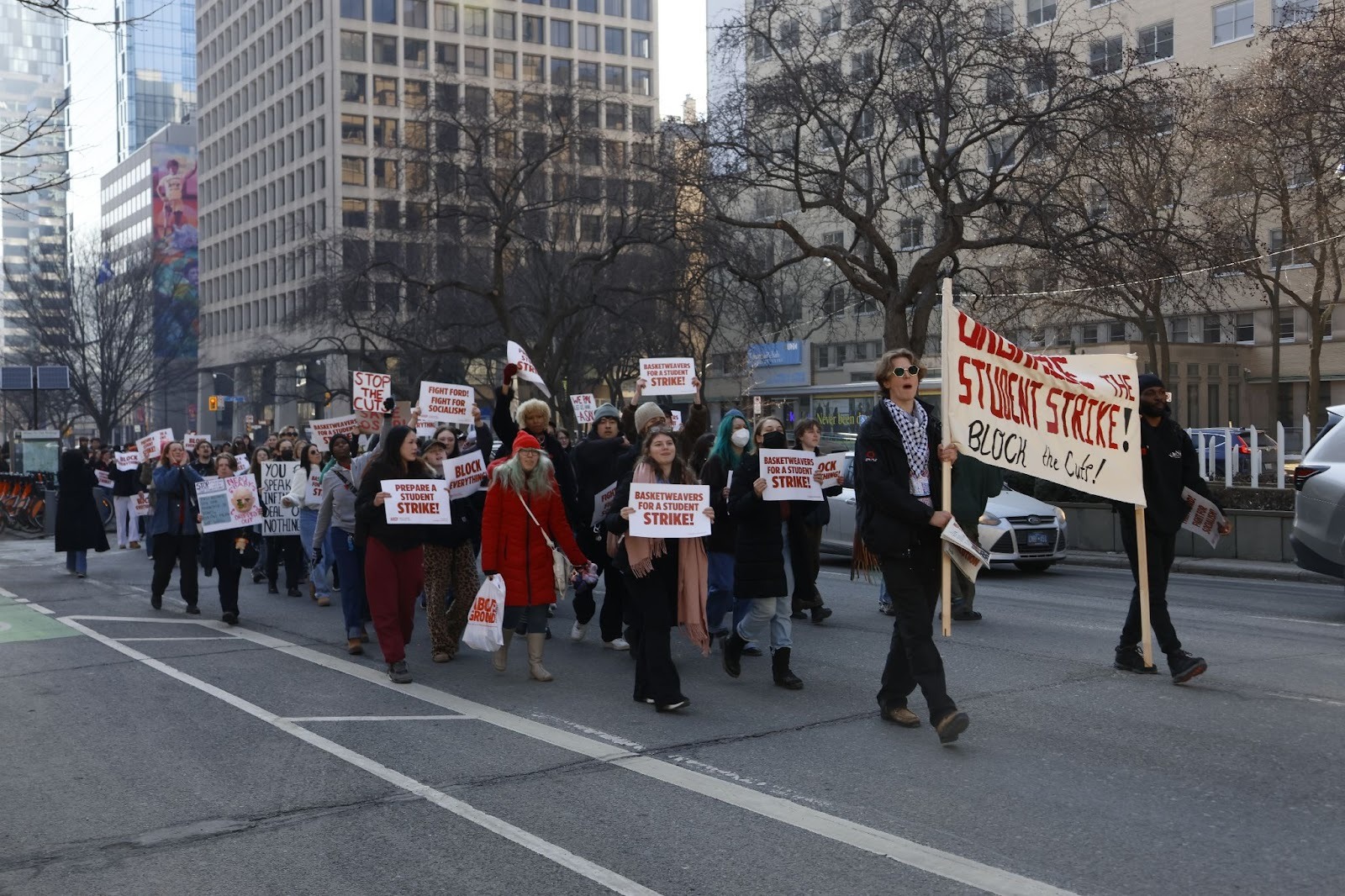
We would also like to point out our work at OCAD University. On March 4, our comrades there staged a walkout and march demanding a student strike. We only have a handful of student comrades at OCAD, yet we were able to draw out 200 students—a big crowd for a campus of only 4,500. If a small group was able to have this kind of an impact, what could be achieved on a mass scale?
The next steps
First of all, the CFS must take up the demand for a student strike. Representing 350,000 students in Ontario, they are by far the biggest student organization with the largest reach. They are the organization in the best position to lead the type of movement that we need.
The CFS and the local student unions should conduct a broad educational campaign informing students of what a student strike is and why it’s necessary. Like the student union at UWaterloo, they should create social media content and posters popularizing the idea, and spread them widely.
The student leadership must also begin preparing a real plan for escalation. The CFS has already announced another rally in Toronto on March 24, to coincide with the provincial government’s return from its 14-week winter vacation. This is a good step, but it shouldn’t just be a repeat of March 4. It should be seen as an opportunity to build a student strike movement.
That’s why we demand that the CFS call for a one-day, province-wide strike on March 24. The CFS, along with the local student unions, should mobilize widely to get the best showing at as many different campuses as possible. General assemblies and strike votes should be held on every campus, so that students can decide the next steps and organize the campaign themselves.
By bringing out as many students as possible around the demand for a student strike on March 24, we can popularize the idea and win confidence in the movement from a wider layer of students. A successful one-day strike would be a step-towards an all-out strike like Quebec 2012.
The student unions shouldn’t let logistics stand in the way of action. The exact next steps will naturally vary from city to city, and campus to campus. The important thing is that we escalate, mobilize widely, and put this movement in the hands of students.
Student leaders, the ball is in your court. Students are ready to fight. It’s up to you to give a clear lead and start preparing the path towards victory.
Fight Ford!
Prepare the student strike!
Block everything!

