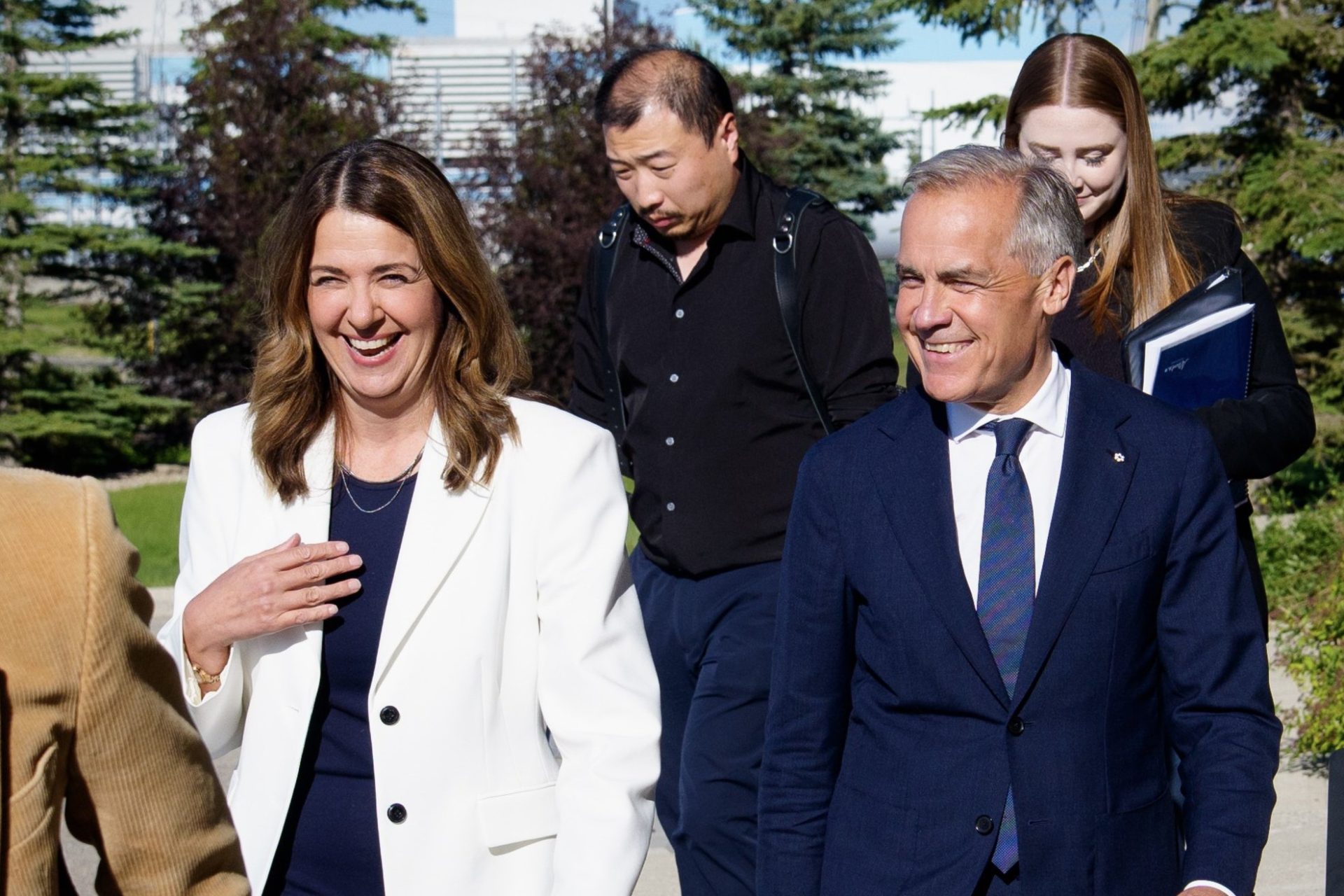
On Thursday evening, Mark Carney and Danielle Smith held a press conference where they announced, at long last, that a company had been found to build a new pipeline from Alberta to BC’s Pacific coast.
The announcement followed the signing of a “Memorandum of Understanding” between Carney and Smith in November of last year, the main point of which was an agreement to approve the Alberta-proposed pipeline so long as certain conditions were met. However, no company had come forward offering to build it at the time.
Now, to many people’s surprise, the project has been handed over to the state-owned Trans Mountain Corporation—surprising because, until now, both Carney and Smith had insisted that the new line would be built by a “private sector proponent.” Instead, as with the first Trans Mountain pipeline, the government has once again stepped in to pick up the slack—and at a potentially great cost to the Canadian taxpayer.
In fact, the eventual involvement of the federal government was all too predictable (and in fact was predicted in our articles). Alberta’s oil barons had long since signalled that they saw no business case in building a new pipeline as proposed by Smith. In May, Enbridge’s CEO stated it plainly: “Enbridge is not a proponent of this pipeline. And frankly, nobody is at this point in time as the conditions just don’t exist to commercialize such a proposal.”
The private sector worried that a new pipeline could meet the same fate as other past projects, including the cancelled Northern Gateway pipeline—an outcome that would prove catastrophic to their balance sheets. The public sector remained the only proponent capable of absorbing the risk. In his own statement in May, Trans Mountain’s CEO hinted that the federal government “know[s] very well that we’re here and what we’re capable of doing.”
Keeping secrets
In all likelihood, both Carney and Smith knew for some time that Trans Mountain would step in to build the project. But if that holds true, then why the months of insisting that the private sector would get the job done?
The most obvious reason is the cost to the Canadian public. The original Trans Mountain pipeline ended up costing Canadian taxpayers $34 billion to build—more than six times the estimate when the project was taken over by the federal government.
According to Smith, the new pipeline will end up costing in the range of $35.2 billion to $43.7 billion—though that may well be an underestimate, as projects of this scale usually are in their early stages.
Carney defended the cost of the new project by arguing that “this will be another very profitable pipeline”—a reference to the original Trans Mountain line. However, while that pipeline has been raking in some $1 billion a year, at a cost of $34 billion to build it may well be decades before Canadian taxpayers see a return on their investment—if indeed they ever do.
Further, Smith has projected that the new pipeline will not be completed before 2034. It is anyone’s guess what the price of oil might be eight years (at least) from now, and whether or not this new project will generate public revenue at even the levels of the current Trans Mountain line. This poses an obvious question: if the potential payout for the public is so strong, as Carney claims, then why isn’t the private sector willing to build the project itself?
The involvement of Trans Mountain also means a humiliating climbdown for Smith. Alberta’s Premier has built her political career touting the economic value of the oil and gas giants and the private sector writ large. In May, Smith lampooned newly-elected NDP leader Avi Lewis as being “pretty communist” and wanting to “nationalize everything.”
However, despite her best efforts, Smith’s friends in the private sector left her hanging high and dry. Defeated, she had no option but to turn to the federal government and its own company to have her wishes fulfilled. Whether or not she considers herself “pretty communist” for doing so is unclear.
Who benefits?
The potential benefits of a publicly-built pipeline for ordinary Albertans and Canadians remain questionable at best. The potential costs, meanwhile, will be huge. And is a multi-billion dollar pipeline really the best use of taxpayer money when Canada faces a shortage of hospital beds and child care spaces, among other pressing needs?
The only group guaranteed to benefit will be Alberta’s big oil producers. The construction of a new pipeline by Trans Mountain will open up new markets to them and help lift their profits—and at virtually no cost to themselves.
This comes at a time when Alberta’s oil companies are already raking in windfall profits as a result of the closure of the Strait of Hormuz—most of which will never be seen by Alberta’s people, let alone the rest of Canada. The profits flowing from this generous public gift will no doubt be shared out in the same way—that is, they won’t.
Beyond that, the enlistment of Trans Mountain serves as a harsh condemnation of the state of Canadian capitalism itself. Both Carney and Smith had framed the new pipeline as an important “nation-building” project and as a way to shrink Canada’s reliance on the U.S in the context of the ongoing trade war. However, despite its declared importance, the private sector was nowhere to be found in the moment of need. Once again, the state has stepped in to save Canada’s capitalists from themselves.
Canada’s oil barons now get to breathe easy and profit heartily with another pipeline paid out of the public purse. The workers whose tax dollars will fund it? They get diddly squat.

