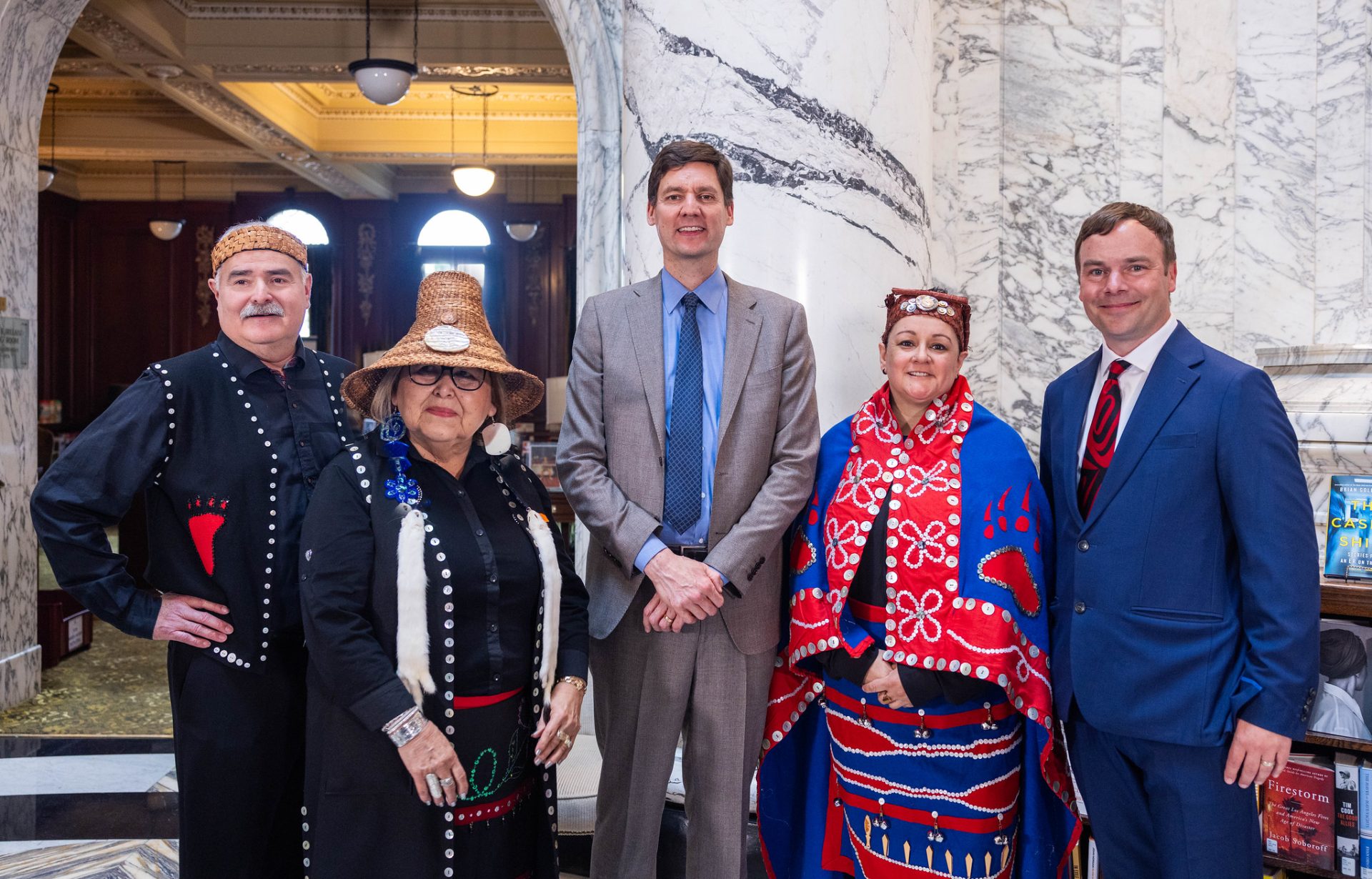
In the last decade, the Canadian ruling class has made a big show of its so-called “reconciliation” with Indigenous people. This came with many promises and symbolic gestures. Nowhere did these promises raise as much hope as in British Columbia, where the NDP government adopted the Declaration of the Rights of Indigenous Peoples Act (DRIPA). Now, recent developments in B.C. have revealed starkly something that Marxists have always explained: reconciliation is impossible under capitalism.
Eby flip-flops on DRIPA
At the beginning of April, B.C. Premier David Eby announced plans to amend DRIPA. This marks a sharp shift in the approach of the provincial NDP, which had previously made British Columbia the first and only jurisdiction to adopt the United Nations Declarations on the Rights of Indigenous Peoples (UNDRIP) into law.
UNDRIP recognizes that Indigenous people have the right to autonomy, self-government, and the right to own and control resources on their land. In line with this, DRIPA promised that “free, prior, and informed consent” would be required before any economic activities could take place in and through Indigenous communities.
Most governments across the world realized that these rights would ultimately be impossible to grant under capitalism. In Canada specifically, with hundreds of Indigenous governments across the country, the ruling class could never tolerate “free, prior, and informed consent” to have access to land and resources. This led to the federal Liberals informing Indigenous groups that passing UNDRIP into law was “unworkable”. And now Eby is learning this lesson the hard way.
The attempt to implement DRIPA has led to a series of court cases which have sought to clarify the relationship between Indigenous land rights and private property. In particular, Eby has cited a recent case in which the court sided with Indigenous groups against the interests of mining companies as the reason the law needs to change.
Opposition to Eby’s amending of DRIPA was immediate and visceral. Prior to announcing his plans, Eby broke the news to a meeting of Indigenous leaders. According to The Canadian Press, “speaker after speaker lambasted Eby.” One leader called it “absolute betrayal.” Another said that it “smacks of colonialism.”
This has provoked a governmental crisis, nearly leading to a snap election. The NDP caucus—which tenuously governs with a majority of just one—has become divided on the issue, meaning Eby doesn’t have the votes he needs to change DRIPA. At least 10 NDP MLAs, led by Joan Phillip (the wife of Grand Chief Stewart Phillip, president of the Union of BC Indian Chiefs), have stated that they will oppose any attempt to amend the law.
While Eby first said the changes to DRIPA were “non-negotiable,” he has been forced to walk this back, faced with internal opposition and mass protests. But this does not mean that Eby has abandoned his plans. The NDP is stuck between the interests of the ruling class who need unfettered access to land and resources, and the promise made to Indigenous people through DRIPA that they would have control over their lands.
B.C.’s place in the ‘new Canada’
This turn cannot be understood without an understanding of the abject crisis facing Canadian capitalism.
With the breakdown in trade relations with the United States, the ruling class in Canada drastically needs to reorient the economy. With the massive increase in military production and the booming tech markets, the Canadian bourgeoisie look to resource extraction as their lifeline. In particular, the federal government is moving to increase exploitation of Canada’s vast reserves of critical minerals and oil and gas.
British Columbia is pivotal for these plans. B.C. controls the west coast as well as significant deposits of critical minerals. In order to expand production, the capitalists desperately need new pipelines and facilities off of the coast of B.C., in order to ship through the Pacific. The Mining Association of B.C. notes that there are 17 new critical minerals facilities currently in the works.
Unsurprisingly, Eby has made a big push to expand the mining industry in B.C. He passed Bill 15, which lowers environmental standards for big infrastructure projects, and his government has approved several big mining projects.
Eby has also been supporting big liquid natural gas projects, most notably the Ksi Lisims project, which will be built off of the upper coast.
Easier said than done
But many of these projects would have to be built through Indigenous communities, which for the most part are understandably suspicious and hostile to private development.
For example, aside from the Nisga’a, who co-own the project, Ksi Lisims faces opposition from nearly every First Nation that exists in the region. An expansion of the Copper Mountain mine, which has been fast tracked by the province, is opposed by the Upper and Lower Similkameen Indian Bands. And a magnesium mine has been paused after opposition from the Sinixt Confederacy.
In other words, laws like DRIPA, which the NDP previously supported, have now become a barrier in the way of the needs of Canadian capitalism. It’s still not known what parts of DRIPA Eby wants to suspend, but it doesn’t take a magnifying glass to see that much of DRIPA is incompatible with capitalism.
For instance, Article 32 reads as follows:
- Indigenous peoples have the right to determine and develop priorities and strategies for the development or use of their lands or territories and other resources.
- States shall consult and cooperate in good faith with the indigenous peoples concerned through their own representative institutions in order to obtain their free and informed consent prior to the approval of any project affecting their lands or territories and other resources, particularly in connection with the development, utilization or exploitation of mineral, water or other resources.
- States shall provide effective mechanisms for just and fair redress for any such activities, and appropriate measures shall be taken to mitigate adverse environmental, economic, social, cultural or spiritual impact.
While initially Eby tried to defend DRIPA against mounting criticism, concerns from mining corporations shifted his thinking. Back in December, the B.C. Court of Appeal ruled in favour of the Gitxaała and Ehattesaht First Nations, who argued that the mineral claims were being made without their consent. Eby actually directly cited this as the reason for needing to amend DRIPA.
If DRIPA is left in place it would make things difficult for mining corporations. According to Eby, over 20 ongoing lawsuits have already been amended in accordance with the Gitxaała ruling. It is therefore likely that Eby is seeking to amend DRIPA to undermine Indigenous rights in the interest of mining corporations.
The logic of reformism
The current B.C. government was elected in the midst of a swelling up of support for Indigenous issues. Many Indigenous people, youth, and workers had genuine hope that the NDP would take real steps to resolving these problems.
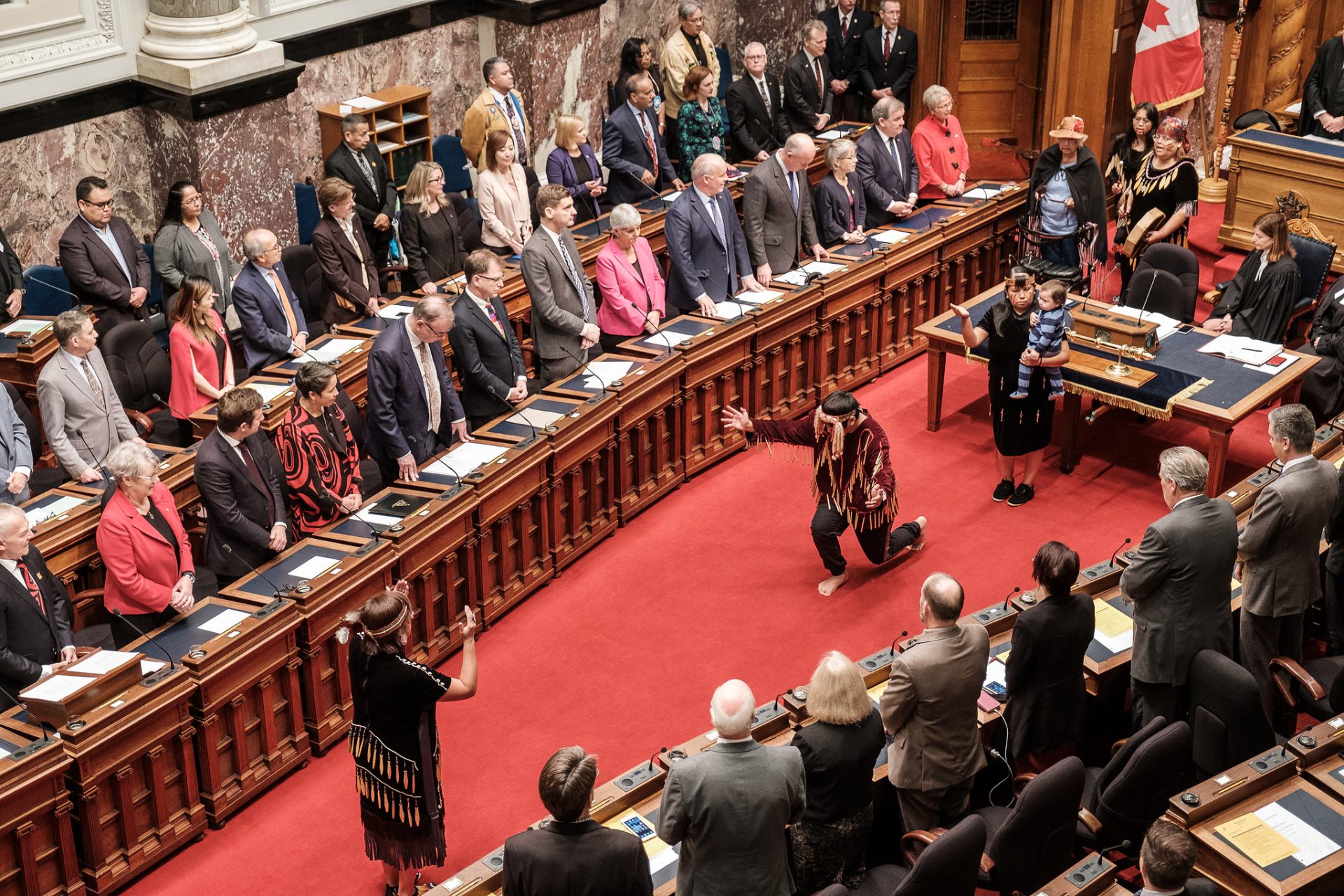
When DRIPA was first introduced in the legislature, it passed unanimously, even winning support from the openly pro-corporate provincial Liberals who naively hoped that by adopting a legal framework, Indigenous opposition to private developments could be quelled.
However, this was always untenable in the long-run. Industries like mining and oil and gas require large up-front capital investments, and no private investor will want to pony up the money for a project that must get consent every step of the way from one or more Indigenous groups. Unsurprisingly, the Business Council of B.C. produced a report at the end of 2025 which described private sector activity in the province as “broadly weak.”
Any reformist government that takes private property and production for profit as a given will, sooner or later, have to bend to the whims of the capitalist market. This inevitably means violating the rights of Indigenous people.
Truthfully, the B.C. NDP has always been hypocritical on this question. For example, in the years after DRIPA, the government worked with TC Energy to force an unwanted pipeline through land that belongs to the Wet’suwet’en. The provincial government authorized the RCMP to attack a Wet’suwet’en protest camp with police dogs and snipers.
This example proves that legal frameworks like DRIPA are no solution to the issues facing Indigenous people. Whatever principles bourgeois governments declare themselves in favour of, they will dissolve into air as soon as they come up against the needs of the capitalist system.
Now, the deepening crisis of capitalism has more fully exposed this contradiction in the NDP’s program, which has forced them to come out more openly on the side of the bosses. This is the same process that has pushed them to attack public sector workers and pass an austerity budget in the past year.
The Cowichan and Musqueam cases
Tied to everything that’s already been stated is the question of Aboriginal title. There are two high profile land claims cases that have further complicated things and have sent the entire capitalist establishment into a tizzy.
First is the Cowichan Tribes v. Canada (2025) ruling. The Cowichan Tribes claim rightful title to a significant portion of land in the city of Richmond, which is in the greater Vancouver area. After one of the longest trials in Canadian history, the B.C. Supreme Court ruled that the Cowichan have a rightful claim to 1,846 acres of land in Richmond in an area that includes businesses and private homes. The Supreme Court also found that all fee simple property (i.e. full private ownership) in this area is “defective and invalid.”
Shortly after, the federal government signed a deal with the Musqueam Nation. The deal recognizes the Musqueam’s claim to title over a significant portion of the Vancouver metropolitan area, and states that the government will negotiate with them to determine how their rights can be exercised.
There’s still little that’s publicly known about discussions between the federal government and the Musqueam. But it seems very likely that the Musqueam deal was signed by the federal government in response to the Cowichan case. They seem to want to keep the Musqueam’s case out of court, and may be willing to give a few concessions to do so.
These cases, particularly the Cowichan ruling, have caused a lot of concern among the government and capitalists.
The province plans on challenging the Cowichan ruling. Eby even tried to claim that he didn’t know about the Musqueam deal until it went public—despite the fact that he was photographed at the signing ceremony.
B.C. Attorney General Niki Sharma said that the Cowichan ruling “could have significant unintended consequences for fee simple private property rights in B.C. that must be reconsidered by a higher court.” The Business Council of British Columbia warned that the ruling has created “significant uncertainty about the legal standing of property titles across the province.”
In response to the Musqueam deal, Thomas Isaac, one of the leading voices of Aboriginal law (and a B.C. property owner), appeared on a real estate podcast completely red in the face, seemingly on the verge of tears. He admitted he’s “had a couple sleepless nights” because of the deal, and warned “I think we’re in at an existential moment in British Columbia.”
He also said to the National Post that “If [DRIPA] were to stay in place, British Columbia is ungovernable. You can’t govern in accordance with UNDRIP.”
What is Aboriginal title?
It takes a bit of understanding of the history around Aboriginal title to fully appreciate the significance of these rulings.
The parameters of Aboriginal title are still ambiguous in a lot of ways. There’s no law, or clear set of laws, that determines where and how Aboriginal title can be applied. This is because, if legislators made it clear, they would either have to say that Aboriginal title nullified private property rights or that Aboriginal title was merely symbolic. The first option is untenable for the capitalists-–the second unacceptable for Indigenous groups.
Therefore, Aboriginal title has largely been defined by a series of Supreme Court cases. Two landmark cases, Delgamuukw v. British Columbia (1997) and Tsilhqot’in Nation v. British Columbia (2014) agree that Aboriginal title guarantees the “right to exclusive use and occupation of land.”
Now the Cowichan decision, if it holds up to future rulings, could set a legal precedent which would allow Indigenous people to assert title over privately held property. This has massive implications for the functioning of Canadian capitalism, which was created through the seizure of land from Indigenous people through often-illegal means.
This has created an air of uncertainty which is already impacting business in Vancouver. Appraisers expect that real estate prices in the area covered by the Cowichan cases could drop by 30 or 40 per cent. An Ontario based company has already cancelled a purchase over a luxury hotel in Richmond because of the uncertainty generated by the case.
More importantly, if the ruling class doesn’t deal with this, these rulings could have significant knock-on effects on land disputes all over the country. For example, the Kitigan Zibi Anishinabeg are pursuing title over a large portion of western Quebec, including chunks of Gatineau. The Wolastoqey Nation is seeking recognition of title over around half of New Brunswick. The Cowichan ruling could very well impact both of these cases.
This is especially problematic for B.C. Historically, very few treaties were ever signed in the province. But according to the Royal Proclamation of 1763, which serves as the cornerstone of Indigenous law to this day, Aboriginal title can only be extinguished by the Crown. This was the entire purpose of the treaty-making process to begin with, to convince Indigenous people to give up collective rights, often under duress.
This is why the Fraser Institute has declared Aboriginal title to be a “national, constitutional threat”. From the point of view of the capitalists, they’re not wrong. Carried to its logical conclusion, the Cowichan decision makes the functioning of capitalism impossible in B.C. and large chunks of the country.
Of course, the capitalists will never let things go that far. They’ll do whatever it takes to preserve the function of the system, whether through changing laws, or even breaking their own laws if it ends up being necessary.
But it will take years, perhaps even decades, of legal battles before they can hope to resolve this. In the meantime, a question mark will hang over a series of development projects. And the last thing that the capitalists need is anything that dissuades investment, precisely at a point in time that they’re trying to reorganize the economy.
Indigenous rights irreconcilable with capitalism
From every angle, an extremely flammable situation is developing in B.C.
First of all, the NDP is trying to maintain an impossible balancing act. They want to expedite resource extraction and tear down any barriers in the way of private investment.But they cannot do this without infuriating Indigenous people and sparking off movements.
The Indigenous movement has a very recent history of militant action against corporate encroachment on their land. The struggle of the Wet’suwet’en took place only a few years ago. The further that the NDP goes in attacking Indigenous rights, the more they guarantee the inevitability of future blockades and protest camps.
At the same time, the Cowichan case and Musqueam deal reveal how unresolvable land claims disputes are under capitalism. Some liberal-leaning legal publications have asserted that Aboriginal title and fee simple property can co-exist. But this simply isn’t true in practice. When Indigenous groups and private property holders disagree over the use of land, which happens frequently, the rights of one party will have to supersede the other.
But simply granting title in these cases isn’t necessarily a solution. In fact, on the basis of capitalism, these types of disputes can quickly become reactionary traps.
For example, there’s a very real risk of different Indigenous groups in B.C. being pit against each other. The Musqueam and the Cowichan have competing claims. The Cowichan oppose the Musqueam agreement, and the Musqueam oppose the Cowichan ruling. And both are opposed by the Squamish and Tsawassen, who also have overlapping claims.
There’s also a danger of these cases being used to turn a section of working class people against Indigenous rights. There’s a layer of non-Indigenous working class home owners who are opposed to or alarmed by these cases. They worry that they could affect the value of their homes, or result in them getting kicked out.
According to a recent poll from Angus Reid, 53 per cent of respondents in B.C. now believe that DRIPA goes too far, up from 44 per cent just a few months ago.
To First Nations, Aboriginal title is seen as a way to right historic wrongs. It’s seen as a way to control what happens on their land, and as a way to secure the resources they need to develop their own communities.
At the same time, we can understand why non-Indigenous workers would be alarmed when they hear on the news that the deed to their house is “defective and invalid”.
Both sides here are motivated by understandable concerns. Communists oppose any outcome that would serve to turn these groups against each other. The only group in society that benefits from that is the ruling class, which survives by pitting different layers of the working class and oppressed people against each other.
The right-wing is already trying to manipulate the anxieties of working-class people in the province. The B.C. Conservative Party leadership race is dominated by discussions about Musqueam and Cowichan. A number of candidates have promised to repeal DRIPA entirely. And Pierre Polievre has come out against the Cowichan ruling, putting himself forward as a supposed defender of homeowners.
Of course, none of them care about the working class. Poilievre and every candidate from the provincial leadership race promise attacks and austerity measures. They are only opportunistically using Indigenous issues to fear monger and distract from the real content of their programs.
We can only cut across this with a class approach that highlights the shared interests between the working class and Indigenous communities.
Socialism is the only way forward
These recent developments have very clearly highlighted the limits of Indigenous rights under capitalism, and how little space this system has for Indigenous liberation. Capitalism is a system based on production for profit and on the private property of the means of production—that is, private property of lands, natural resources and factories. The demand from Indigenous peoples to have control over their land comes into conflict with the interests of the big mining and oil and gas capitalists.
In the last analysis, the interests of the ruling capitalists will always take precedence over the interests of Indigenous people. A lasting resolution to the oppression of Indigenous people is impossible under capitalism.
It is therefore unsurprising that Eby is backtracking on DRIPA. This is not due to some personal fault of Eby but because he defends the maintenance of the capitalist system. Therefore, at the end of the day, he is forced to bend to the interests of the capitalists who hold the economy of British Columbia hostage.
The only way to resolve these long-standing issues would be to bring the big mining and oil and gas companies into common ownership. But that would require getting rid of the capitalist system. By eliminating the profit motive and the question of private property, these issues could be resolved amicably between Indigenous groups and the wider working class.
For all of Canada’s history, Indigenous people have suffered the consequences of capitalist development, without seeing any of the benefits. It is unsurprising that they are sceptical of development projects.
With common ownership and a socialist planned economy, we could put an end to the blind plundering of the environment and the constant violation of Indigenous land. A socialist plan for the economy would not rise or fall based on the whims of private investors. This would allow us to devote huge resources to developing new forms of energy, and plan projects as safely as possible, in harmony with the needs of the environment. This is the only way to both meet the needs of the wider working class as well as Indigenous groups.
A socialist economy would change social relations, and create a world based on cooperation and respect. This would open the door to genuine collaboration, and it’s only on that basis that a solution to these questions can become possible.

