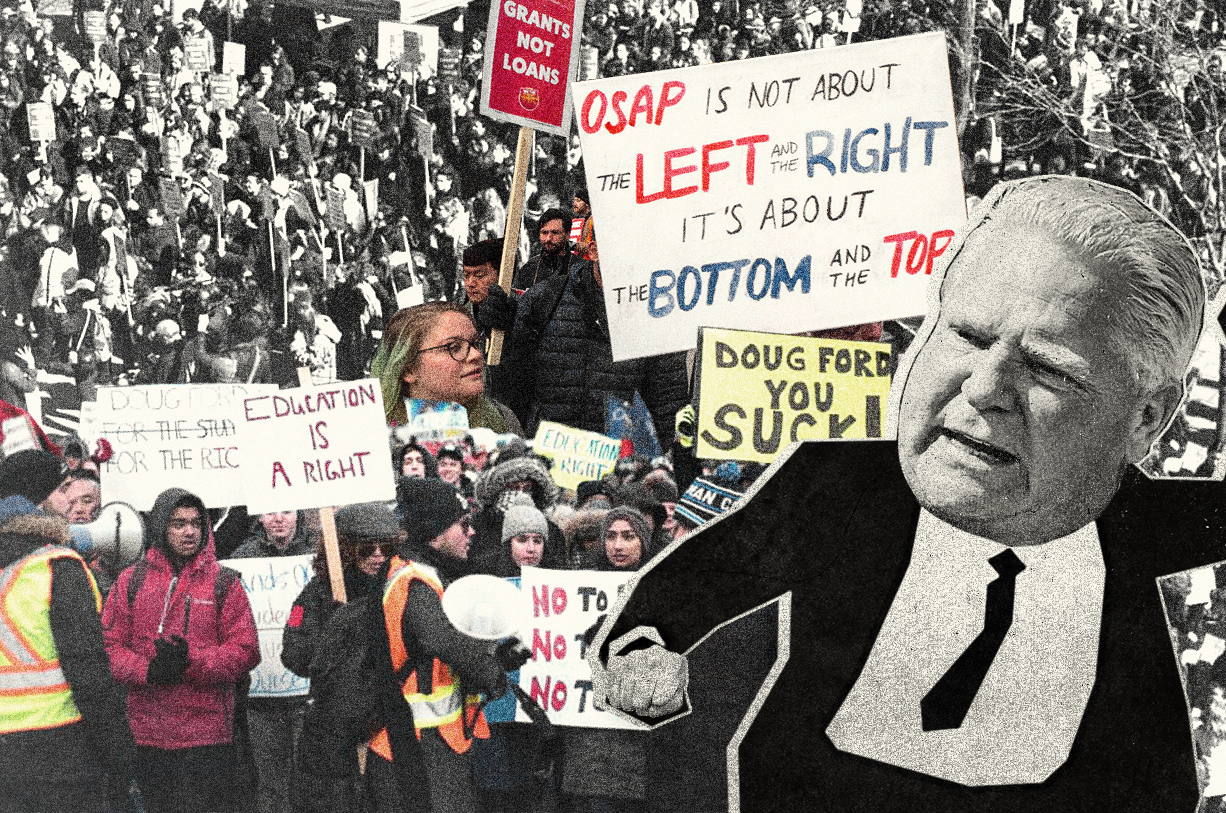
Doug Ford has slashed OSAP public grants for students in Ontario. Much of this money will now be given in the form of loans, which will have to be paid back with interest. This is a massive attack that students everywhere should take note of. It’s an early sign of what’s to come.
Post-secondary education is sinking into a deep crisis. Funding for education has declined for years, and now we’re beginning to feel the consequences. All over the country, programs are being cut and campus workers are getting laid off in the hundreds.
This is only going to get worse as the crisis of Canadian capitalism deepens. The ruling class is preparing for big austerity. Funding will only get more scarce in the coming years. Provincial governments and university administrations will do whatever it takes to make students pay.
How do we fight back against anti-student austerity? And how can we save higher education from the death spiral of capitalism?
Creeping cuts
On paper, public funding for higher education has remained stagnant for the past few decades. Since 2011, federal funding for colleges and universities has remained around $10 billion, and total provincial funding across the country has been kept at around $20 billion.
But when you take into account population growth, this actually amounts to a significant cut. Public spending on education per inhabitant has dropped 21 per cent. To match population and GDP growth, post-secondary funding would need to increase by $20 billion.
Universities and colleges had to find some way to make up the difference. Their solution? Bring in a bunch of wealthy international students from countries like India and China, make them pay exorbitant tuition (an average of $36,100 per year for international undergraduates), and in that way, keep things running without having to significantly raise costs for domestic students. At the University of Toronto alone, international students contributed $1 billion, roughly one-third of the university’s budget.
This strategy worked—for a time. Right up until the ruling class started attacking immigrants. After the capitalist media waged a campaign to scapegoat immigrants for the housing crisis, the federal government imposed immigration caps.
Since then, the number of international students in the country has dropped substantially. In 2025, there was a 61 per cent drop in new international students.
Now, like in the third act of a gangster movie, things are rapidly tumbling down.
Campuses bleeding dry
Cut off from this important source of revenue, universities and colleges everywhere are facing a funding crisis. Many of the biggest universities in the country are expecting big deficits.
Universities in Quebec are expecting a $200-million shortfall this year. Campuses in Atlantic Canada expect a $163-million decrease in revenue. Nineteen of British Columbia’s 25 post-secondary campuses are projecting deficits within the next several years. The president of the B.C. Association of Institutes and Universities said, “There’s no institution that’s going to come through this unscathed.”
The crisis is especially bad in Ontario, which accounts for 40 per cent of all students in Canada’s post-secondary system. For the past decade, the Ontario government has spent half as much on post-secondary education as other provinces. Now, universities in the province expect a nearly $1-billion drop in funds over the next two years.
It would require huge increases in public spending to fill these gaps. But the federal government is openly talking about austerity, and the capitalist press everywhere is pushing for “fiscal restraint” and “budget balancing” (which is code for “cuts”).
So there are really only two things that post-secondary institutions can do: either make domestic students pay higher tuition and fees, or make huge cuts to staff and services—or a combination of both. Either way, it’s students who are going to suffer as a result.
This has started to happen already. According to one report, 850 post-secondary programs have been shut down since the student cap was announced. Alex Usher, president of consulting firm Higher Education Strategy Associates, expects another 1,000 to disappear in Ontario.
Post-secondary administrations are also gearing up to gut campus programs and support staff. Campus workers face being laid off in the thousands. Thirty-five campuses across the country report at least 100 positions will be impacted at each institution. In Ontario alone, nearly 10,000 college staff risk losing their jobs.
This is why we shouldn’t see Ford’s cuts to student grants as an isolated event, or just “bad policy”. It flows entirely out of the logic of events.
The fight for education
Students need to be prepared to fight. As the crisis deepens, the politicians and university administrators will do whatever it takes to make students pay. More attacks are just over the horizon.
We need to build fighting traditions in the student movement. That’s why the RCP puts forward the demand for student strikes. By shutting down campuses and making “business as usual” impossible, we can force those in power to back down from the worst of their attacks. This is the best tool that students have in their arsenal.
The model for this is the 2012 Quebec student strike. With over a year of preparation and campaigning, Quebec students led a movement that beat back tuition hikes and toppled the provincial Liberal government.
That’s why we have called on the Canadian Federation of Students to begin preparing a student strike in Ontario against Ford’s cuts. If the student leadership takes up the call and begins preparing now, we can beat back this attack and set the right example for students across the country. It would embolden the movement everywhere and make further attacks more difficult.
Victories like this are possible. But, at the same time, we have to be entirely honest: under capitalism, any victory against austerity will always be temporary.
For instance, in the case of Ontario, even if OSAP cuts are cancelled, it would not solve the crisis in the post-secondary education system. Massive underfunding would remain, leading inevitably to further cuts to staff and services.
This means that this fight cannot remain a defensive fight. We need to fight for a massive refunding of the education system; for quality, free education for all.
But this requires a broader fight against austerity and the capitalist system as a whole.
Post-secondary education is far from the only victim of this austerity. Schools at all levels are crumbling. Hospitals are falling apart and seeing a doctor is becoming ever-more difficult. All public services and social safety nets are suffering from decades of underfunding and cuts.
Canadian capitalism is experiencing an existential crisis. It’s less productive and deeper in debt than ever before. And capitalists are dead set on shifting the burden of the crisis on workers and working-class students through austerity.
There is plenty of wealth in society to guarantee everyone free education. Canada is one of the richest countries in the world. The wealth of the country’s billionaires continues to grow each year. They just don’t want to spend that money on us.
To save post-secondary education, we need to fight to expropriate the billionaire class and their system, and to replace it with a socialist system, where the vast wealth of our society would be owned collectively and controlled democratically.
In a world like this, we would be able to cancel all student debt and guarantee everyone quality, free education. We could make massive investments in science and technology, art and literature, and improve life from every direction. This is a world within reach, if we band together and fight for it.

